NGSS MS-LS2-3
The Standard
Develop a model to describe the cycling of matter and flow of energy among living and nonliving parts of an ecosystem.
Next Generation Science Standards
Teacher's field guide
What This Standard Means
What Students Need to Do
- Students create a model that connects organisms with air, water, soil, and sunlight. They trace matter as it cycles and energy as it enters, moves through, and leaves a defined system.
What Mastery Looks Like
- A complete model includes producers, consumers, decomposers, water, air, soil, and an energy source. Arrows correctly show matter cycling and energy moving through the system and leaving as heat.
Common Misconceptions
- Students may show energy cycling back to the Sun or treat energy and matter as the same thing. They may think plants get food from soil, or leave decomposers and nonliving parts out of the model.
How to Assess It
- Exit ticket: Draw a boundary around a pond ecosystem. Trace water or carbon through three living and nonliving parts, trace energy from sunlight, and explain what cycles and what leaves.
Lesson moves
Ways to Teach It
Use organism, water, air, soil, and sunlight cards to build a tabletop ecosystem, then draw arrows for matter and energy.
Write three sentences explaining why water and carbon cycle through a pond while energy does not cycle.
Play an arrow-sorting game by placing labeled arrows between pond components, then classifying each arrow as matter transfer or energy transfer.
Map a school compost bin, showing food scraps, decomposers, soil, heat, and the system boundary.
Free download
Printable MS-LS2-3 Worksheet
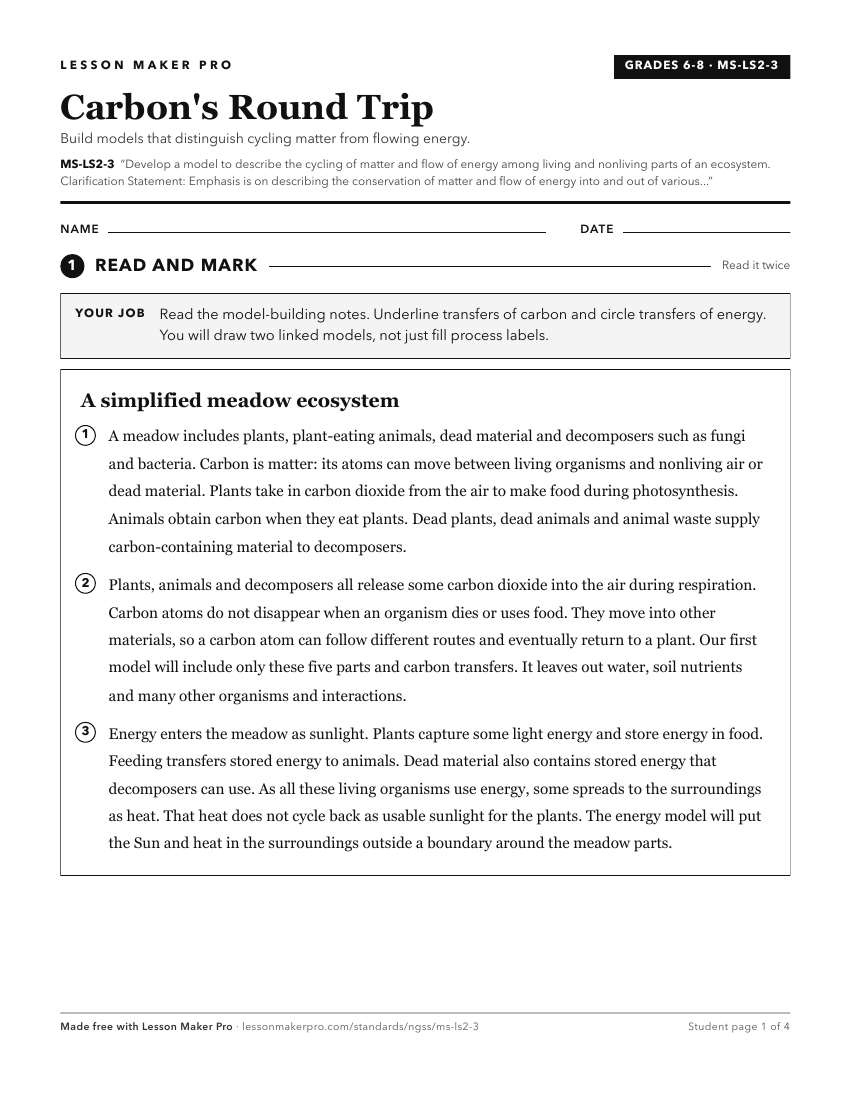
A ready-to-print activity worksheet aligned to MS-LS2-3, with an answer key for the teacher on its own page. No account needed.
PDF, US Letter, prints cleanly in black and white.
Download the worksheetBefore This Standard
If students are struggling here, check these first.
What This Unlocks
Mastery here sets students up for these next.
- HS-LS2-4
The ecosystem model of matter cycling and energy flow becomes quantitative evidence for claims about organism interactions.
- HS-LS2-5
Students carry forward ecosystem matter cycling models to explain carbon movement through photosynthesis, respiration, and Earth systems.
- HS-LS2-3
Understanding ecosystem matter cycling and energy flow supports explaining how those processes differ in aerobic and anaerobic conditions.
Keep exploring
Related Standards
Turn this exact standard into a lesson
Grade, subject, topic, and the complete standard are prefilled. Create one free, no account needed.
Also for this standard:Make a WorksheetMake a QuizMake a Sub Lesson