NGSS HS-LS2-4
The Standard
Use mathematical representations to support claims for the cycling of matter and flow of energy among organisms in an ecosystem. Clarification Statement: Emphasis is on using a mathematical model of stored energy in biomass to describe the transfer of energy from one trophic level to another and that matter and energy are conserved as matter cycles and energy flows through ecosystems. Emphasis is on atoms and molecules such as carbon, oxygen, hydrogen and nitrogen being conserved as they move through an ecosystem. Assessment Boundary: Assessment is limited to proportional reasoning to describe the cycling of matter and flow of energy.
Next Generation Science Standards
Teacher's field guide
What This Standard Means
What Students Need to Do
- Students build or interpret a numerical model showing energy stored in biomass at several trophic levels. They use proportional reasoning to support claims about energy transfer and the conservation of carbon, oxygen, hydrogen, and nitrogen.
What Mastery Looks Like
- Students calculate energy or biomass transfers using ratios, percentages, tables, or pyramids. They use the model to explain energy loss between trophic levels and the continued movement of atoms through organisms and the environment.
Common Misconceptions
- Students may say energy cycles like matter. They may treat biomass as population count rather than stored organic matter. They may assume all stored energy transfers to the next trophic level.
How to Assess It
- Give students this exit ticket: Grass stores 20,000 kJ, grasshoppers store 2,000 kJ, and frogs store 200 kJ. Calculate each transfer percentage, then explain what flows and what cycles.
Adopted as
This framework is adopted as written in California, Connecticut, Delaware, District of Columbia, Hawaii, Illinois, Kansas, Maryland, Nevada, New Hampshire, New Mexico, Rhode Island, Vermont.
Lesson moves
Ways to Teach It
Use two colors of counters to model energy transfer and carbon movement through producers, consumers, decomposers, and the environment.
Write a claim explaining why hawks have less stored biomass than grass, using a labeled energy pyramid as evidence.
Run a calculation relay where teams complete missing biomass values on food chain cards using given transfer percentages.
Analyze biomass data from a local lake or farm, then predict how changes in producers would affect higher trophic levels.
Free download
Printable HS-LS2-4 Worksheet
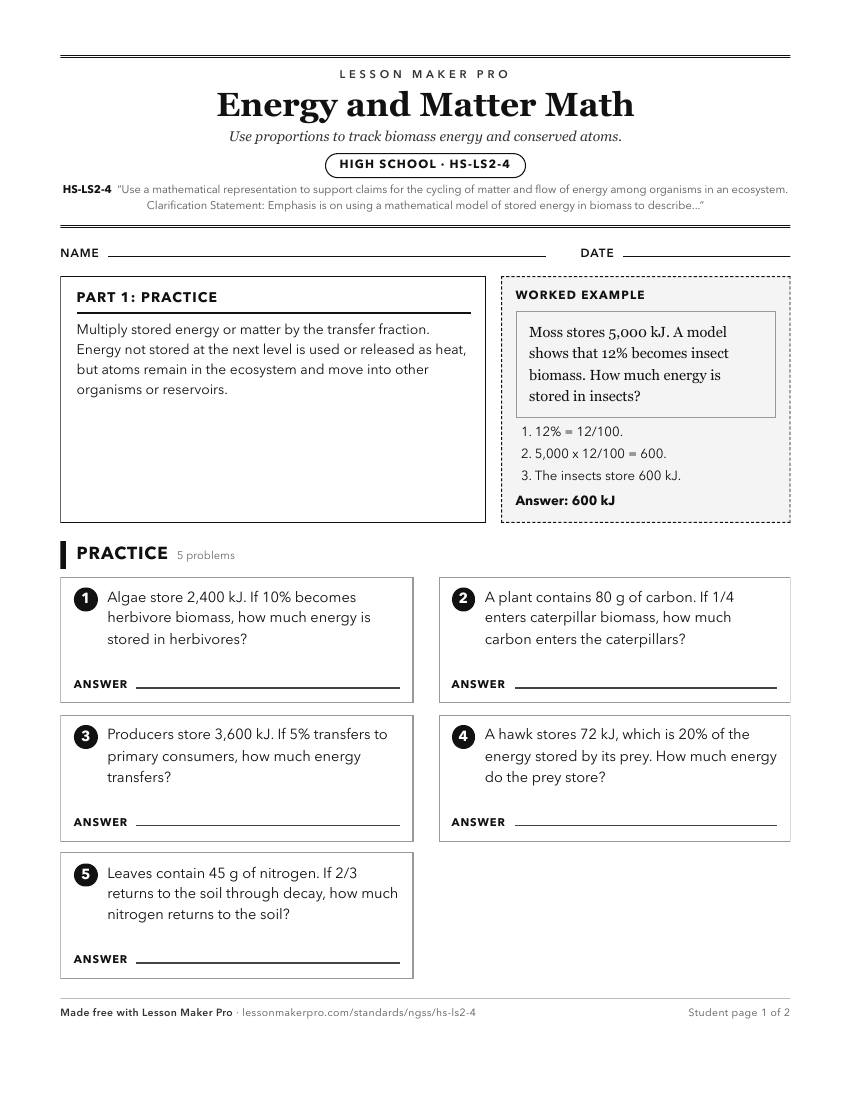
A ready-to-print activity worksheet aligned to HS-LS2-4, with an answer key for the teacher on its own page. No account needed.
PDF, US Letter, prints cleanly in black and white.
Download the worksheetBefore This Standard
If students are struggling here, check these first.
Keep exploring
Related Standards
- MS-LS1-6
Construct a scientific explanation based on evidence for the role of photosynthesis in the cycling of matter and flow of energy into and out of organisms.
- MS-ESS2-1
Develop a model to describe the cycling of Earth's materials and the flow of energy that drives this process.
- HS-LS2-3
Construct and revise an explanation based on evidence for the cycling of matter and flow of energy in aerobic and anaerobic conditions.
Turn this exact standard into a lesson
Grade, subject, topic, and the complete standard are prefilled. Create one free, no account needed.
Also for this standard:Make a WorksheetMake a QuizMake a Sub Lesson