NGSS MS-ESS2-5
The Standard
Collect data to provide evidence for how the motions and complex interactions of air masses results in changes in weather conditions.
Next Generation Science Standards
Teacher's field guide
What This Standard Means
What Students Need to Do
- Students collect and compare temperature, air pressure, humidity, precipitation, and wind data from one place over time. They use patterns in the data to explain air movement and collisions, then make forecasts supported by evidence and stated uncertainty.
What Mastery Looks Like
- Given a sequence of maps or data tables, students trace air movement from high pressure toward low pressure. They link an approaching boundary to measured weather changes and give a likely forecast supported by multiple data points.
Common Misconceptions
- Students may think low pressure pushes air away, rather than air flowing toward it. They may treat a front as a guarantee of rain, assume every weather measure changes together, or confuse a short weather shift with climate.
How to Assess It
- Give an exit ticket with pressure falling from 1018 to 1008 mb, humidity rising from 45% to 80%, and temperature dropping 7°C. Ask students to explain the likely air mass interaction and predict the next weather condition using two data points.
Lesson moves
Ways to Teach It
Set up thermometer, barometer, and hygrometer stations; teams record readings three times and compare them with observed wind, clouds, and precipitation.
Show two weather maps six hours apart and ask, “Which data best explains the local change, and how certain is your forecast?”
Run a card sort where teams sequence pressure, humidity, temperature, and wind readings before and after an air mass collision.
Compare yesterday's local forecast with observed conditions, then have students explain why a 60 percent rain chance did not guarantee rain.
Free download
Printable MS-ESS2-5 Worksheet
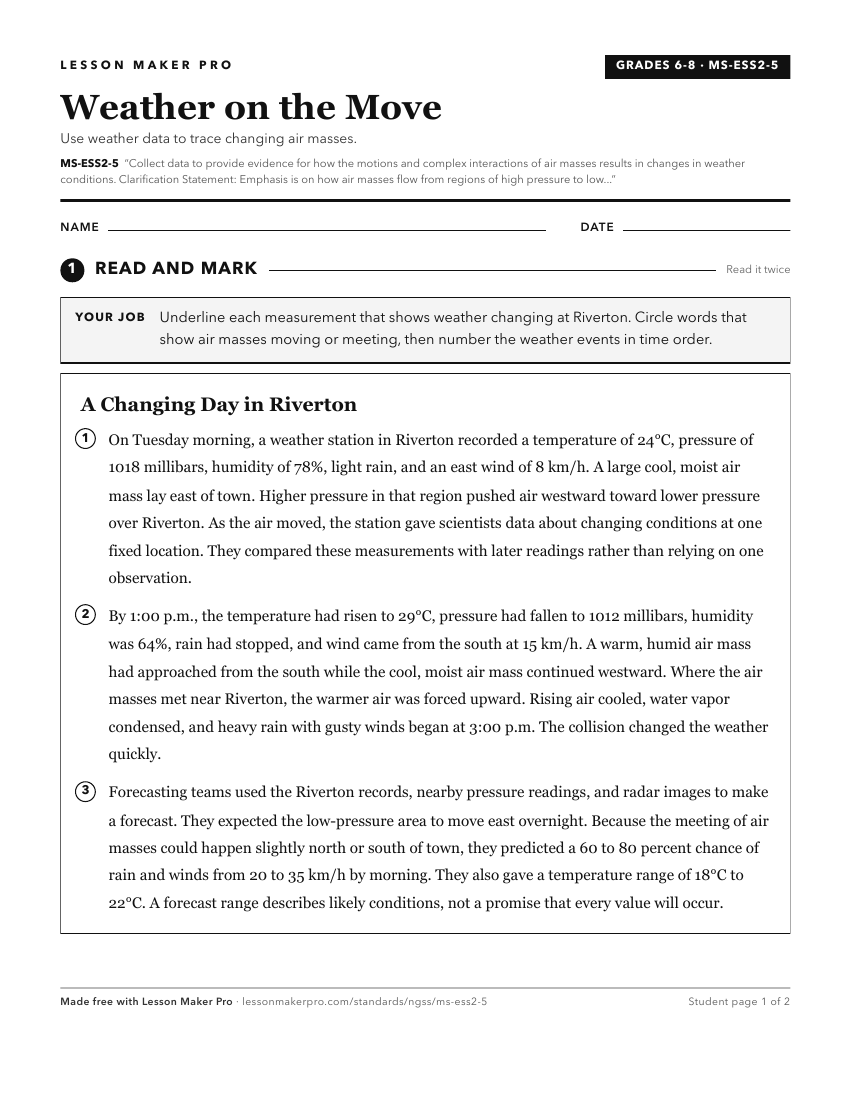
A ready-to-print activity worksheet aligned to MS-ESS2-5, with an answer key for the teacher on its own page. No account needed.
PDF, US Letter, prints cleanly in black and white.
Download the worksheetLearning progression
Where This Standard Sits
See the whole path on the Earth & Space Science progression map.
Before This Standard
If students are struggling here, check these first.
What This Unlocks
Mastery here sets students up for these next.
Keep exploring
Related Standards
Turn this exact standard into a lesson
Grade, subject, topic, and the complete standard are prefilled. Create one free, no account needed.
Also for this standard:Make a WorksheetMake a QuizMake a Sub Lesson