NGSS MS-PS3-1
The Standard
Construct and interpret graphical displays of data to describe the relationships of kinetic energy to the mass of an object and to the speed of an object.
Next Generation Science Standards
Teacher's field guide
What This Standard Means
What Students Need to Do
- Students make and read graphs showing how kinetic energy changes when mass changes while speed stays fixed. They also explain energy changes when speed changes while mass stays fixed.
What Mastery Looks Like
- Students label axes and units, plot data accurately, and describe trends without mixing variables. They recognize that speed increases affect kinetic energy more sharply than equal mass increases.
Common Misconceptions
- Students may think doubling speed only doubles kinetic energy, or that heavier objects always move faster. They may reverse graph axes or compare trials where both mass and speed changed.
How to Assess It
- Give students data for energy at several speeds with mass held constant. Ask them to graph the data and write one sentence describing the pattern.
Lesson moves
Ways to Teach It
Use carts, washers, a ramp, and a motion sensor to collect mass and speed data, then graph calculated kinetic energy for controlled trials.
Compare bicycle crash graphs and write which change, added mass or added speed, produces the larger energy increase and why.
Run a graph-matching relay where teams pair data tables, graphs, and claim cards, then correct one mismatched set.
Analyze bicycle helmet test data at several speeds, then explain why speed limits matter even when rider mass stays constant.
Free download
Printable MS-PS3-1 Worksheet
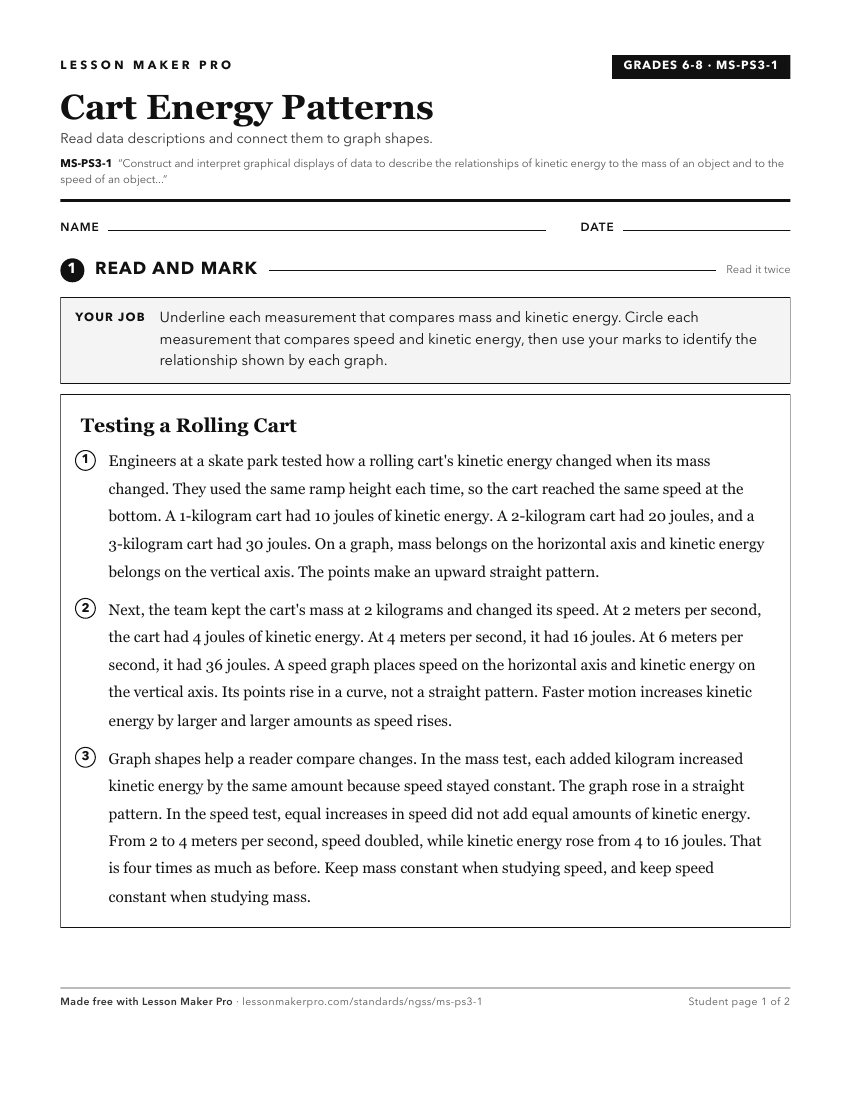
A ready-to-print activity worksheet aligned to MS-PS3-1, with an answer key for the teacher on its own page. No account needed.
PDF, US Letter, prints cleanly in black and white.
Download the worksheetLearning progression
Where This Standard Sits
See the whole path on the Physical Science progression map.
What This Unlocks
Mastery here sets students up for these next.
- HS-PS3-2
Understanding kinetic energy as motion supports modeling macroscopic energy as particle motion and distinguishing it from field-stored energy.
- HS-PS3-1
Graphing kinetic energy relationships prepares students to quantify energy changes before modeling energy transfers within a system.
- HS-PS3-3
Understanding kinetic energy depends on mass and speed helps students reason about energy forms and losses when refining conversion devices.
Keep exploring
Related Standards
- 3-PS2-2
Make observations and/or measurements of an object's motion to provide evidence that a pattern can be used to predict future motion.
- 4-PS3-1
Use evidence to construct an explanation relating the speed of an object to the energy of that object.
- MS-PS3-5
Construct, use, and present arguments to support the claim that when the kinetic energy of an object changes, energy is transferred to or from the object.
- HS-PS3-5
Develop and use a model of two objects interacting through electric or magnetic fields to illustrate the forces between objects and the changes in energy of the...
Turn this exact standard into a lesson
Grade, subject, topic, and the complete standard are prefilled. Create one free, no account needed.
Also for this standard:Make a WorksheetMake a QuizMake a Sub Lesson