NGSS MS-PS3-5
The Standard
Construct, use, and present arguments to support the claim that when the kinetic energy of an object changes, energy is transferred to or from the object.
Next Generation Science Standards
Teacher's field guide
What This Standard Means
What Students Need to Do
- Students compare an object’s motion before and after an interaction and decide whether its kinetic energy increased or decreased. They use observations, such as speed or temperature changes, to argue that energy moved into or out of the object.
What Mastery Looks Like
- Students can identify the direction of energy transfer from a before-and-after motion record. They support the claim with specific evidence and explain why it shows a kinetic energy change, without calculating energy.
Common Misconceptions
- Students often say energy disappears when an object slows or appears from nowhere when it speeds up. They may confuse speed with force or assume a direction change at constant speed always changes kinetic energy. They may also miss that warmer brakes or surfaces provide evidence of energy transfer.
How to Assess It
- Exit ticket: A toy car rolls onto carpet and slows. State whether energy moved into or out of the car, then cite one observable piece of evidence.
Lesson moves
Ways to Teach It
Roll a marble into a stationary cup, record both objects’ motion before and after, then draw arrows showing the direction of energy transfer.
Discuss this prompt: A soccer ball stops in mud; where did its kinetic energy go, and what evidence supports your answer?
Sort scenario cards into energy transferred in, energy transferred out, or no kinetic energy change, then justify each choice with motion evidence.
Examine bicycle braking, then explain how slower wheel motion and warmer brake pads show energy transferring from the bicycle.
Free download
Printable MS-PS3-5 Worksheet
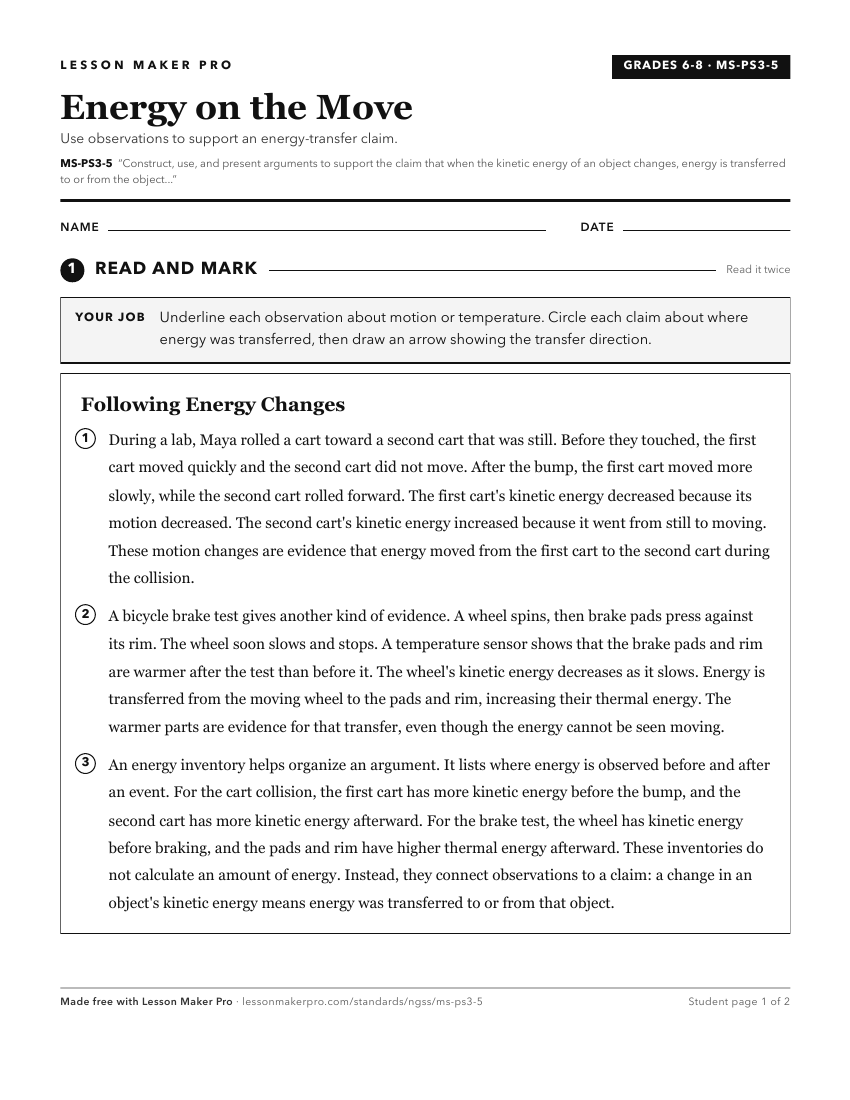
A ready-to-print activity worksheet aligned to MS-PS3-5, with an answer key for the teacher on its own page. No account needed.
PDF, US Letter, prints cleanly in black and white.
Download the worksheetLearning progression
Where This Standard Sits
See the whole path on the Physical Science progression map.
What This Unlocks
Mastery here sets students up for these next.
Keep exploring
Related Standards
- 4-PS3-2
Make observations to provide evidence that energy can be transferred from place to place by sound, light, heat, and electric currents.
- 4-PS3-1
Use evidence to construct an explanation relating the speed of an object to the energy of that object.
- MS-PS3-1
Construct and interpret graphical displays of data to describe the relationships of kinetic energy to the mass of an object and to the speed of an object.
- MS-PS3-4
Plan an investigation to determine the relationships among the energy transferred, the type of matter, the mass, and the change in the average kinetic energy of...
Turn this exact standard into a lesson
Grade, subject, topic, and the complete standard are prefilled. Create one free, no account needed.
Also for this standard:Make a WorksheetMake a QuizMake a Sub Lesson