NGSS 4-PS3-1
The Standard
Use evidence to construct an explanation relating the speed of an object to the energy of that object.
Next Generation Science Standards
Teacher's field guide
What This Standard Means
What Students Need to Do
- Students compare the same object moving at different speeds. They use visible effects, such as pushing, rolling, or knocking something over, as evidence about its motion energy.
What Mastery Looks Like
- Students identify which of two identical moving objects has more motion energy. They support the claim with observations, such as moving another object farther or causing a larger change during a collision.
Common Misconceptions
- Students may think a larger object always has more motion energy, even when comparing the same object at different speeds. They may also confuse speed with force or claim that a stopped object has no energy of any kind.
How to Assess It
- Exit ticket: Two identical toy cars hit paper cups, and the faster car moves its cup farther. Ask which car had more motion energy and what evidence supports the answer.
Lesson moves
Ways to Teach It
Release the same toy car from two ramp heights, then compare how far it pushes a wooden block.
Ask students to write: Which car had more motion energy, and what observation supports your claim?
Give pairs speed-and-effect cards to match, such as fast ball with many pins knocked down, then have them explain each match.
Compare videos of a slow and fast bicycle stopping, then discuss why the faster bicycle takes more effort and distance to stop.
Free download
Printable 4-PS3-1 Worksheet
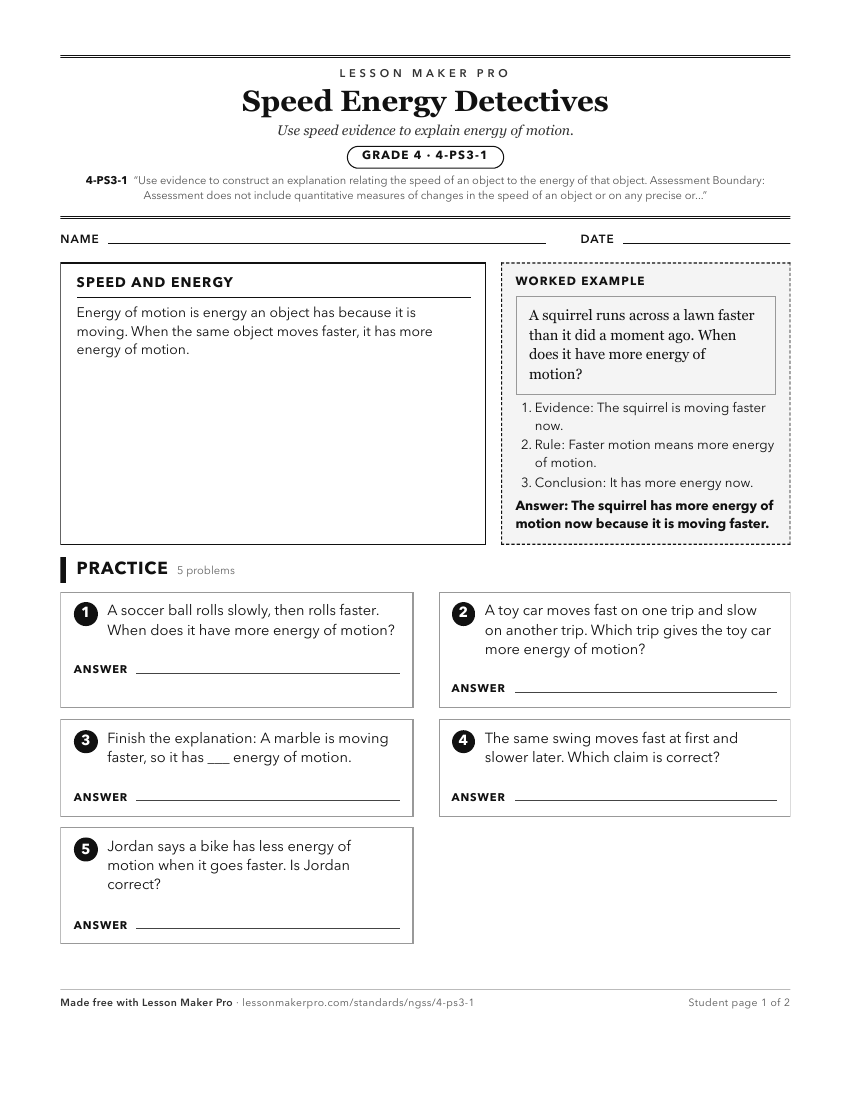
A ready-to-print activity worksheet aligned to 4-PS3-1, with an answer key for the teacher on its own page. No account needed.
PDF, US Letter, prints cleanly in black and white.
Download the worksheetKeep exploring
Related Standards
- 4-PS3-2
Make observations to provide evidence that energy can be transferred from place to place by sound, light, heat, and electric currents.
- MS-PS3-1
Construct and interpret graphical displays of data to describe the relationships of kinetic energy to the mass of an object and to the speed of an object.
- MS-PS3-5
Construct, use, and present arguments to support the claim that when the kinetic energy of an object changes, energy is transferred to or from the object.
- MS-PS2-2
Plan an investigation to provide evidence that the change in an object's motion depends on the sum of the forces on the object and the mass of the object.
Turn this exact standard into a lesson
Grade, subject, topic, and the complete standard are prefilled. Create one free, no account needed.
Also for this standard:Make a WorksheetMake a QuizMake a Sub Lesson