NGSS 4-PS3-2
The Standard
Make observations to provide evidence that energy can be transferred from place to place by sound, light, heat, and electric currents.
Next Generation Science Standards
Teacher's field guide
What This Standard Means
What Students Need to Do
- Students observe a source and a receiver, then note changes that show energy moved between them. They explain the transfer using evidence from sound, light, warming, or an electric circuit.
What Mastery Looks Like
- Students identify where energy starts, where it goes, and what change shows the transfer. They use observations such as sound heard, light seen, warming felt, or a bulb lighting as evidence.
Common Misconceptions
- Students may think energy is a substance that gets used up as it moves. They may also confuse the source with the evidence, or think heat moves from colder objects to warmer ones.
How to Assess It
- Give students four sketches: a ringing speaker, a flashlight beam, a warm spoon, and a battery-powered bulb. Ask them to label the source, receiver, and observed evidence in each.
Lesson moves
Ways to Teach It
Set up stations with a cup telephone, flashlight and paper, warm-water spoon, and battery-bulb circuit; students record what changed at each receiver.
Write: Where did the energy start, where did it go, and what observation proves movement in one classroom example?
Students sort scenario cards under sound, light, heat, or electric current, then defend one choice to a partner.
Trace how energy reaches your hand when sunlight warms a car seat, then label the source, path, and observed effect.
Free download
Printable 4-PS3-2 Worksheet
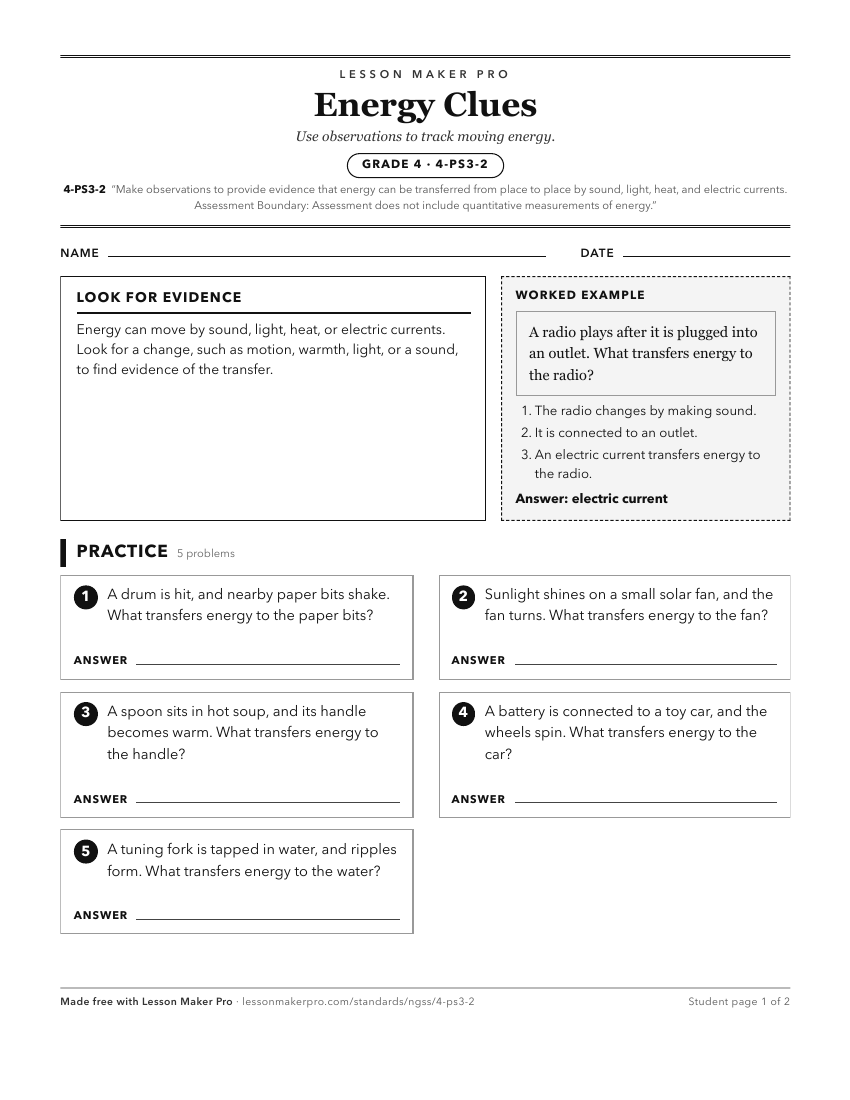
A ready-to-print activity worksheet aligned to 4-PS3-2, with an answer key for the teacher on its own page. No account needed.
PDF, US Letter, prints cleanly in black and white.
Download the worksheetLearning progression
Where This Standard Sits
See the whole path on the Physical Science progression map.
What This Unlocks
Mastery here sets students up for these next.
Keep exploring
Related Standards
- 4-PS3-1
Use evidence to construct an explanation relating the speed of an object to the energy of that object.
- 1-PS4-1
Plan and conduct investigations to provide evidence that vibrating materials can make sound and that sound can make materials vibrate.
- MS-PS3-5
Construct, use, and present arguments to support the claim that when the kinetic energy of an object changes, energy is transferred to or from the object.
- HS-PS2-5
Plan and conduct an investigation to provide evidence that an electric current can produce a magnetic field and that a changing magnetic field can produce an el...
Turn this exact standard into a lesson
Grade, subject, topic, and the complete standard are prefilled. Create one free, no account needed.
Also for this standard:Make a WorksheetMake a QuizMake a Sub Lesson