NGSS 1-PS4-1
The Standard
Plan and conduct investigations to provide evidence that vibrating materials can make sound and that sound can make materials vibrate.
Next Generation Science Standards
Teacher's field guide
What This Standard Means
What Students Need to Do
- Students plan and carry out simple tests with strings, rubber bands, speakers, or tuning forks. They use what they observe, hear, and feel to connect sound with back-and-forth motion.
What Mastery Looks Like
- A student can make a sound, point out the moving material, and describe the evidence. They can also show that a nearby sound makes paper, rice, or another light object move.
Common Misconceptions
- Students may think sound comes only from hitting objects, or that louder sounds always mean faster vibrations. They may call any movement a vibration, even when it does not move back and forth.
How to Assess It
- Have students pluck a stretched rubber band, then hold paper near a playing speaker. Ask them to draw what moved in each test and label their evidence.
Lesson moves
Ways to Teach It
Stretch rubber bands over empty boxes; students pluck each band, watch closely, touch lightly, and record what they hear and feel.
Ask, "How do you know the rubber band moved when it made sound?" Students draw and write one evidence sentence.
Play Vibration Detective: students test classroom objects, sort sound-makers by visible or felt movement, and explain one choice.
Place rice on plastic wrap over a bowl, clap nearby, and connect the bouncing rice to how speaker cones move.
Free download
Printable 1-PS4-1 Worksheet
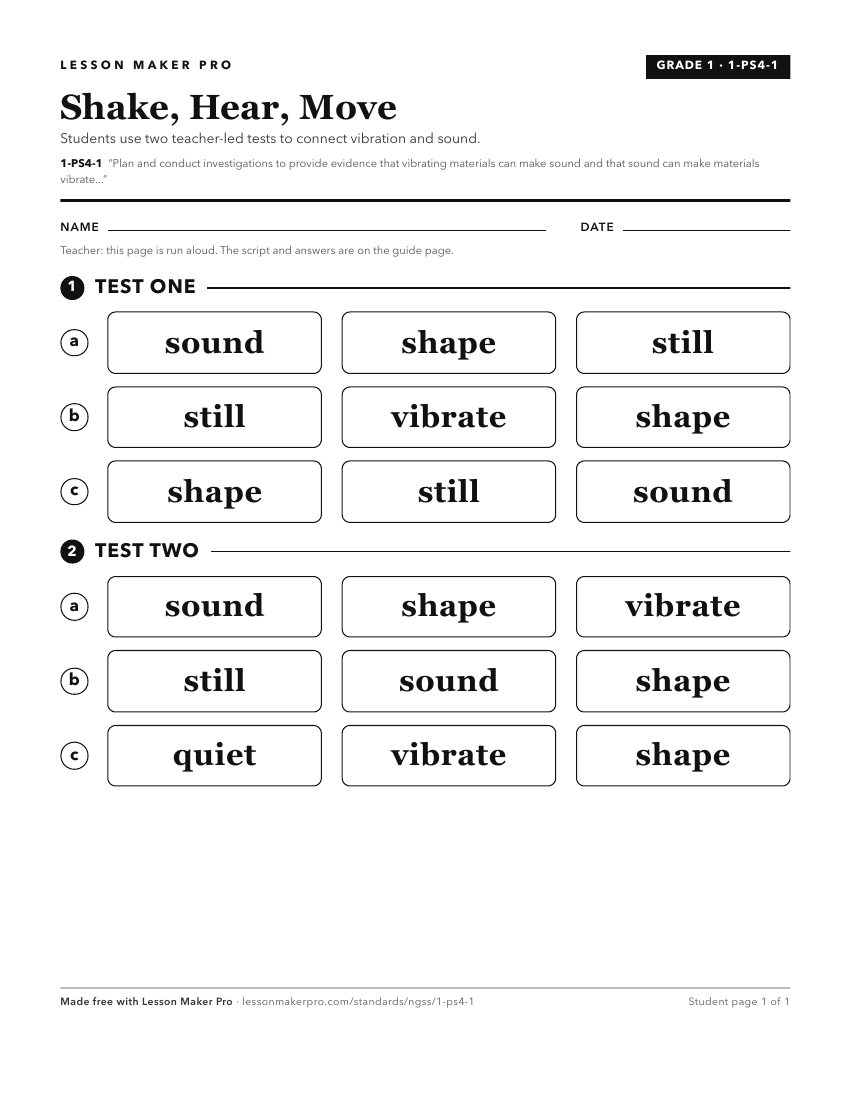
A ready-to-print activity worksheet aligned to 1-PS4-1, with an answer key for the teacher on its own page. No account needed.
PDF, US Letter, prints cleanly in black and white.
Download the worksheetKeep exploring
Related Standards
- 4-PS3-2
Make observations to provide evidence that energy can be transferred from place to place by sound, light, heat, and electric currents.
- 3-PS2-1
Plan and conduct an investigation to provide evidence of the effects of balanced and unbalanced forces on the motion of an object.
- 1-PS4-3
Plan and conduct an investigation to determine the effect of placing objects made with different materials in the path of a beam of light.
- HS-PS2-5
Plan and conduct an investigation to provide evidence that an electric current can produce a magnetic field and that a changing magnetic field can produce an el...
Turn this exact standard into a lesson
Grade, subject, topic, and the complete standard are prefilled. Create one free, no account needed.
Also for this standard:Make a WorksheetMake a QuizMake a Sub Lesson