NGSS 3-PS2-1
The Standard
Plan and conduct an investigation to provide evidence of the effects of balanced and unbalanced forces on the motion of an object.
Next Generation Science Standards
Teacher's field guide
What This Standard Means
What Students Need to Do
- Students set up a fair test with a ball, toy car, or box. They change only the number, relative strength, or direction of pushes and pulls. They use observed motion to decide whether the forces cancel or cause a change.
What Mastery Looks Like
- A student can compare trials in which only the number, relative strength, or direction of forces changes. They record motion changes and use those observations to explain the combined effect of the forces.
Common Misconceptions
- Students may think two forces are balanced simply because there are two, while ignoring strength and direction. They may think balanced forces stop all motion instead of leaving motion unchanged. They may also change several variables during a test, making the result unclear.
How to Assess It
- Exit ticket: A toy car has equal pulls in opposite directions. Draw what happens, then make one pull stronger and predict the result using motion evidence.
Lesson moves
Ways to Teach It
Attach equal rubber bands to both ends of a toy car; pull equally, then farther on one side, and record the motion.
Discuss why a box can stay still while two students push equally from opposite sides, using a labeled force sketch as evidence.
Sort force-arrow cards into balanced or unbalanced groups, then predict whether each object starts, stops, speeds up, slows down, or turns.
Analyze a soccer clip and mark when a kick starts, stops, speeds up, or redirects the ball.
Free download
Printable 3-PS2-1 Worksheet
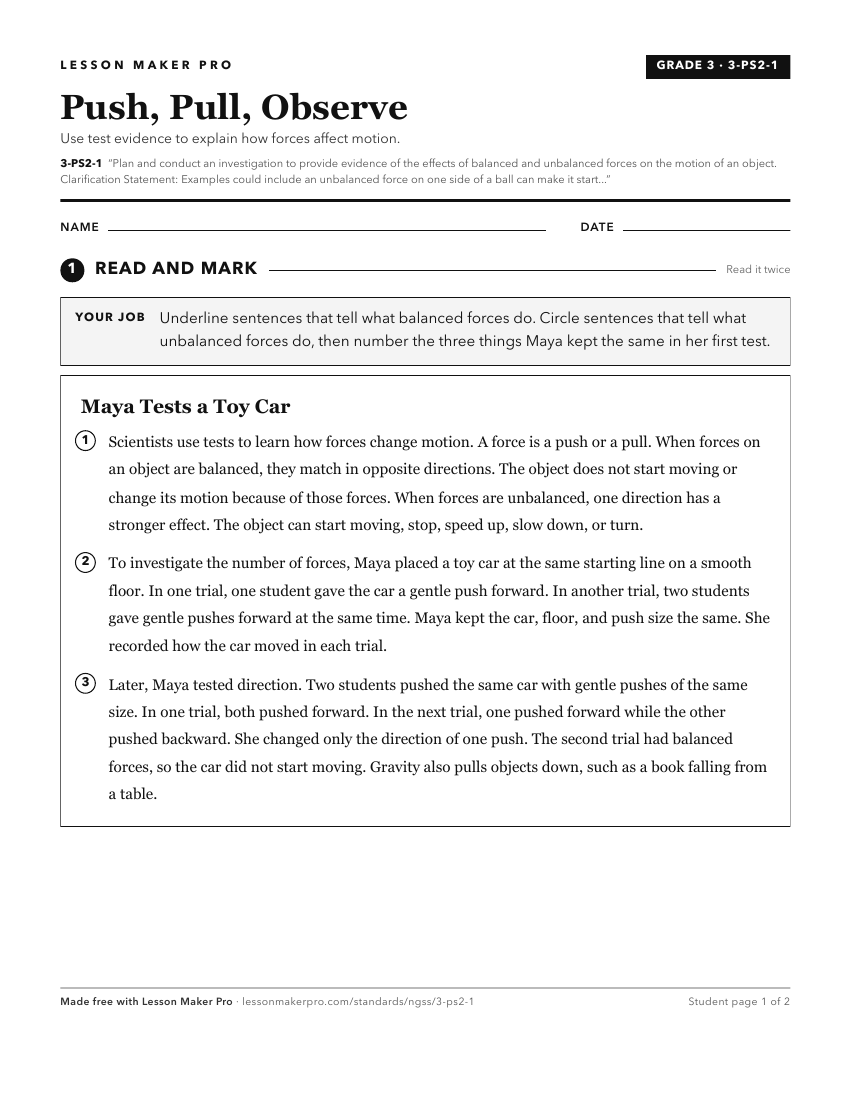
A ready-to-print activity worksheet aligned to 3-PS2-1, with an answer key for the teacher on its own page. No account needed.
PDF, US Letter, prints cleanly in black and white.
Download the worksheetLearning progression
Where This Standard Sits
See the whole path on the Physical Science progression map.
What This Unlocks
Mastery here sets students up for these next.
- MS-PS2-2
Students must understand balanced and unbalanced forces changing motion before investigating net force, mass, and motion changes.
- MS-PS2-5
Students extend evidence from forces affecting motion to investigating noncontact forces as fields between interacting objects.
- MS-PS2-3
Understanding balanced and unbalanced forces supports interpreting electric and magnetic force data as interactions that can change motion.
- MS-PS2-1
Investigating balanced and unbalanced forces supports later use of action and reaction forces in collision design problems.
Keep exploring
Related Standards
- K-PS2-1
Plan and conduct an investigation to compare the effects of different strengths or different directions of pushes and pulls on the motion of an object.
- 1-PS4-3
Plan and conduct an investigation to determine the effect of placing objects made with different materials in the path of a beam of light.
Turn this exact standard into a lesson
Grade, subject, topic, and the complete standard are prefilled. Create one free, no account needed.
Also for this standard:Make a WorksheetMake a QuizMake a Sub Lesson