NGSS MS-PS2-1
The Standard
Apply Newton's Third Law to design a solution to a problem involving the motion of two colliding objects.
Next Generation Science Standards
Teacher's field guide
What This Standard Means
What Students Need to Do
- Students identify the equal and opposite forces acting on two objects during a collision. They use force diagrams and test results to design a way to control motion or reduce collision effects.
What Mastery Looks Like
- Students draw equal-size force arrows in opposite directions on the two objects and label which object exerts each force. They predict different motion changes for different masses, then defend a design choice with test evidence.
Common Misconceptions
- Students may think the larger or moving object exerts a larger force. They may place both force arrows on one object, so the forces appear to cancel. They may assume equal forces produce equal speed changes, even when masses differ.
How to Assess It
- Exit ticket: A 1 kg cart moving right hits a stationary 2 kg cart. Draw and label the force pair, predict each cart’s acceleration direction, and propose one bumper feature to limit damage.
Lesson moves
Ways to Teach It
Build clay, foam, and rubber-band bumpers for two carts, then measure rebound distance after each collision.
Ask students why a lighter cart can change speed more even though both carts experience equal contact forces.
Run a force-pair card sort where teams match collision diagrams, force arrows, and correct explanations.
Compare two head-on crash-test clips, identify each force pair, and write a bumper recommendation supported by observed motion.
Free download
Printable MS-PS2-1 Worksheet
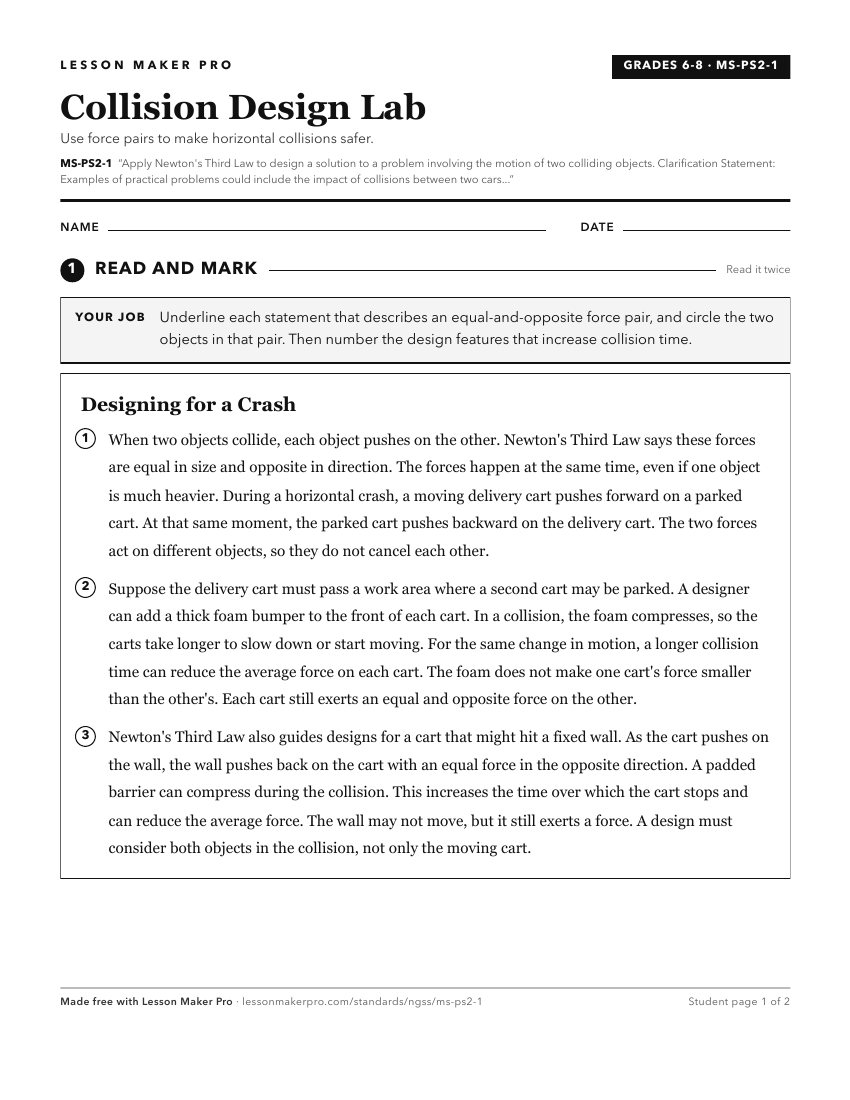
A ready-to-print activity worksheet aligned to MS-PS2-1, with an answer key for the teacher on its own page. No account needed.
PDF, US Letter, prints cleanly in black and white.
Download the worksheetLearning progression
Where This Standard Sits
See the whole path on the Physical Science progression map.
Before This Standard
If students are struggling here, check these first.
What This Unlocks
Mastery here sets students up for these next.
- HS-PS2-3
Newton’s Third Law with colliding objects supports reasoning about collision forces when designing and improving force-reducing devices.
- HS-PS2-2
Newton’s third-law collision forces prepare students to see internal interactions cancel, leading to total momentum conservation in systems.
- HS-PS2-1
Students carry forward force interactions from collisions, then quantify how net force and mass determine an object's acceleration.
Keep exploring
Related Standards
Turn this exact standard into a lesson
Grade, subject, topic, and the complete standard are prefilled. Create one free, no account needed.
Also for this standard:Make a WorksheetMake a QuizMake a Sub Lesson