NGSS 4-PS3-3
The Standard
Ask questions and predict outcomes about the changes in energy that occur when objects collide.
Next Generation Science Standards
Teacher's field guide
What This Standard Means
What Students Need to Do
- Students ask testable questions about collisions and predict what will move faster, slower, or stop afterward. They use changes in speed to describe how energy moves between objects.
What Mastery Looks Like
- Students ask testable questions about how starting speed affects a collision. They predict and explain changes in motion by describing energy moving between objects, without calculating energy.
Common Misconceptions
- Students may think energy disappears when a moving object stops. They may assume every collision makes both objects stop, or that the larger object always transfers more energy.
How to Assess It
- Exit ticket: A fast toy car and a slow toy car each hit an identical resting car. Write one testable question and predict which resting car moves faster afterward.
Lesson moves
Ways to Teach It
Roll marbles from low and high ramp positions into a stationary marble, recording predictions and the motion of both marbles after impact.
Ask, “Where did the moving ball’s energy go after it hit the block?” and have students support answers with observed motion.
Play Collision Match: students pair before-collision picture cards with likely after-collision picture cards, then explain each match using speed and energy.
Compare helmet, bumper, and bowling-pin collisions, then predict how changing an object’s starting speed changes what moves afterward.
Free download
Printable 4-PS3-3 Worksheet
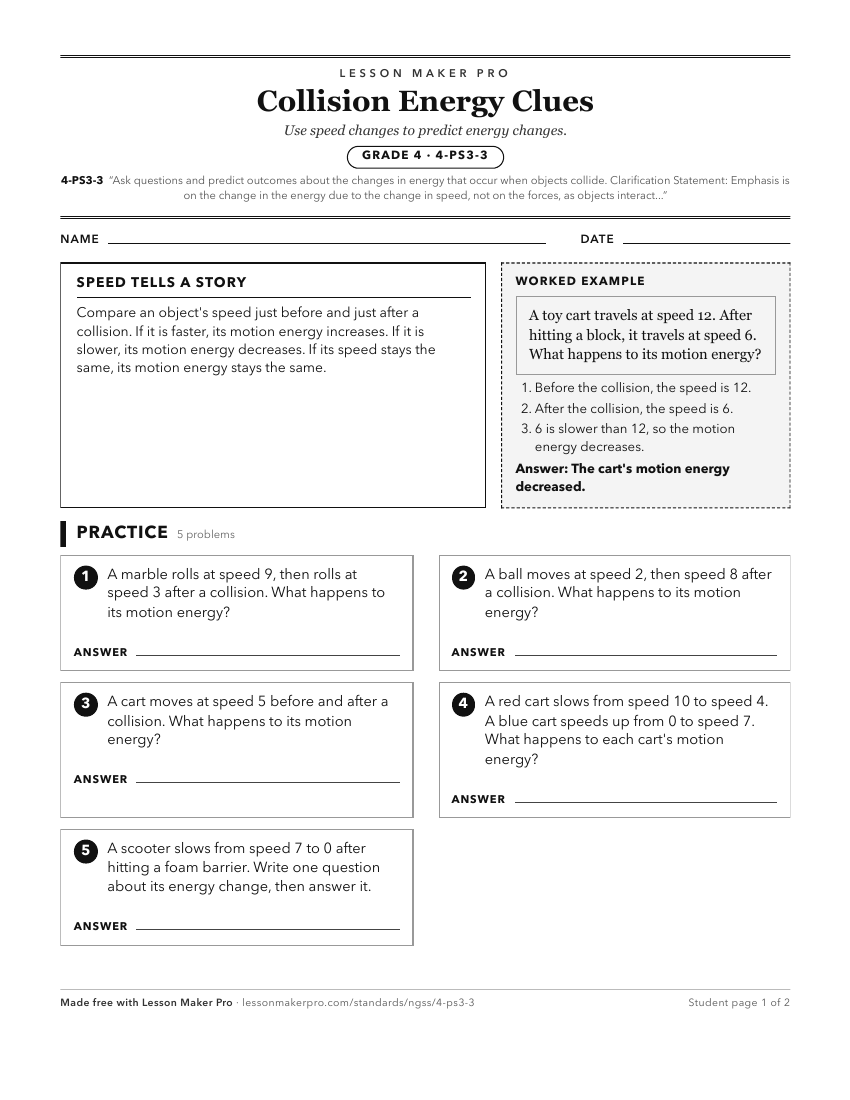
A ready-to-print activity worksheet aligned to 4-PS3-3, with an answer key for the teacher on its own page. No account needed.
PDF, US Letter, prints cleanly in black and white.
Download the worksheetLearning progression
Where This Standard Sits
See the whole path on the Physical Science progression map.
What This Unlocks
Mastery here sets students up for these next.
Keep exploring
Related Standards
- 3-PS2-3
Ask questions to determine cause and effect relationships of electric or magnetic interactions between two objects not in contact with each other.
- HS-PS3-5
Develop and use a model of two objects interacting through electric or magnetic fields to illustrate the forces between objects and the changes in energy of the...
- MS-PS3-2
Develop a model to describe that when the arrangement of objects interacting at a distance changes, different amounts of potential energy are stored in the syst...
- HS-PS2-3
Apply scientific and engineering ideas to design, evaluate, and refine a device that minimizes the force on a macroscopic object during a collision.
Turn this exact standard into a lesson
Grade, subject, topic, and the complete standard are prefilled. Create one free, no account needed.
Also for this standard:Make a WorksheetMake a QuizMake a Sub Lesson