NGSS 3-PS2-3
The Standard
Ask questions to determine cause and effect relationships of electric or magnetic interactions between two objects not in contact with each other.
Next Generation Science Standards
Teacher's field guide
What This Standard Means
What Students Need to Do
- Students investigate how magnets and statically charged objects push or pull without touching. They ask questions about how distance, magnet direction, or charge changes the interaction.
What Mastery Looks Like
- Students can pose a testable question, change one variable, and record what happens. They use observations to explain how distance, magnet direction, or charge affects pushing and pulling.
Common Misconceptions
- Students may think forces only act when objects touch. They may believe magnets always attract, all metals are magnetic, or a charged balloon stays charged forever.
How to Assess It
- Exit ticket: Draw two bar magnets facing each other. Ask one testable question about distance or orientation, then predict the result and explain why.
Lesson moves
Ways to Teach It
Rub a balloon with wool, move it toward paper bits, and measure the greatest distance at which the paper moves.
Ask students to write what they predict will happen when one bar magnet is turned around, then defend their prediction.
Set up magnet challenge cards asking pairs to make magnets attract, repel, or move a paperclip from increasing distances.
Examine a magnetic cabinet latch and test how adding cardboard layers changes its ability to hold the door closed.
Free download
Printable 3-PS2-3 Worksheet
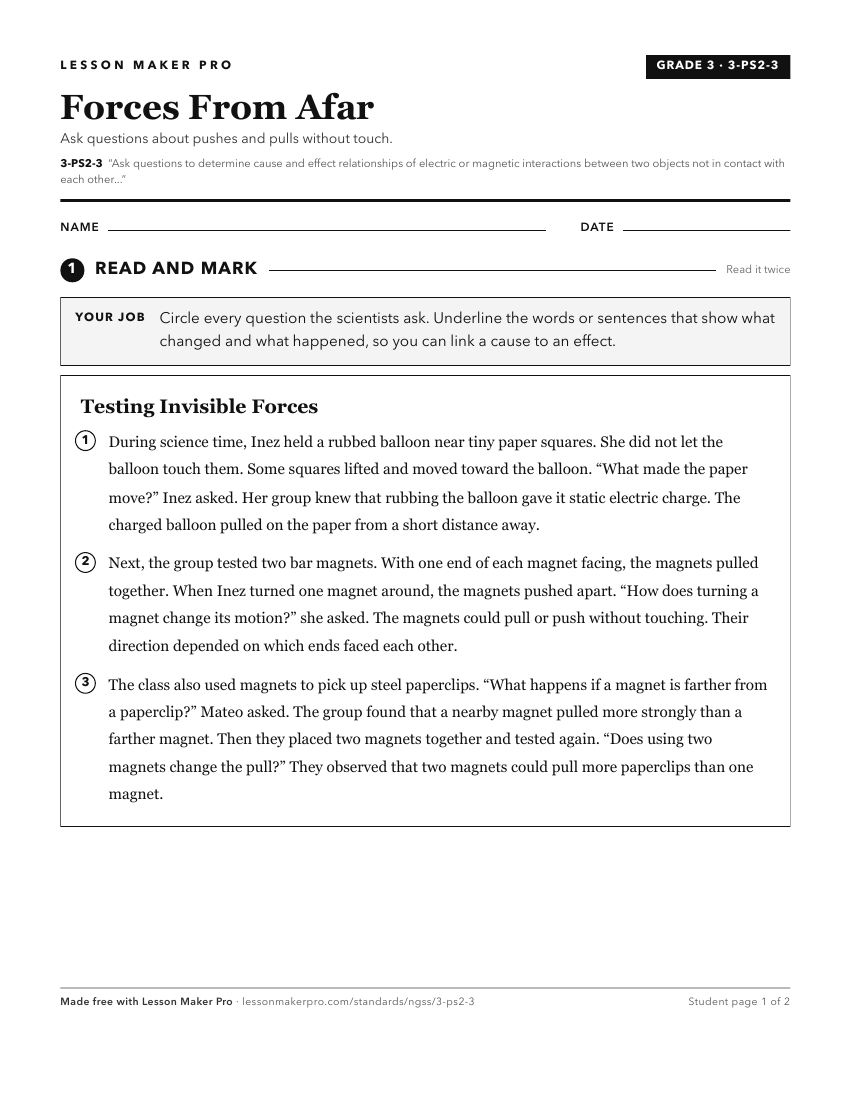
A ready-to-print activity worksheet aligned to 3-PS2-3, with an answer key for the teacher on its own page. No account needed.
PDF, US Letter, prints cleanly in black and white.
Download the worksheetLearning progression
Where This Standard Sits
See the whole path on the Physical Science progression map.
What This Unlocks
Mastery here sets students up for these next.
Keep exploring
Related Standards
- HS-PS3-5
Develop and use a model of two objects interacting through electric or magnetic fields to illustrate the forces between objects and the changes in energy of the...
- HS-PS2-5
Plan and conduct an investigation to provide evidence that an electric current can produce a magnetic field and that a changing magnetic field can produce an el...
Turn this exact standard into a lesson
Grade, subject, topic, and the complete standard are prefilled. Create one free, no account needed.
Also for this standard:Make a WorksheetMake a QuizMake a Sub Lesson