NGSS MS-PS2-3
The Standard
Ask questions about data to determine the factors that affect the strength of electric and magnetic forces.
Next Generation Science Standards
Teacher's field guide
What This Standard Means
What Students Need to Do
- Students examine tables, graphs, or measurements showing how electric or magnetic force changes. They ask testable questions about factors such as distance, current, wire turns, or magnet strength.
What Mastery Looks Like
- Students can ask a testable question that names a changed factor and a measurable force outcome. They can use a table or graph to support a claim about coils, current, magnet strength, or distance.
Common Misconceptions
- Students may think larger magnets are always stronger or that distance does not affect force. They may also assume more wire turns guarantee a stronger electromagnet, even when current, core material, or battery strength changes.
How to Assess It
- Show this table: 10 turns lifts 4 clips, 20 turns lifts 8, and 30 turns lifts 12. Ask students to write a testable question about the pattern and predict the result for 40 turns.
Lesson moves
Ways to Teach It
Build nail electromagnets with the same battery, vary the wire turns, count lifted paper clips, and graph the results.
Give students motor speed data and ask, "Which factor appears to affect speed, and what new data would strengthen your claim?"
Run a card sort where students match data tables with testable questions about coil turns, magnet number, current, or distance.
Compare fan motor speeds with one and two magnets, then have students recommend a design using evidence from the measurements.
Free download
Printable MS-PS2-3 Worksheet
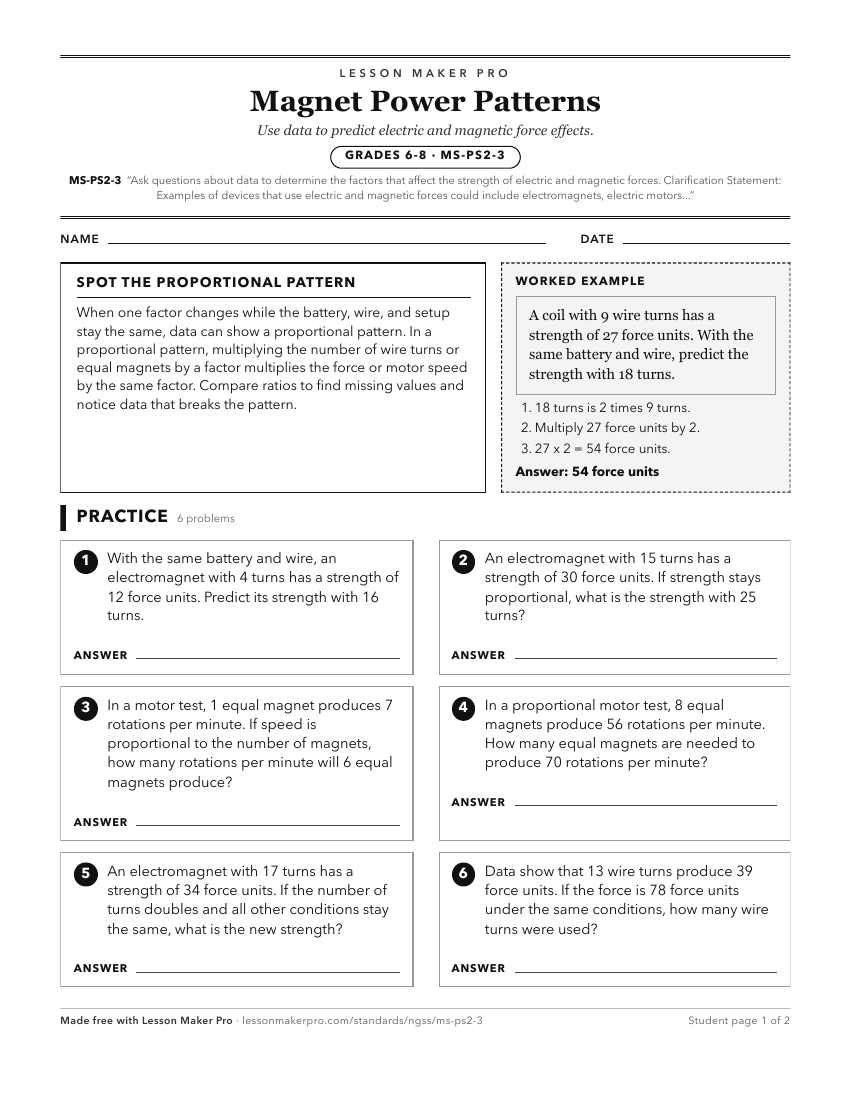
A ready-to-print activity worksheet aligned to MS-PS2-3, with an answer key for the teacher on its own page. No account needed.
PDF, US Letter, prints cleanly in black and white.
Download the worksheetLearning progression
Where This Standard Sits
See the whole path on the Physical Science progression map.
Before This Standard
If students are struggling here, check these first.
- 3-PS2-3
Students move from identifying electric and magnetic effects at a distance to questioning data about what changes force strength.
- 3-PS2-1
Understanding balanced and unbalanced forces supports interpreting electric and magnetic force data as interactions that can change motion.
- 3-PS2-4
Elementary magnet applications prepare students to consider what changes magnetic effects, later extended to data about force strength and electric forces.
What This Unlocks
Mastery here sets students up for these next.
- HS-PS2-5
Understanding how electric and magnetic force strength depends on factors supports investigating current produced magnetic fields and induction.
- HS-PS2-4
Qualitative work with factors affecting electric force prepares students to use Coulomb’s Law variables mathematically to predict force strength.
- HS-PS1-3
Students carry forward how distance and charge affect electric force strength to infer particle attractions from bulk substance properties.
Keep exploring
Related Standards
- HS-PS3-5
Develop and use a model of two objects interacting through electric or magnetic fields to illustrate the forces between objects and the changes in energy of the...
- MS-PS2-5
Conduct an investigation and evaluate the experimental design to provide evidence that fields exist between objects exerting forces on each other even though th...
Turn this exact standard into a lesson
Grade, subject, topic, and the complete standard are prefilled. Create one free, no account needed.
Also for this standard:Make a WorksheetMake a QuizMake a Sub Lesson