NGSS HS-PS1-3
The Standard
Plan and conduct an investigation to gather evidence to compare the structure of substances at the bulk scale to infer the strength of electrical forces between particles.
Next Generation Science Standards
Teacher's field guide
What This Standard Means
What Students Need to Do
- Students plan and run a fair investigation comparing measurable properties of substances. They use the results to infer which substances have stronger or weaker electrical attractions between particles.
What Mastery Looks Like
- Students design a fair test, control key variables, repeat measurements, and record useful data. They use patterns in melting point, boiling point, vapor pressure, or surface tension to compare particle attraction strength.
Common Misconceptions
- Students may think boiling or evaporation breaks molecules into atoms. They may claim that higher vapor pressure means stronger particle attraction. Some confuse the amount of a substance with intrinsic properties such as boiling point or surface tension.
How to Assess It
- Give students boiling point and vapor pressure data for three unknown liquids. Ask them to rank particle attraction strength and write one evidence-based reason for their ranking.
Lesson moves
Ways to Teach It
Teams test equal volumes of water, rubbing alcohol, and glycerin for evaporation rate, then rank particle attraction strength from their data.
Ask students to explain why a liquid with a high boiling point usually has a low vapor pressure at the same temperature.
Students sort substance data cards by melting point, boiling point, vapor pressure, and surface tension, then defend their force rankings.
Compare product labels for fast-drying sanitizer and moisturizing lotion, then connect evaporation behavior to particle attraction and product use.
Free download
Printable HS-PS1-3 Worksheet
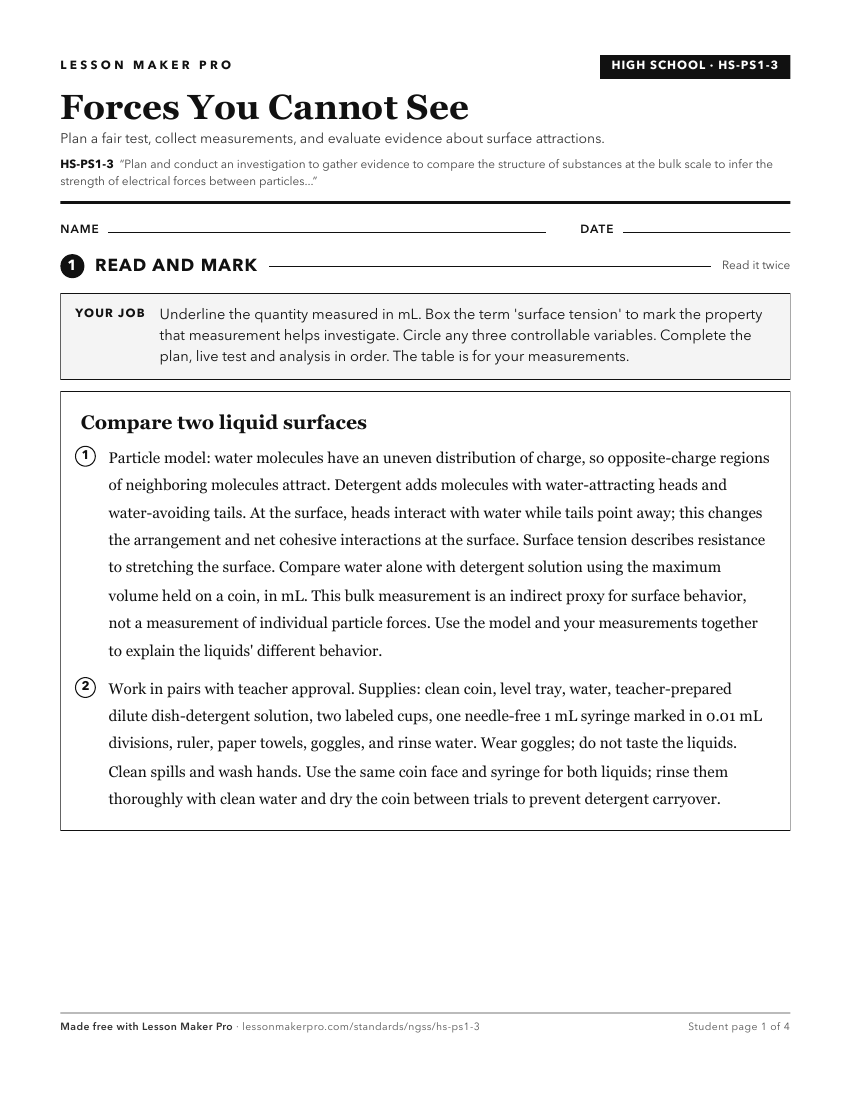
A ready-to-print activity worksheet aligned to HS-PS1-3, with an answer key for the teacher on its own page. No account needed.
PDF, US Letter, prints cleanly in black and white.
Download the worksheetLearning progression
Where This Standard Sits
See the whole path on the Physical Science progression map.
Before This Standard
If students are struggling here, check these first.
- MS-PS1-1
Modeling molecules and extended structures prepares students to connect particle arrangement with bulk properties and forces between particles.
- MS-PS1-2
Students carry forward using substance properties as evidence, then connect those properties to particle structure and electrical forces.
- MS-PS1-4
Particle models of state changes prepare students to connect bulk properties with particle attractions and force strength.
- MS-PS1-3
Understanding that materials have distinct properties and origins supports investigating how bulk properties reveal particle-level forces in substances.
- MS-PS2-5
Understanding noncontact fields helps students connect particle-level electrical attractions to observable bulk properties of substances.
- MS-PS2-4
The idea that unseen forces between objects depend on object properties supports reasoning about particle-level electrical forces from bulk evidence.
Keep exploring
Related Standards
- 2-PS1-1
Plan and conduct an investigation to describe and classify different kinds of materials by their observable properties.
- 3-PS2-1
Plan and conduct an investigation to provide evidence of the effects of balanced and unbalanced forces on the motion of an object.
- MS-PS2-2
Plan an investigation to provide evidence that the change in an object's motion depends on the sum of the forces on the object and the mass of the object.
Turn this exact standard into a lesson
Grade, subject, topic, and the complete standard are prefilled. Create one free, no account needed.
Also for this standard:Make a WorksheetMake a QuizMake a Sub Lesson