NGSS 2-PS1-1
The Standard
Plan and conduct an investigation to describe and classify different kinds of materials by their observable properties.
Next Generation Science Standards
Teacher's field guide
What This Standard Means
What Students Need to Do
- Students choose observable properties to check, such as color, texture, hardness, and flexibility. They examine samples, record observations, and group materials that share properties.
What Mastery Looks Like
- A student describes each sample with specific observations instead of opinions. The student sorts materials by a shared property and explains the grouping with evidence.
Common Misconceptions
- Students may name an object, such as a spoon, when asked for its material, such as metal. They may confuse hard with unbreakable, or flexible with soft.
How to Assess It
- Give students felt, foil, a craft stick, and a plastic lid. Ask them to record two properties, sort the samples, and explain their groups.
Lesson moves
Ways to Teach It
Set out fabric, foil, wood, rubber, and plastic samples for students to observe, test gently, record, and sort.
Ask students to write: Which two materials belong together, and what observable property supports your choice?
Play Property Clues, where one student describes a hidden material by color, texture, hardness, and flexibility while classmates identify it.
Have students inspect a raincoat, window, and pencil, then explain how each material's properties suit its use.
Free download
Printable 2-PS1-1 Worksheet
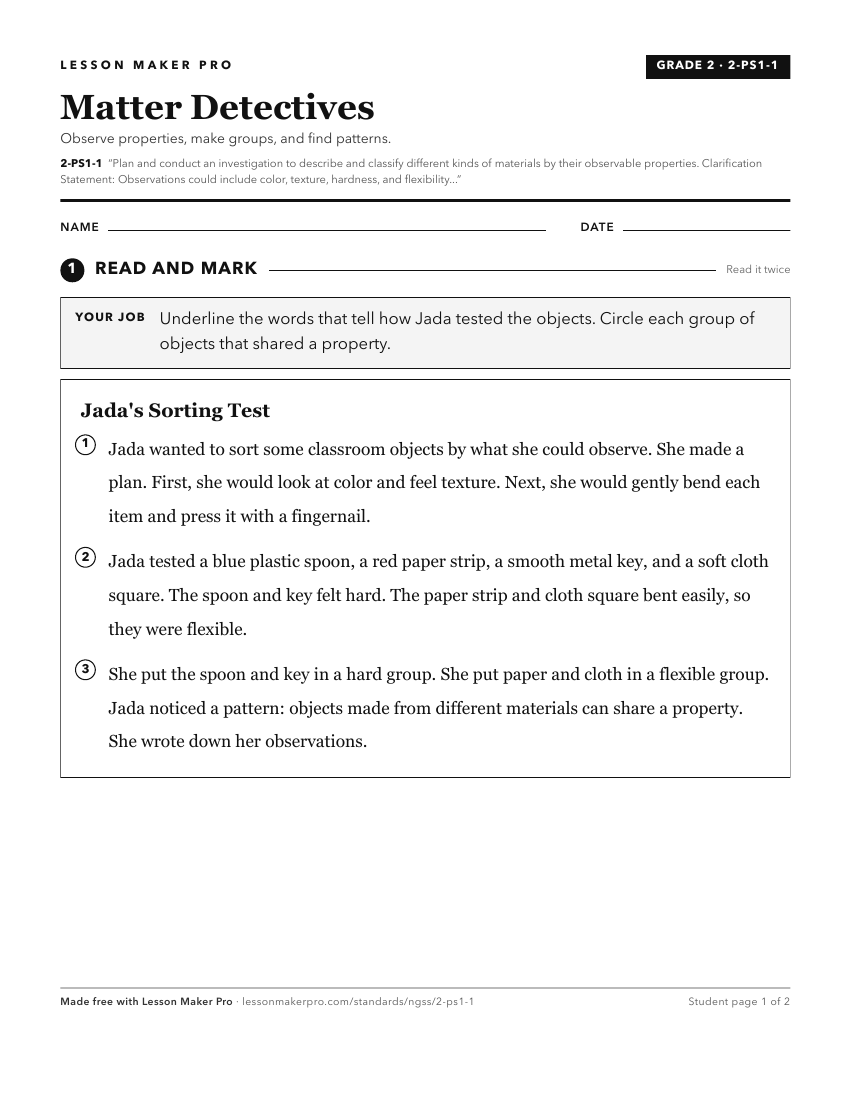
A ready-to-print activity worksheet aligned to 2-PS1-1, with an answer key for the teacher on its own page. No account needed.
PDF, US Letter, prints cleanly in black and white.
Download the worksheetKeep exploring
Related Standards
- HS-ESS2-5
Plan and conduct an investigation of the properties of water and its effects on Earth materials and surface processes.
- 1-PS4-3
Plan and conduct an investigation to determine the effect of placing objects made with different materials in the path of a beam of light.
- 2-PS1-2
Analyze data obtained from testing different materials to determine which materials have the properties that are best suited for an intended purpose.
- 5-PS1-3
Make observations and measurements to identify materials based on their properties.
Turn this exact standard into a lesson
Grade, subject, topic, and the complete standard are prefilled. Create one free, no account needed.
Also for this standard:Make a WorksheetMake a QuizMake a Sub Lesson