NGSS HS-ESS2-5
The Standard
Plan and conduct an investigation of the properties of water and its effects on Earth materials and surface processes.
Next Generation Science Standards
Teacher's field guide
What This Standard Means
What Students Need to Do
- Students plan and run controlled tests using water, rock, soil, sediment, or soluble solids. They collect data and explain links among water movement, weathering, erosion, deposition, and rock change.
What Mastery Looks Like
- Students isolate a variable, use a fair comparison, record measurements, and identify patterns. They use their data to explain how water changes, moves, or deposits Earth materials.
Common Misconceptions
- Students often treat weathering, erosion, and deposition as the same process. They may think freezing water contracts or that water causes only physical changes, overlooking dissolution and recrystallization.
How to Assess It
- Exit ticket: Design a test of how water flow affects sediment movement. Name the variable changed, the measurement, one control, and the expected evidence.
Lesson moves
Ways to Teach It
Build two stream trays with equal slopes, vary water flow, and measure sediment moved and deposited at marked distances.
Write a claim explaining how freezing water breaks rock, using particle motion and volume change as evidence.
Sort investigation cards into weathering, erosion, deposition, or recrystallization, then defend each choice with the water property involved.
Compare local road cracks or stream-bank damage after rain, and identify how water caused the observed surface change.
Free download
Printable HS-ESS2-5 Worksheet
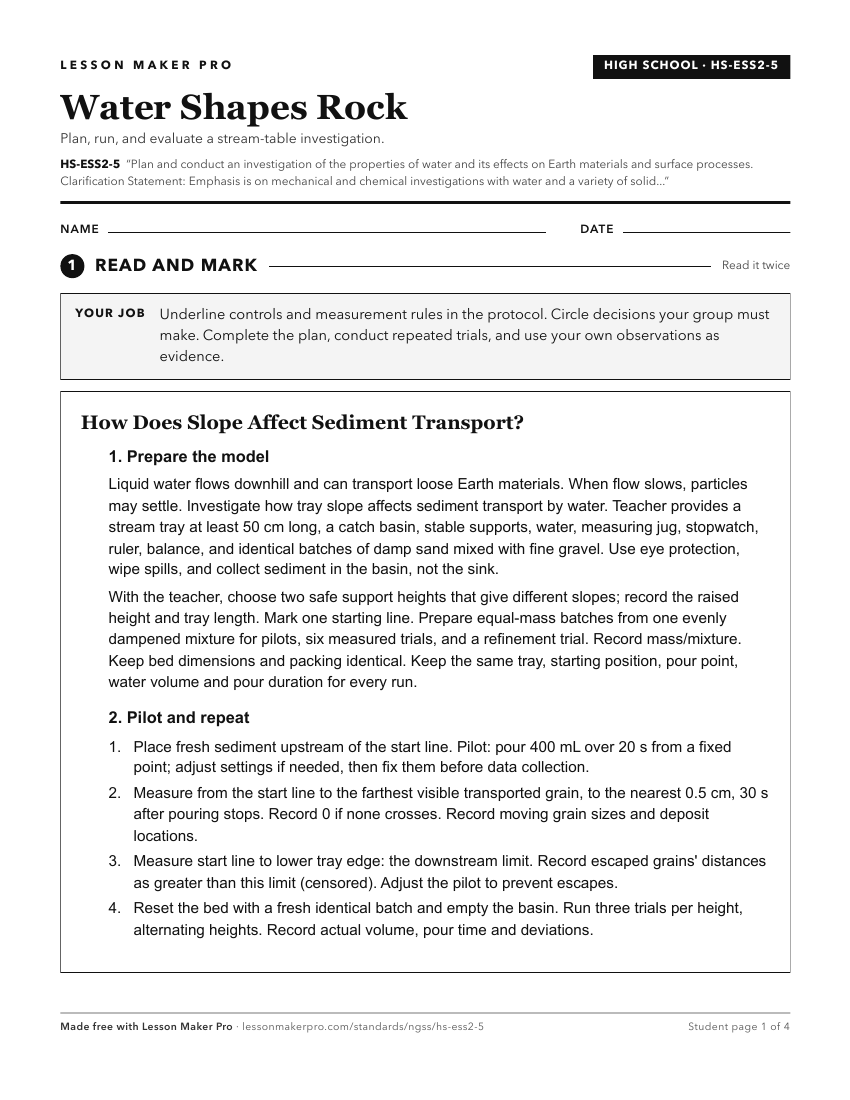
A ready-to-print activity worksheet aligned to HS-ESS2-5, with an answer key for the teacher on its own page. No account needed.
PDF, US Letter, prints cleanly in black and white.
Download the worksheetLearning progression
Where This Standard Sits
See the whole path on the Earth & Space Science progression map.
Before This Standard
If students are struggling here, check these first.
- MS-ESS2-4
Understanding how sunlight and gravity move water supports investigating how water’s properties shape Earth materials and surface processes.
- MS-ESS2-2
Students extend explaining surface changes across scales to investigating how water drives weathering, erosion, and other surface processes.
- MS-ESS2-6
Ideas about water moving heat in oceans support investigating how water’s properties affect Earth materials and surface processes.
Keep exploring
Related Standards
- 2-PS1-1
Plan and conduct an investigation to describe and classify different kinds of materials by their observable properties.
- MS-ESS3-1
Construct a scientific explanation based on evidence for how the uneven distributions of Earth's mineral, energy, and groundwater resources are the result of pa...
- 2-ESS2-3
Obtain information to identify where water is found on Earth and that it can be solid or liquid.
Turn this exact standard into a lesson
Grade, subject, topic, and the complete standard are prefilled. Create one free, no account needed.
Also for this standard:Make a WorksheetMake a QuizMake a Sub Lesson