NGSS MS-PS2-5
The Standard
Conduct an investigation and evaluate the experimental design to provide evidence that fields exist between objects exerting forces on each other even though the objects are not in contact.
Next Generation Science Standards
Teacher's field guide
What This Standard Means
What Students Need to Do
- Students plan and run a fair test using magnets or charged objects, then record what happens across a gap. They judge whether the setup and evidence support the presence of an electric or magnetic field.
What Mastery Looks Like
- Students produce repeatable observations, such as a paper clip moving toward a magnet across a gap. They identify controls and use the pattern of motion as qualitative evidence of a field.
Common Misconceptions
- Students may think forces require touching or that air causes every motion. They may also treat a field as visible matter, or claim a field exists without comparing controlled observations.
How to Assess It
- Give students a magnet, paper clip, ruler, and cardboard sheet. Ask them to outline a test, name one controlled variable, and explain how the results could show a magnetic field.
Lesson moves
Ways to Teach It
Place a magnet under cardboard, move it toward a paper clip, record the distance where motion begins, and repeat three times.
Ask students to write why a paper clip moving without contact supports a field explanation rather than an air push.
Give groups investigation cards and have them sort each design as fair or flawed, then revise one flawed design.
Examine how refrigerator magnets, speakers, or scrapyard cranes apply magnetic forces across gaps, then label where the field acts.
Free download
Printable MS-PS2-5 Worksheet
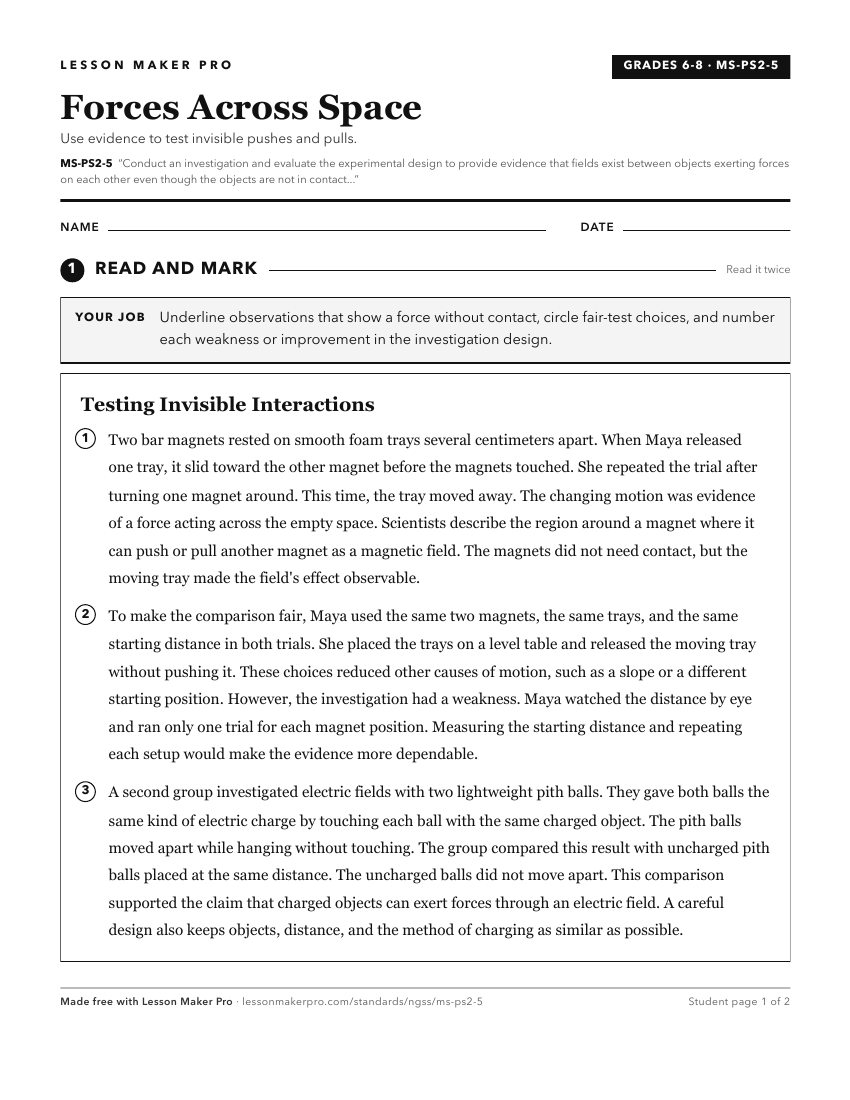
A ready-to-print activity worksheet aligned to MS-PS2-5, with an answer key for the teacher on its own page. No account needed.
PDF, US Letter, prints cleanly in black and white.
Download the worksheetLearning progression
Where This Standard Sits
See the whole path on the Physical Science progression map.
Before This Standard
If students are struggling here, check these first.
- 3-PS2-4
Using magnets to solve problems introduces noncontact forces, which supports investigating invisible fields that cause forces between objects.
- 3-PS2-1
Students extend evidence from forces affecting motion to investigating noncontact forces as fields between interacting objects.
- 3-PS2-3
Students move from noticing noncontact electric and magnetic cause-effect interactions to testing evidence for fields that explain those forces.
What This Unlocks
Mastery here sets students up for these next.
- HS-PS2-4
Middle school field evidence supports high school models of gravitational and electric forces acting at a distance with mathematical laws.
- HS-PS2-5
Understanding fields as invisible agents of noncontact forces supports explaining magnetic fields from currents and induced currents from changing fields.
- HS-PS1-3
Understanding noncontact fields helps students connect particle-level electrical attractions to observable bulk properties of substances.
Keep exploring
Related Standards
- K-PS2-1
Plan and conduct an investigation to compare the effects of different strengths or different directions of pushes and pulls on the motion of an object.
- MS-PS2-2
Plan an investigation to provide evidence that the change in an object's motion depends on the sum of the forces on the object and the mass of the object.
Turn this exact standard into a lesson
Grade, subject, topic, and the complete standard are prefilled. Create one free, no account needed.
Also for this standard:Make a WorksheetMake a QuizMake a Sub Lesson