NGSS HS-PS2-4
The Standard
Use mathematical representations of Newton's Law of Gravitation and Coulomb's Law to describe and predict the gravitational and electrostatic forces between objects.
Next Generation Science Standards
Teacher's field guide
What This Standard Means
What Students Need to Do
- Students calculate the force magnitude between two masses or two charges. They predict how force changes when mass, charge, or separation changes, and use field arrows to show direction and relative strength.
What Mastery Looks Like
- A student chooses the correct equation, converts units, squares the separation, and reports a force with direction. They explain that gravity is always attractive, while electric force may attract or repel, and that both weaken with the square of distance.
Common Misconceptions
- Students often use r instead of r², or say doubling distance cuts force in half rather than to one fourth. They may ignore charge signs and predict repulsion for opposite charges. They also confuse field strength with force and forget that field direction is defined for a positive test charge.
How to Assess It
- Exit ticket: Two masses M and 2M are separated by r, while charges +q and -2q are separated by r. Write each force magnitude, state each direction, and show how both forces change when r doubles.
Lesson moves
Ways to Teach It
Make two top-bottom clear tape pairs, separate them, test all pairings, and sketch field arrows for attraction and repulsion.
Write a claim explaining why doubling separation changes both forces by the same factor, even though their sources differ.
Run a card sort matching mass, charge, and distance changes to force multipliers such as 4, 1/4, 2, and 1/2.
Use NASA data for a satellite's mass and orbital radius to calculate gravitational force and predict the effect of moving it higher.
Free download
Printable HS-PS2-4 Worksheet
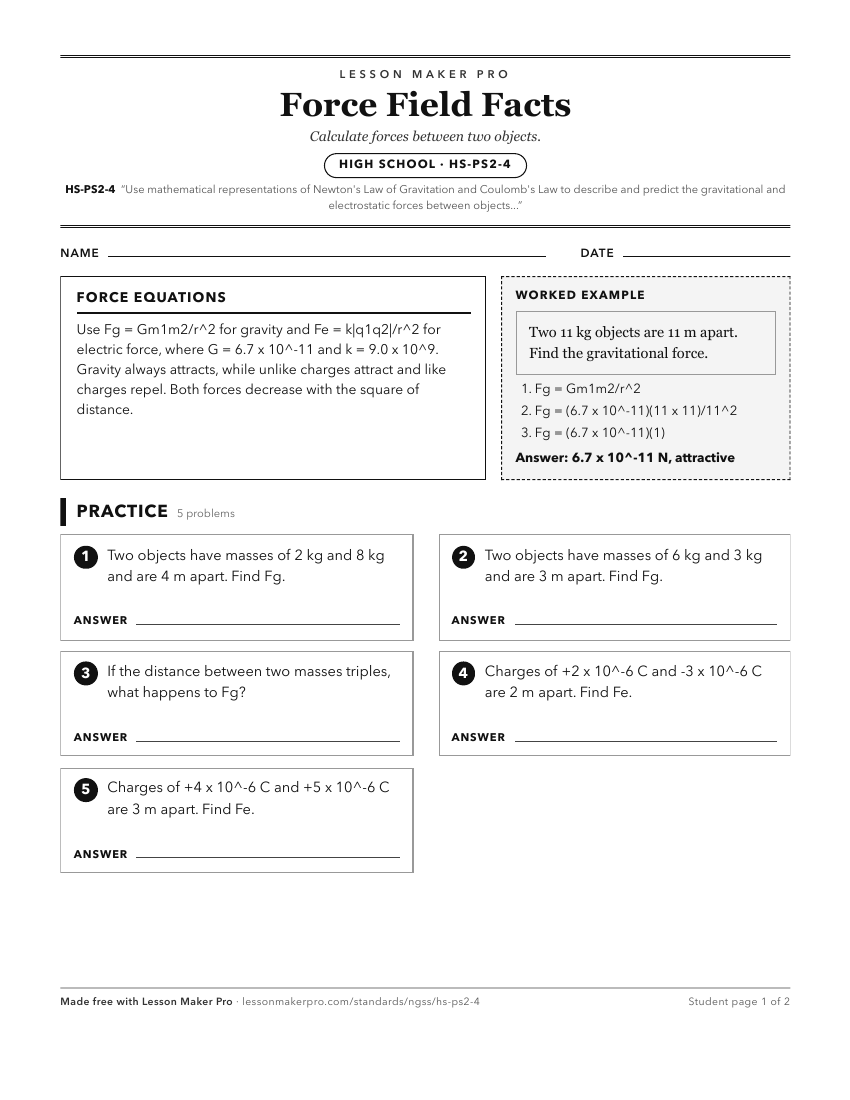
A ready-to-print activity worksheet aligned to HS-PS2-4, with an answer key for the teacher on its own page. No account needed.
PDF, US Letter, prints cleanly in black and white.
Download the worksheetLearning progression
Where This Standard Sits
See the whole path on the Physical Science progression map.
Before This Standard
If students are struggling here, check these first.
- MS-PS2-5
Middle school field evidence supports high school models of gravitational and electric forces acting at a distance with mathematical laws.
- MS-PS2-3
Qualitative work with factors affecting electric force prepares students to use Coulomb’s Law variables mathematically to predict force strength.
- MS-PS2-4
The middle school idea that gravity is attractive and mass-dependent supports using equations to predict gravitational and electrostatic forces.
Keep exploring
Related Standards
- HS-PS2-1
Analyze data to support the claim that Newton's second law of motion describes the mathematical relationship among the net force on a macroscopic object, its ma...
- HS-PS3-5
Develop and use a model of two objects interacting through electric or magnetic fields to illustrate the forces between objects and the changes in energy of the...
- HS-ESS1-4
Use mathematical or computational representations to predict the motion of orbiting objects in the solar system.
Turn this exact standard into a lesson
Grade, subject, topic, and the complete standard are prefilled. Create one free, no account needed.
Also for this standard:Make a WorksheetMake a QuizMake a Sub Lesson