NGSS HS-ESS1-4
The Standard
Use mathematical or computational representations to predict the motion of orbiting objects in the solar system.
Next Generation Science Standards
Teacher's field guide
What This Standard Means
What Students Need to Do
- Students use equations, graphs, spreadsheets, or simulations to model an object orbiting one other body. They calculate or predict orbital force, speed, radius, and period without calculus or multi-body systems.
What Mastery Looks Like
- Students use gravitational force equations or Kepler’s third law to calculate orbital speed, force, radius, or period in a two-body system. They predict how changing mass or orbital radius affects motion and support the prediction with calculations, graphs, or a simple computer model.
Common Misconceptions
- Students may think gravity disappears in space or that orbiting objects need continuous engine thrust. They may also think a heavier satellite moves faster at the same orbital radius, or confuse orbital speed with orbital period.
How to Assess It
- Give students a satellite whose orbital radius doubles. Ask them to use T² ∝ r³ to find the factor by which its period changes and explain the result.
Lesson moves
Ways to Teach It
Swing a rubber stopper on a string at two measured radii, time ten revolutions, and compare how radius changes the period.
Write a claim explaining why astronauts feel weightless in orbit even though Earth’s gravity still acts on them.
Run an orbit card sort: match radius, speed, and period cards for satellites orbiting the same body, then justify each match.
Use the ISS altitude and Earth’s mass to calculate its orbital period, then compare the result with a published tracking value.
Free download
Printable HS-ESS1-4 Worksheet
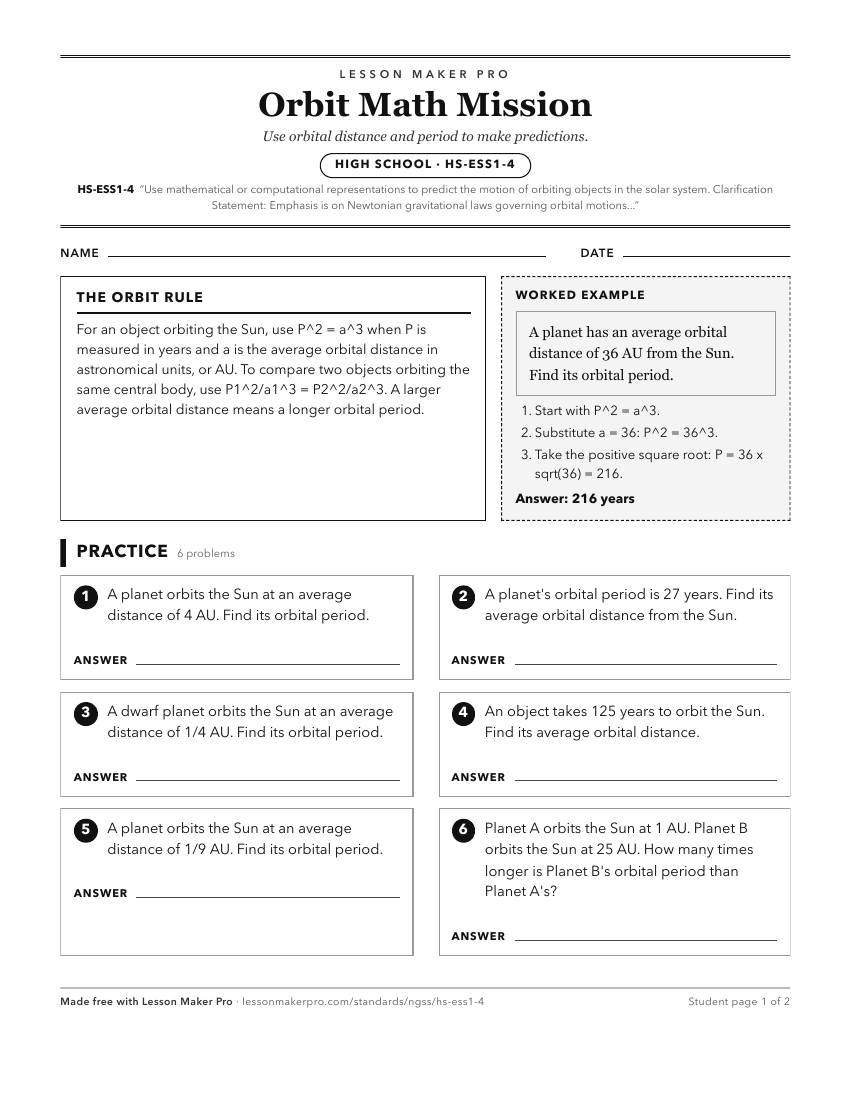
A ready-to-print activity worksheet aligned to HS-ESS1-4, with an answer key for the teacher on its own page. No account needed.
PDF, US Letter, prints cleanly in black and white.
Download the worksheetLearning progression
Where This Standard Sits
See the whole path on the Earth & Space Science progression map.
Before This Standard
If students are struggling here, check these first.
- MS-ESS1-2
Students move from modeling gravity’s role in solar system motion to using math or computation to predict orbital motion.
- MS-ESS1-3
Understanding solar system scale supports using mathematical models to predict orbital motion, though orbit prediction also needs new dynamics ideas.
- MS-ESS1-1
Earth-sun-moon modeling supports later quantitative prediction of orbital motion, but students can begin orbit calculations without eclipse or season mastery.
Keep exploring
Related Standards
Turn this exact standard into a lesson
Grade, subject, topic, and the complete standard are prefilled. Create one free, no account needed.
Also for this standard:Make a WorksheetMake a QuizMake a Sub Lesson