NGSS MS-ESS1-2
The Standard
Develop and use a model to describe the role of gravity in the motions within galaxies and the solar system.
Next Generation Science Standards
Teacher's field guide
What This Standard Means
What Students Need to Do
- Students make physical, visual, or conceptual models of motion around stars and within galaxies. They use those models to explain how gravity changes paths and keeps systems together.
What Mastery Looks Like
- Students create a model showing objects moving forward while gravity pulls them toward a larger mass. They use it to explain planetary orbits and how stars remain grouped in galaxies.
Common Misconceptions
- Students may think gravity acts only near Earth or disappears in space. They may also think planets need continuous pushing, or that orbital paths are always perfect circles.
How to Assess It
- Give students a diagram of a planet moving past a star. Ask them to draw the planet’s path, add a force arrow, and explain both choices.
Lesson moves
Ways to Teach It
Roll a marble around the inside of a large bowl, then label what the bowl can and cannot represent about gravity and orbiting.
Ask students to explain in writing why Earth does not fly away from the Sun or fall straight into it.
Play an orbit sorting game where teams match diagrams with correct gravity arrows, paths, and explanations.
Use satellite maps to connect orbital motion with weather forecasts, GPS directions, television signals, and Earth observation.
Free download
Printable MS-ESS1-2 Worksheet
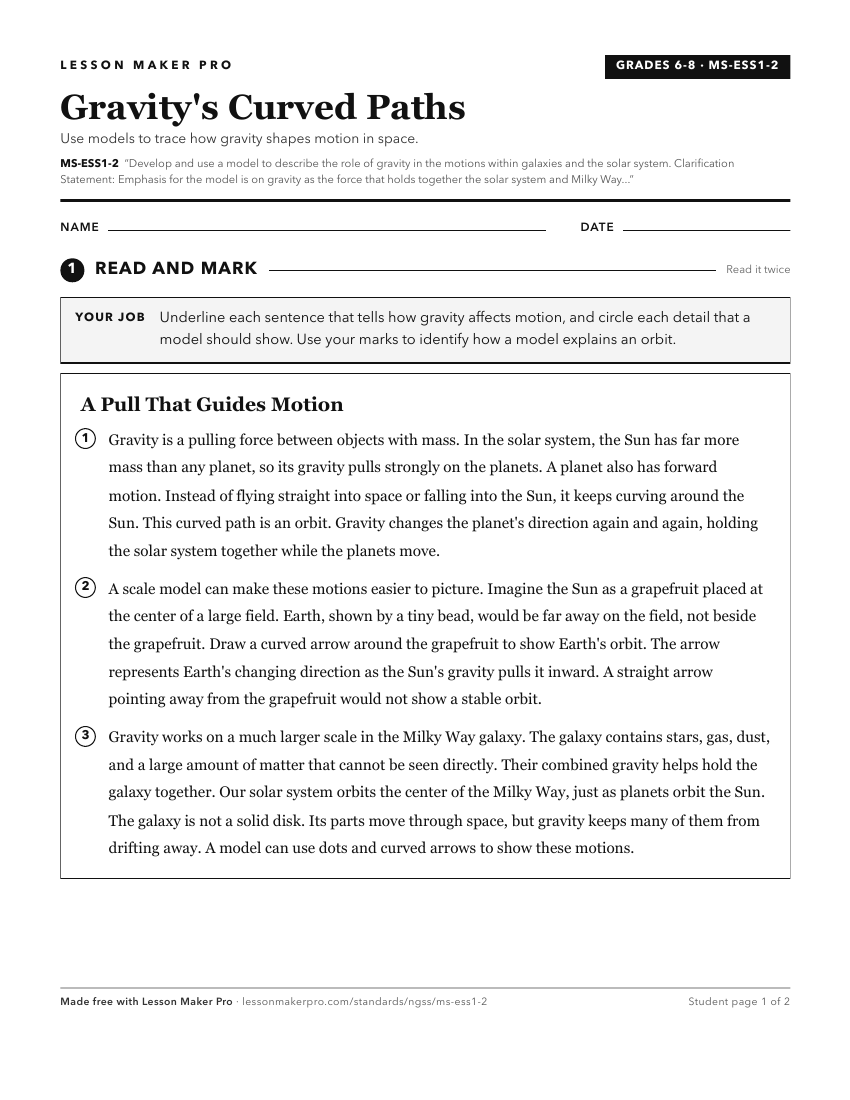
A ready-to-print activity worksheet aligned to MS-ESS1-2, with an answer key for the teacher on its own page. No account needed.
PDF, US Letter, prints cleanly in black and white.
Download the worksheetLearning progression
Where This Standard Sits
See the whole path on the Earth & Space Science progression map.
Before This Standard
If students are struggling here, check these first.
What This Unlocks
Mastery here sets students up for these next.
- HS-ESS1-4
Students move from modeling gravity’s role in solar system motion to using math or computation to predict orbital motion.
- HS-ESS1-3
Understanding gravity’s role in space supports later explanations of how stars form, change, and fuse elements over their life cycles.
- HS-ESS1-1
Middle school gravity models support understanding the Sun as a star in a larger system, but fusion and stellar life cycles are new.
- HS-ESS1-2
Modeling gravity-driven motions in galaxies prepares students to interpret galaxy motion evidence used in Big Bang explanations.
Keep exploring
Related Standards
- MS-ESS1-3
Analyze and interpret data to determine scale properties of objects in the solar system.
- MS-ESS1-1
Develop and use a model of the Earth-sun-moon system to describe the cyclic patterns of lunar phases, eclipses of the sun and moon, and seasons.
- MS-ESS2-4
Develop a model to describe the cycling of water through Earth's systems driven by energy from the sun and the force of gravity.
Turn this exact standard into a lesson
Grade, subject, topic, and the complete standard are prefilled. Create one free, no account needed.
Also for this standard:Make a WorksheetMake a QuizMake a Sub Lesson