NGSS MS-ESS1-1
The Standard
Develop and use a model of the Earth-sun-moon system to describe the cyclic patterns of lunar phases, eclipses of the sun and moon, and seasons.
Next Generation Science Standards
Teacher's field guide
What This Standard Means
What Students Need to Do
- Students build diagrams or physical models showing the positions and motions of Earth, the sun, and the moon. They use those models to explain moon phases, eclipses, and seasons.
What Mastery Looks Like
- Students correctly model the repeating sequence of moon phases. They show the alignments that produce solar and lunar eclipses. They explain opposite seasons in each hemisphere using Earth’s tilt and orbit.
Common Misconceptions
- Students often think moon phases come from Earth’s shadow. They may think seasons result from Earth’s distance from the sun. Some expect an eclipse every month because they overlook the moon’s tilted orbit.
How to Assess It
- Exit ticket: In three boxes, model first-quarter moon, a lunar eclipse, and Northern Hemisphere summer. Label sunlight, positions, and Earth’s tilt, then explain each pattern in one sentence.
Lesson moves
Ways to Teach It
Use a lamp, globe, and foam ball to model moon phases, eclipses, and seasonal sunlight angles.
Ask students to explain why summer is not caused by Earth moving closer to the sun.
Run a card sort matching system positions with phase, eclipse, and season diagrams.
Compare local daylight records and moon calendars, then connect repeating changes to Earth’s tilt and orbital positions.
Free download
Printable MS-ESS1-1 Worksheet
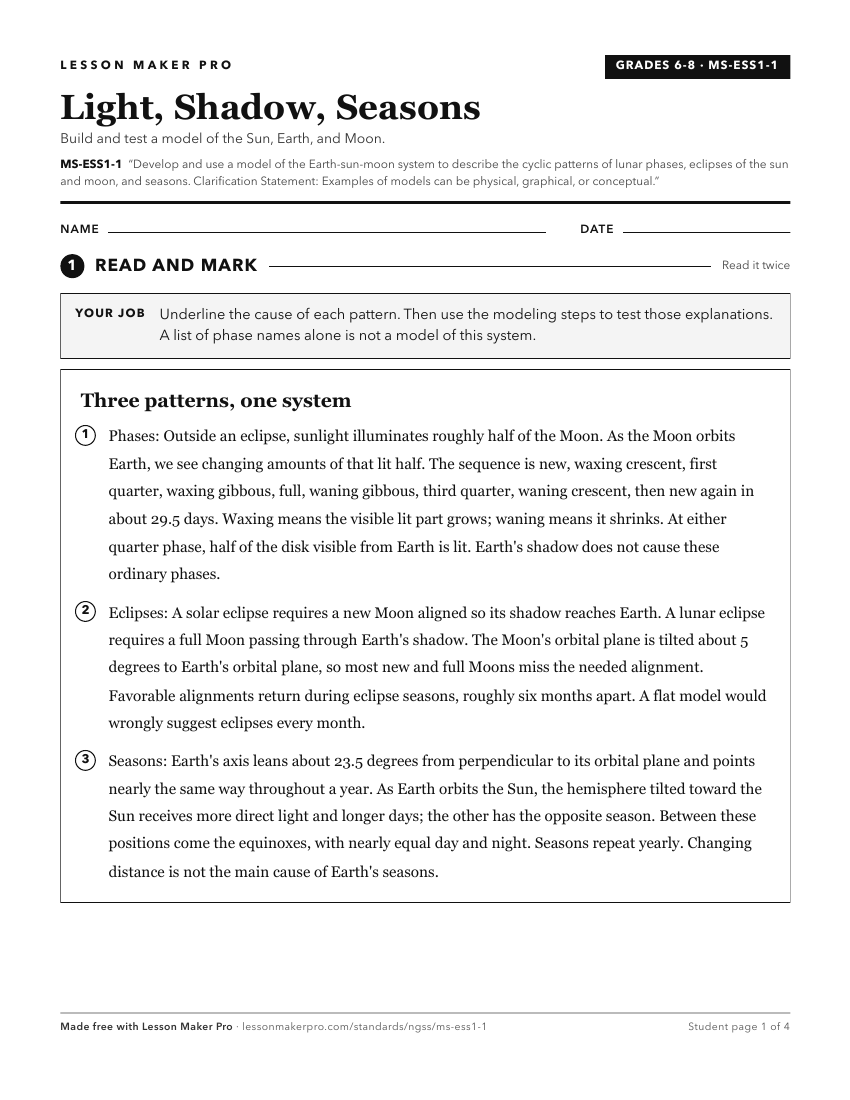
A ready-to-print activity worksheet aligned to MS-ESS1-1, with an answer key for the teacher on its own page. No account needed.
PDF, US Letter, prints cleanly in black and white.
Download the worksheetLearning progression
Where This Standard Sits
See the whole path on the Earth & Space Science progression map.
Before This Standard
If students are struggling here, check these first.
What This Unlocks
Mastery here sets students up for these next.
- HS-ESS1-1
Middle school modeling of Sun-Earth patterns supports understanding the Sun as a radiation source before explaining its fusion-driven energy.
- HS-ESS1-4
Earth-sun-moon modeling supports later quantitative prediction of orbital motion, but students can begin orbit calculations without eclipse or season mastery.
- HS-ESS1-2
Modeling predictable sky patterns prepares students to use astronomical observations as evidence for larger explanations about space systems.
Keep exploring
Related Standards
- MS-ESS1-2
Develop and use a model to describe the role of gravity in the motions within galaxies and the solar system.
- MS-ESS2-4
Develop a model to describe the cycling of water through Earth's systems driven by energy from the sun and the force of gravity.
- MS-ESS2-1
Develop a model to describe the cycling of Earth's materials and the flow of energy that drives this process.
- 1-ESS1-1
Use observations of the sun, moon, and stars to describe patterns that can be predicted.
Turn this exact standard into a lesson
Grade, subject, topic, and the complete standard are prefilled. Create one free, no account needed.
Also for this standard:Make a WorksheetMake a QuizMake a Sub Lesson