NGSS 1-ESS1-1
The Standard
Use observations of the sun, moon, and stars to describe patterns that can be predicted.
Next Generation Science Standards
Teacher's field guide
What This Standard Means
What Students Need to Do
- Students observe and record how the Sun, Moon, and stars appear at different times. They compare records to find repeated changes. They use those changes to predict what will appear next.
What Mastery Looks Like
- A student can put sky pictures in time order and describe what changes. They can identify when stars are visible and use an observation chart to make a reasonable prediction.
Common Misconceptions
- Students may think the Sun stays in one place all day. They may say stars disappear during daylight or that the Moon appears only at night.
How to Assess It
- Give students four cards showing morning, midday, evening, and night skies. Ask them to order the cards, draw what comes next, and explain one clue.
Lesson moves
Ways to Teach It
Students arrange morning, midday, evening, and night photo cards on a paper sky, then add arrows to show the repeating sequence.
Ask, “What would you expect to see after sunset, and which class observation supports your answer?”
Play Sky Sequence, where partners draw cards, place them in time order, and predict the next card.
Use a stargazing event flyer to choose the best viewing time and explain why an afternoon start would not work.
Free download
Printable 1-ESS1-1 Worksheet
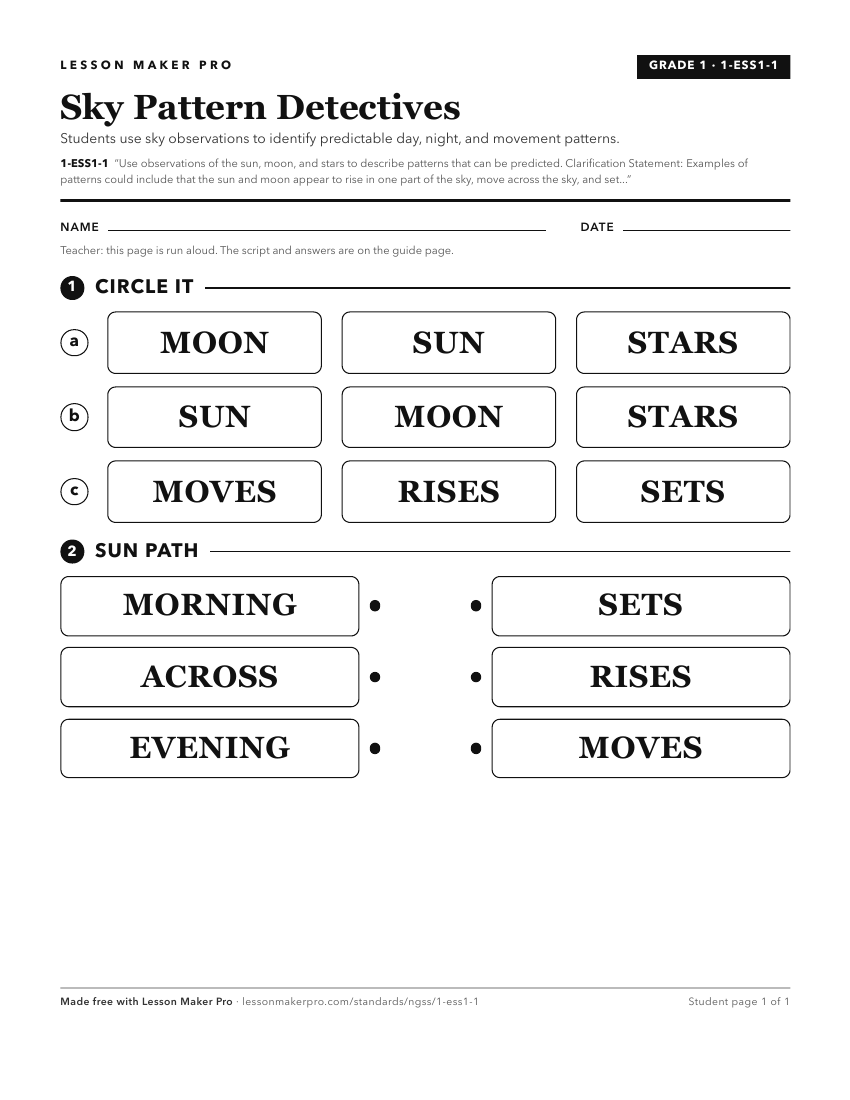
A ready-to-print activity worksheet aligned to 1-ESS1-1, with an answer key for the teacher on its own page. No account needed.
PDF, US Letter, prints cleanly in black and white.
Download the worksheetKeep exploring
Related Standards
- K-ESS2-1
Use and share observations of local weather conditions to describe patterns over time.
- 3-PS2-2
Make observations and/or measurements of an object's motion to provide evidence that a pattern can be used to predict future motion.
- MS-ESS1-1
Develop and use a model of the Earth-sun-moon system to describe the cyclic patterns of lunar phases, eclipses of the sun and moon, and seasons.
- 5-ESS1-2
Represent data in graphical displays to reveal patterns of daily changes in length and direction of shadows, day and night, and the seasonal appearance of some ...
Turn this exact standard into a lesson
Grade, subject, topic, and the complete standard are prefilled. Create one free, no account needed.
Also for this standard:Make a WorksheetMake a QuizMake a Sub Lesson