NGSS 3-PS2-2
The Standard
Make observations and/or measurements of an object's motion to provide evidence that a pattern can be used to predict future motion.
Next Generation Science Standards
Teacher's field guide
What This Standard Means
What Students Need to Do
- Students watch a moving object several times and record its positions or directions in order. They find a repeating pattern and use that evidence to predict the object's next movement.
What Mastery Looks Like
- Students record an object's positions or directions in order across several repeated movements. They identify the repeating sequence, predict what comes next, and support the prediction with their records.
Common Misconceptions
- Students may treat one observation as enough evidence or expect every motion to repeat. They may describe where an object is without tracking its direction or sequence. Some predict by guessing instead of citing recorded observations.
How to Assess It
- Roll a marble back and forth in a bowl. Have students record four turnaround locations, predict the fifth location, and explain the pattern supporting their prediction.
Lesson moves
Ways to Teach It
Hang a washer from string, mark its left, center, and right positions, then have students record and predict its next five positions.
Ask students to write: How can several observations of a playground swing help you predict where it will move next?
Give teams motion sequence cards to arrange, extend, and explain, such as left, center, right, center, left.
Observe windshield wipers during a video, pause after several movements, and have students predict and explain the wipers’ next position.
Free download
Printable 3-PS2-2 Worksheet
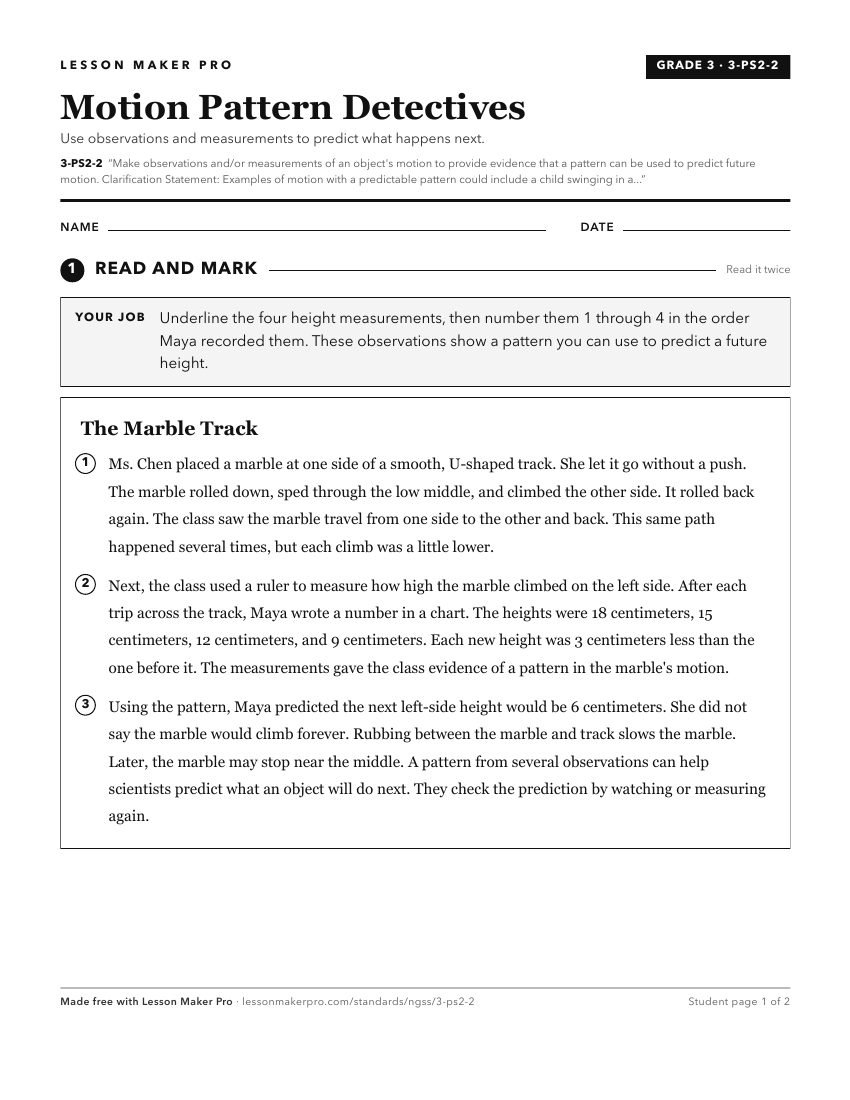
A ready-to-print activity worksheet aligned to 3-PS2-2, with an answer key for the teacher on its own page. No account needed.
PDF, US Letter, prints cleanly in black and white.
Download the worksheetLearning progression
Where This Standard Sits
See the whole path on the Physical Science progression map.
What This Unlocks
Mastery here sets students up for these next.
Keep exploring
Related Standards
- 3-PS2-1
Plan and conduct an investigation to provide evidence of the effects of balanced and unbalanced forces on the motion of an object.
- 1-ESS1-1
Use observations of the sun, moon, and stars to describe patterns that can be predicted.
- 4-ESS2-1
Make observations and/or measurements to provide evidence of the effects of weathering or the rate of erosion by water, ice, wind, or vegetation.
Turn this exact standard into a lesson
Grade, subject, topic, and the complete standard are prefilled. Create one free, no account needed.
Also for this standard:Make a WorksheetMake a QuizMake a Sub Lesson