NGSS 5-ESS1-2
The Standard
Represent data in graphical displays to reveal patterns of daily changes in length and direction of shadows, day and night, and the seasonal appearance of some stars in the night sky.
Next Generation Science Standards
Teacher's field guide
What This Standard Means
What Students Need to Do
- Students turn tables or observations into line graphs, bar graphs, and direction diagrams. They use these displays to find repeated changes in shadows, daylight length, and stars visible during different months.
What Mastery Looks Like
- Students choose a suitable display, label it clearly, and plot data accurately. They use evidence to describe patterns, such as shorter midday shadows, changing daylight across months, or stars visible during certain seasons.
Common Misconceptions
- Students may think shadows point toward the Sun or stay the same length all day. They may expect equal daylight every month. Some assume the same stars are visible every night or think a seasonally hidden star has disappeared.
How to Assess It
- Give students shadow data for 9 a.m., noon, and 3 p.m. Ask them to graph the lengths, add direction arrows, and write one supported pattern.
Lesson moves
Ways to Teach It
Place a meter stick upright outdoors, then have teams measure shadow length and direction in the morning, at noon, and afternoon.
Show a monthly daylight graph and ask, "Which months have similar daylight, and what evidence from the graph supports your answer?"
Give pairs cards with times, shadow measurements, and star-visibility months; students match each data set to the correct graph.
Use local sunrise and sunset times to choose the best month for an evening sports event with the most daylight.
Free download
Printable 5-ESS1-2 Worksheet
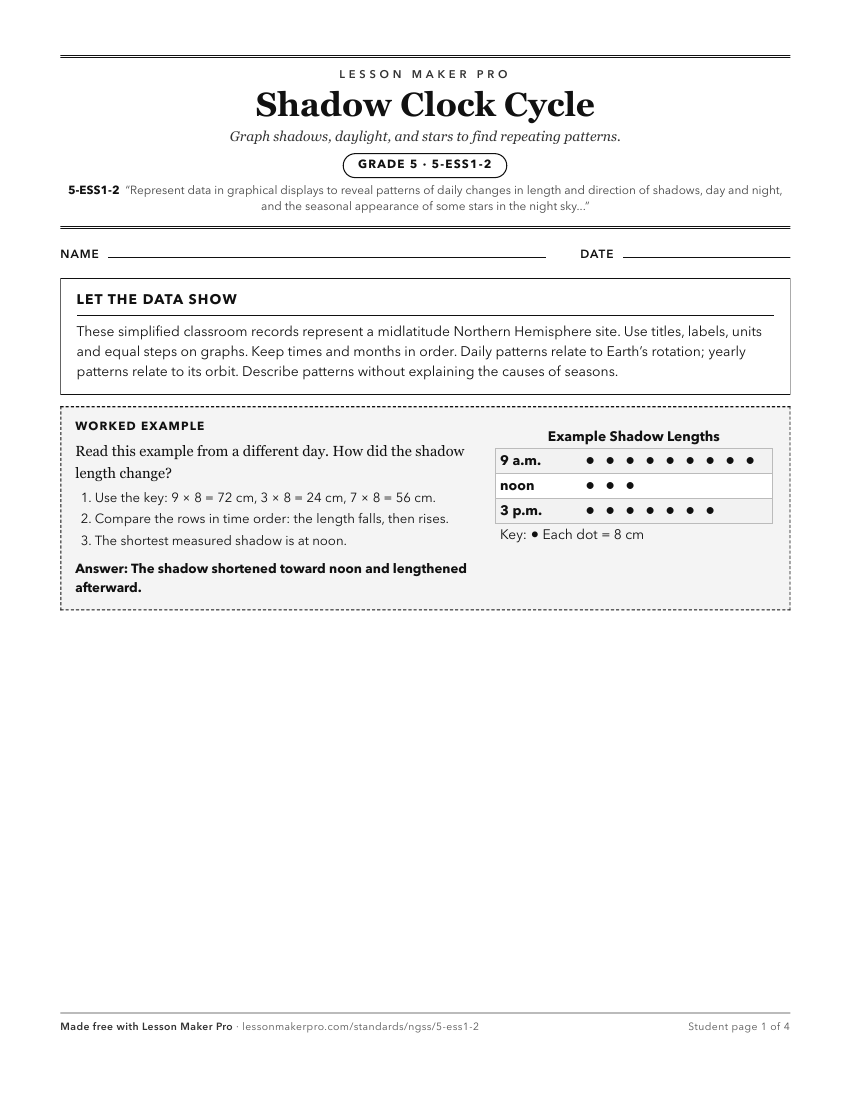
A ready-to-print activity worksheet aligned to 5-ESS1-2, with an answer key for the teacher on its own page. No account needed.
PDF, US Letter, prints cleanly in black and white.
Download the worksheetLearning progression
Where This Standard Sits
See the whole path on the Earth & Space Science progression map.
What This Unlocks
Mastery here sets students up for these next.
- MS-ESS1-1
Students move from observing daily and seasonal sky patterns to modeling Earth, sun, and moon motions that explain those cycles.
- MS-ESS1-3
Students extend interpreting astronomical data and sky patterns to comparing sizes and distances of solar-system objects.
- MS-ESS1-2
Observing daily and seasonal sky patterns prepares students to model larger celestial motions and explain them with gravity.
Keep exploring
Related Standards
- 1-ESS1-1
Use observations of the sun, moon, and stars to describe patterns that can be predicted.
- 3-ESS2-1
Represent data in tables and graphical displays to describe typical weather conditions expected during a particular season.
- 1-ESS1-2
Make observations at different times of year to relate the amount of daylight to the time of year.
Turn this exact standard into a lesson
Grade, subject, topic, and the complete standard are prefilled. Create one free, no account needed.
Also for this standard:Make a WorksheetMake a QuizMake a Sub Lesson