NGSS MS-ESS1-3
The Standard
Analyze and interpret data to determine scale properties of objects in the solar system.
Next Generation Science Standards
Teacher's field guide
What This Standard Means
What Students Need to Do
- Students use measurements, images, and models from ground telescopes, space telescopes, and spacecraft to compare solar system objects. They account for units and image scale rather than judging by appearance. They support comparisons with numerical or visual evidence.
What Mastery Looks Like
- Given unfamiliar objects and supplied data, a student accurately compares at least two scale properties. The student uses consistent units, reads scales correctly, and cites specific values or visible features to support each claim.
Common Misconceptions
- Students often treat an object's apparent size in a photograph as its actual size, or compare diagrams that use different scales. They may confuse radius with diameter, planetary radius with orbital radius, or feature height with total object size. Some rely on memorized planet facts instead of the supplied evidence.
How to Assess It
- Exit ticket: Display these data: Earth diameter 12,742 km and orbital radius 150 million km; Mars diameter 6,779 km and orbital radius 228 million km. Ask students to write two comparison claims, each supported by numbers and units.
Lesson moves
Ways to Teach It
Use clay and a ruler to build scaled models of Earth, Mars, and the Moon from a supplied diameter table.
Have pairs choose the two objects most alike in scale, then cite one table value and one image detail as evidence.
Run a scale match game where teams pair photographs with labeled data cards, then defend each match using one numerical clue.
Use NASA mission data to compare Mars rover travel distances with crater diameters and decide which craters a rover could cross.
Free download
Printable MS-ESS1-3 Worksheet
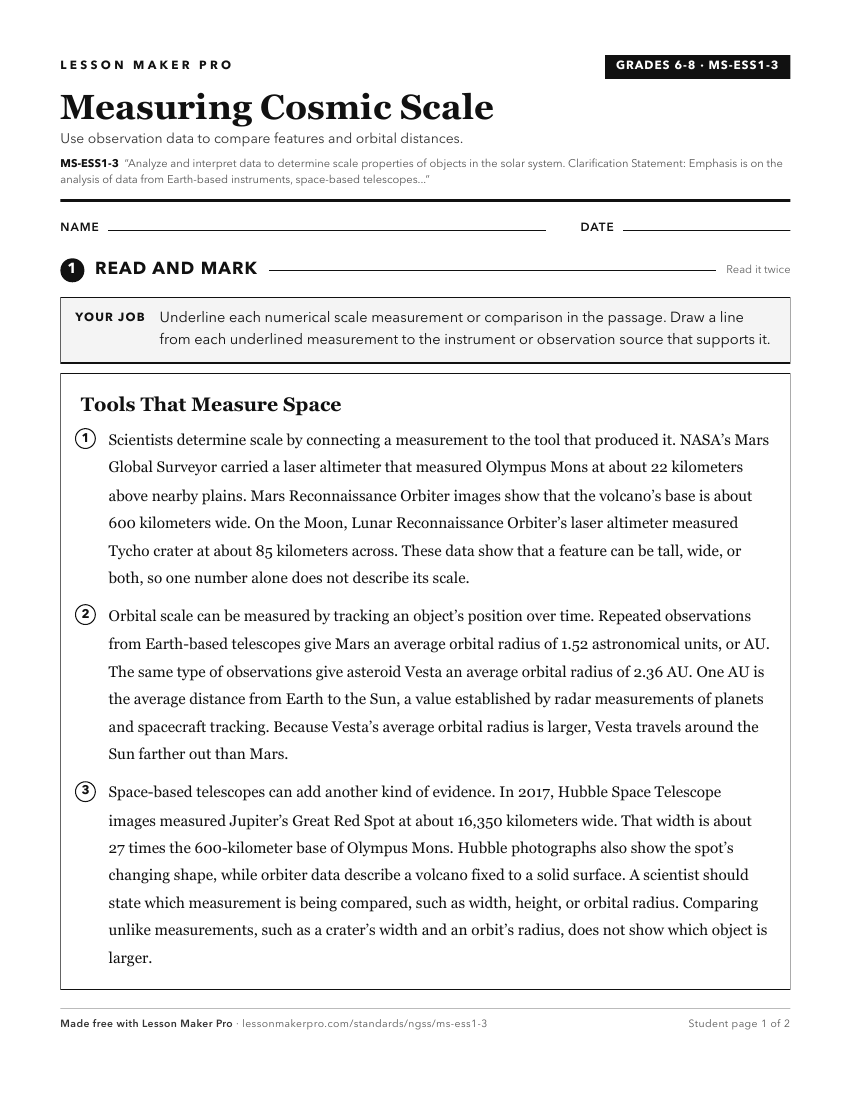
A ready-to-print activity worksheet aligned to MS-ESS1-3, with an answer key for the teacher on its own page. No account needed.
PDF, US Letter, prints cleanly in black and white.
Download the worksheetLearning progression
Where This Standard Sits
See the whole path on the Earth & Space Science progression map.
Before This Standard
If students are struggling here, check these first.
What This Unlocks
Mastery here sets students up for these next.
Keep exploring
Related Standards
Turn this exact standard into a lesson
Grade, subject, topic, and the complete standard are prefilled. Create one free, no account needed.
Also for this standard:Make a WorksheetMake a QuizMake a Sub Lesson