NGSS HS-PS2-1
The Standard
Analyze data to support the claim that Newton's second law of motion describes the mathematical relationship among the net force on a macroscopic object, its mass, and its acceleration.
Next Generation Science Standards
Teacher's field guide
What This Standard Means
What Students Need to Do
- Students use tables and motion graphs to find acceleration and compare it with an object's mass and net force. They analyze several trials and use the patterns to support a mathematical claim.
What Mastery Looks Like
- Students find acceleration from a velocity-time graph or data table and calculate missing force, mass, or acceleration values. They use results from several trials to explain how changing force or mass changes acceleration.
Common Misconceptions
- Students may use one applied force instead of the net force, or call constant speed an acceleration. They may assume heavier objects always accelerate faster or confuse the slope of a velocity-time graph with velocity.
How to Assess It
- Give students two cart trials with mass, net force, and velocity-time data. Ask them to find each acceleration and write one sentence explaining whether the data agree with their calculations.
Lesson moves
Ways to Teach It
Pull a dynamics cart with a hanging mass, record motion sensor data, and compare measured acceleration with the calculated value.
Show two velocity-time graphs and ask students to write which cart had greater net force and what evidence supports their claim.
Run a card sort matching force, mass, acceleration, and graph cards, then have pairs justify each completed set.
Use vehicle mass and acceleration data to estimate the net force needed for a loaded truck and an empty truck.
Free download
Printable HS-PS2-1 Worksheet
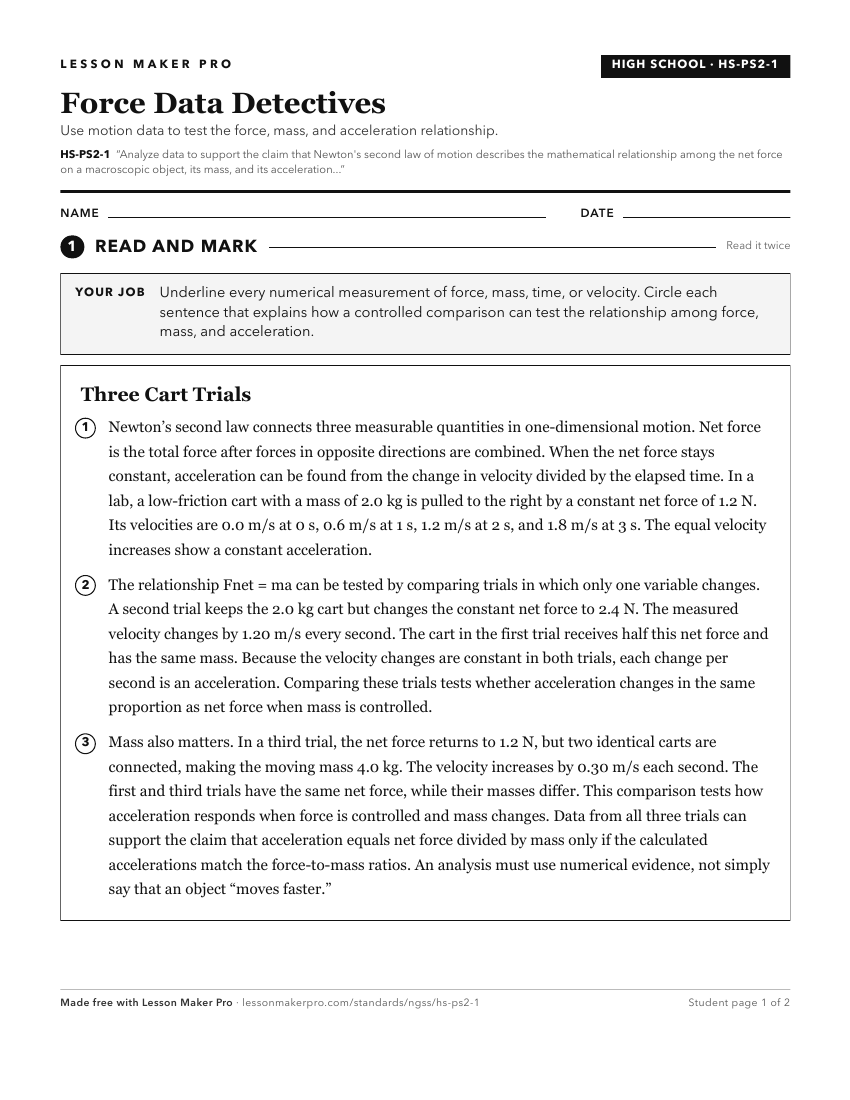
A ready-to-print activity worksheet aligned to HS-PS2-1, with an answer key for the teacher on its own page. No account needed.
PDF, US Letter, prints cleanly in black and white.
Download the worksheetLearning progression
Where This Standard Sits
See the whole path on the Physical Science progression map.
Before This Standard
If students are struggling here, check these first.
Keep exploring
Related Standards
- HS-PS2-4
Use mathematical representations of Newton's Law of Gravitation and Coulomb's Law to describe and predict the gravitational and electrostatic forces between obj...
- HS-PS2-2
Use mathematical representations to support the claim that the total momentum of a system of objects is conserved when there is no net force on the system.
Turn this exact standard into a lesson
Grade, subject, topic, and the complete standard are prefilled. Create one free, no account needed.
Also for this standard:Make a WorksheetMake a QuizMake a Sub Lesson