NGSS MS-PS3-2
The Standard
Develop a model to describe that when the arrangement of objects interacting at a distance changes, different amounts of potential energy are stored in the system.
Next Generation Science Standards
Teacher's field guide
What This Standard Means
What Students Need to Do
- Students build diagrams, pictures, or written models of two objects that interact through gravity, magnetism, or electric charge. They use the models to compare stored energy when distance, position, or orientation changes.
What Mastery Looks Like
- Students draw a clear two-object system and show how changing position or orientation changes stored energy. They compare relative amounts correctly without relying on formulas.
Common Misconceptions
- Students may think potential energy belongs to one object rather than to the two-object system. They may also assume closer always means more energy, ignoring the type of interaction and magnet orientation.
How to Assess It
- Give students drawings of a book on two different shelves. Ask them to circle the book-Earth system, rank stored energy, and explain their ranking with a labeled model.
Lesson moves
Ways to Teach It
Use two bar magnets and spacers to test how distance and pole orientation affect the push or pull, then sketch each setup.
Ask students to explain why a roller coaster cart has different stored energy at the top and bottom of the same hill.
Give pairs arrangement cards for books, magnets, and charged balloons, then have them sort and defend relative energy rankings.
Analyze a magnetic cabinet latch, drawing how the magnet and metal door arrangement changes as the door opens and closes.
Free download
Printable MS-PS3-2 Worksheet
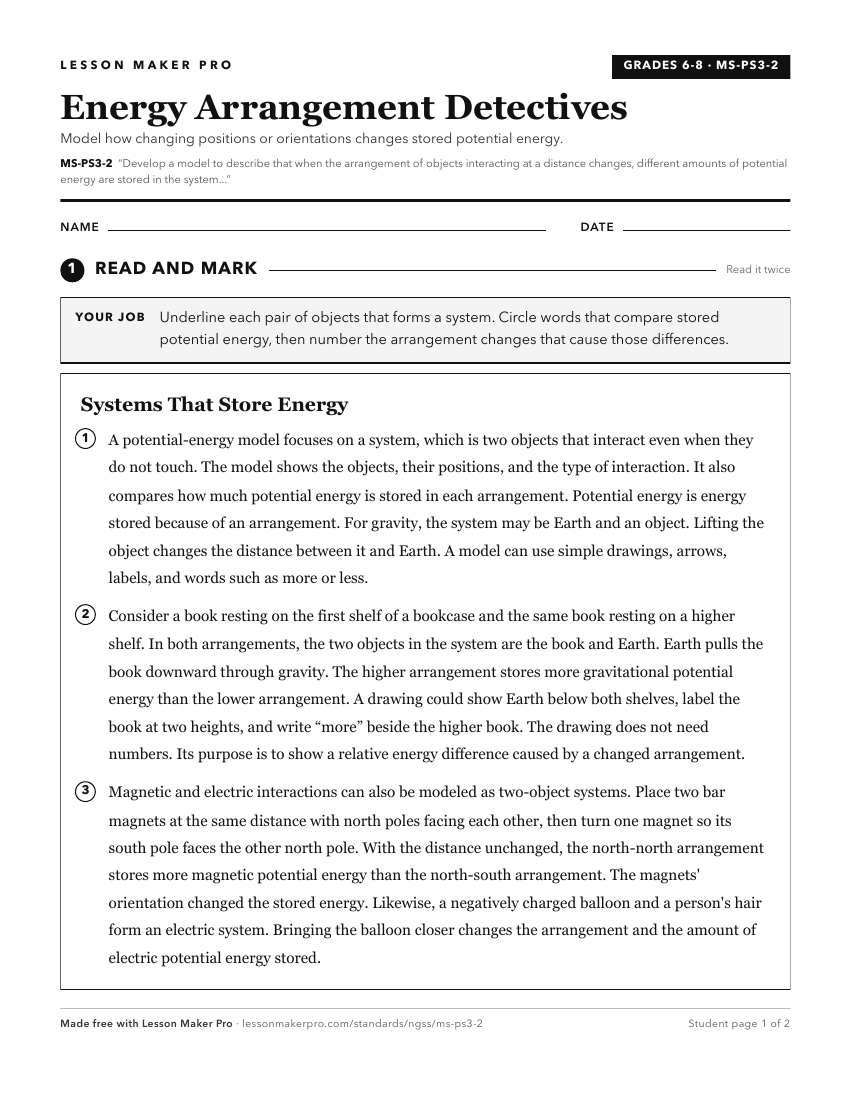
A ready-to-print activity worksheet aligned to MS-PS3-2, with an answer key for the teacher on its own page. No account needed.
PDF, US Letter, prints cleanly in black and white.
Download the worksheetLearning progression
Where This Standard Sits
See the whole path on the Physical Science progression map.
What This Unlocks
Mastery here sets students up for these next.
- HS-PS3-5
Students extend models of stored energy from object arrangements to electric and magnetic field interactions, forces, and energy changes.
- HS-PS3-3
Understanding stored potential energy helps students explain and optimize how devices convert energy from one form to another.
- HS-PS3-2
The middle school model of stored energy from object arrangement becomes the high school field-energy account at macroscopic scale.
- HS-PS3-1
Students carry forward tracking stored energy in interacting systems to calculate component energy changes from transfers and conservation.
Keep exploring
Related Standards
Turn this exact standard into a lesson
Grade, subject, topic, and the complete standard are prefilled. Create one free, no account needed.
Also for this standard:Make a WorksheetMake a QuizMake a Sub Lesson