NGSS HS-PS3-2
The Standard
Develop and use models to illustrate that energy at the macroscopic scale can be accounted for as either motions of particles or energy stored in fields.
Next Generation Science Standards
Teacher's field guide
What This Standard Means
What Students Need to Do
- Students build and interpret diagrams, written models, or simulations that track energy through a visible event. They connect organized particle motion to kinetic energy, random particle motion to thermal energy, and position or charge arrangements to field energy.
What Mastery Looks Like
- Given a falling ball, warming brake, or charged capacitor, students label the system and show where energy is before and after the change. Their model accounts for the energy and explains each transfer using particle motion or gravitational or electric fields.
Common Misconceptions
- Students may treat heat as a substance that objects contain, rather than linking thermal energy to random particle motion. They may place gravitational energy inside a raised object instead of in the interaction between the object and Earth. They may also assume charged plates contain energy separately, rather than modeling energy in the electric field between them.
How to Assess It
- Give this exit ticket: "A ball is released from a shelf, hits the floor, and rebounds to half its starting height. Draw a three-panel model showing gravitational field energy and organized and random particle motion. Explain why the rebound is lower."
Lesson moves
Ways to Teach It
Have pairs rub a wood block with sandpaper for 30 seconds, measure its surface temperature, and draw particle diagrams before and after.
Students write a claim answering, "Where is the energy of a book on a shelf stored?" and defend a field model involving Earth.
Teams match event cards, such as warm brakes and charged plates, to model cards showing particle motion or field energy.
Analyze a bicycle braking diagram and trace energy from the moving bicycle to random particle motion in the brake pads and wheel rim.
Free download
Printable HS-PS3-2 Worksheet
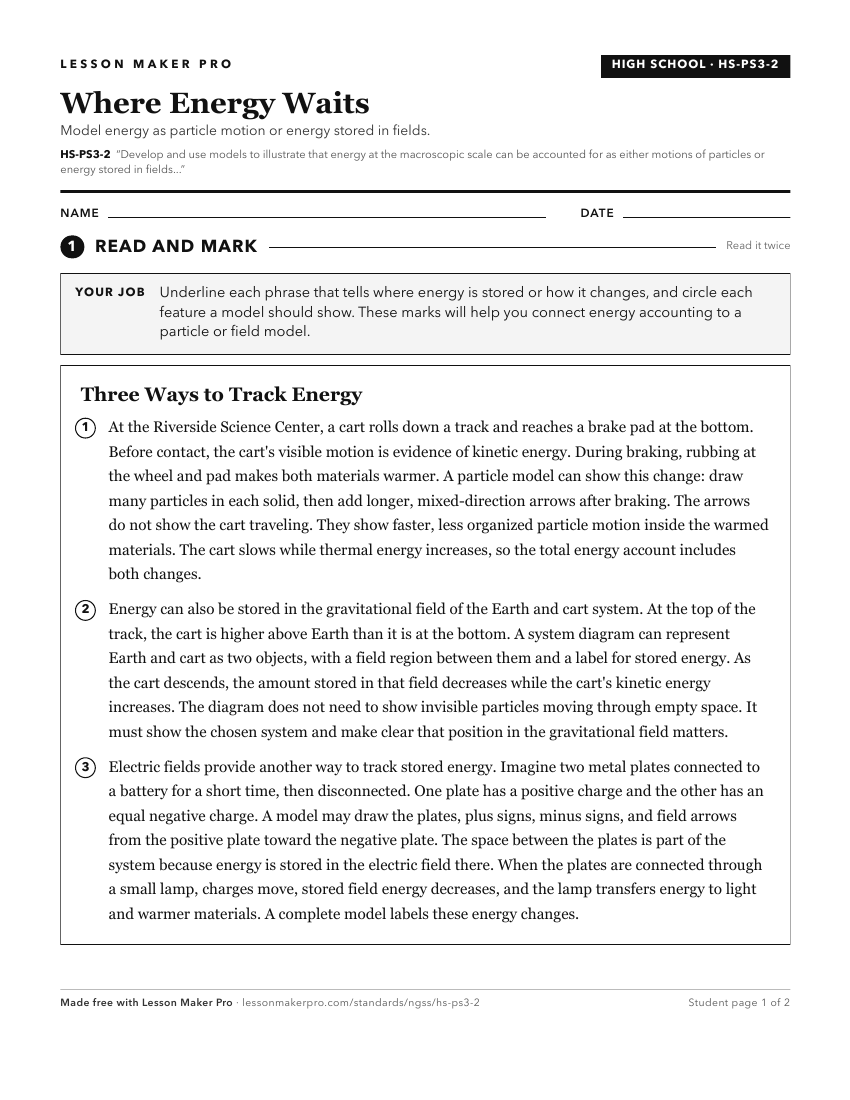
A ready-to-print activity worksheet aligned to HS-PS3-2, with an answer key for the teacher on its own page. No account needed.
PDF, US Letter, prints cleanly in black and white.
Download the worksheetLearning progression
Where This Standard Sits
See the whole path on the Physical Science progression map.
Before This Standard
If students are struggling here, check these first.
- MS-PS3-4
Students move from linking temperature change to particle motion to modeling macroscopic energy as particle motion or field storage.
- MS-PS3-3
Designing for thermal energy transfer gives concrete experience with energy movement that later supports particle-motion models of macroscopic energy.
- MS-PS3-1
Understanding kinetic energy as motion supports modeling macroscopic energy as particle motion and distinguishing it from field-stored energy.
- MS-PS3-2
The middle school model of stored energy from object arrangement becomes the high school field-energy account at macroscopic scale.
- MS-PS1-4
Middle school particle models for thermal energy step up to high school accounting of macroscopic energy as particle motion or fields.
Keep exploring
Related Standards
- 5-PS1-1
Develop a model to describe that matter is made of particles too small to be seen.
- MS-LS2-3
Develop a model to describe the cycling of matter and flow of energy among living and nonliving parts of an ecosystem.
- HS-PS3-5
Develop and use a model of two objects interacting through electric or magnetic fields to illustrate the forces between objects and the changes in energy of the...
Turn this exact standard into a lesson
Grade, subject, topic, and the complete standard are prefilled. Create one free, no account needed.
Also for this standard:Make a WorksheetMake a QuizMake a Sub Lesson