NGSS MS-PS3-4
The Standard
Plan an investigation to determine the relationships among the energy transferred, the type of matter, the mass, and the change in the average kinetic energy of the particles as measured by the temperature of the sample.
Next Generation Science Standards
Teacher's field guide
What This Standard Means
What Students Need to Do
- Students plan fair tests about heating and cooling. They choose variables, controls, measurements, and repeated trials. They use temperature change to track changes in average particle motion.
What Mastery Looks Like
- Students design a fair test that changes one factor and controls the others. They measure temperature change, organize repeated results, and use the pattern to explain effects of mass, material, or energy input.
Common Misconceptions
- Students often treat temperature as the total thermal energy in a sample. They may assume equal heating causes the same temperature change in every material or mass. They may also confuse particle speed with the speed of heating.
How to Assess It
- Give this exit ticket: “Plan a test comparing how 100 grams and 200 grams of water respond to equal heating. Name what you change, measure, and keep constant.”
Lesson moves
Ways to Teach It
Heat equal masses of water, sand, and oil under identical lamps, record temperatures each minute, and compare the changes.
Ask students to write why 100 grams of water and 200 grams of water warm differently after equal heating.
Run a variable-sort game using investigation cards labeled change, measure, control, and flaw.
Compare playground asphalt and a nearby puddle at noon, then connect their temperatures to material type and energy received.
Free download
Printable MS-PS3-4 Worksheet
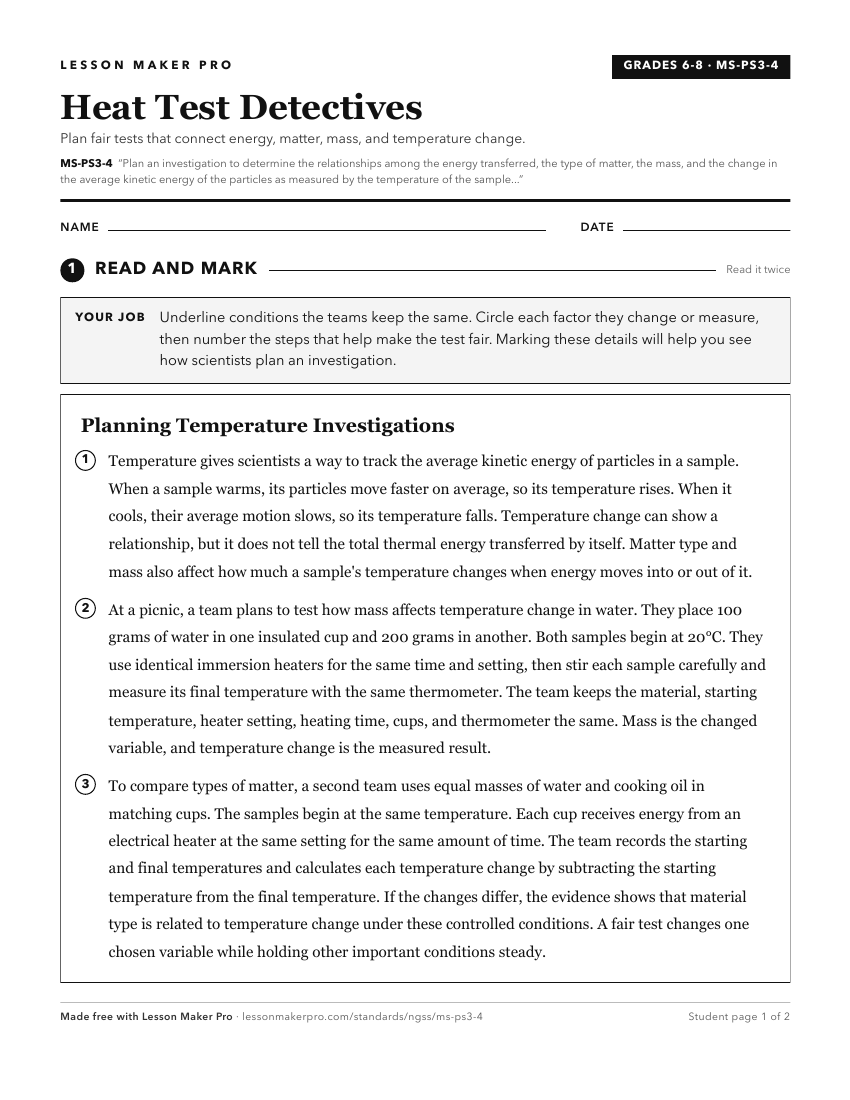
A ready-to-print activity worksheet aligned to MS-PS3-4, with an answer key for the teacher on its own page. No account needed.
PDF, US Letter, prints cleanly in black and white.
Download the worksheetLearning progression
Where This Standard Sits
See the whole path on the Physical Science progression map.
What This Unlocks
Mastery here sets students up for these next.
- HS-PS3-4
Understanding how mass, material, and temperature change affect thermal energy transfer supports investigating energy redistribution toward thermal equilibrium.
- HS-PS3-3
MS work connects energy transfer to matter, mass, and temperature, supporting HS choices when designing devices that convert energy forms.
- HS-PS3-2
Students move from linking temperature change to particle motion to modeling macroscopic energy as particle motion or field storage.
- HS-PS3-1
Middle school links temperature change to energy transfer, matter type, and mass, which supports high school energy accounting in systems.
Keep exploring
Related Standards
- MS-PS1-4
Develop a model that predicts and describes changes in particle motion, temperature, and state of a pure substance when thermal energy is added or removed.
- MS-PS2-2
Plan an investigation to provide evidence that the change in an object's motion depends on the sum of the forces on the object and the mass of the object.
- HS-PS1-5
Apply scientific principles and evidence to provide an explanation about the effects of changing the temperature or concentration of the reacting particles on t...
Turn this exact standard into a lesson
Grade, subject, topic, and the complete standard are prefilled. Create one free, no account needed.
Also for this standard:Make a WorksheetMake a QuizMake a Sub Lesson