NGSS HS-PS3-3
The Standard
Design, build, and refine a device that works within given constraints to convert one form of energy into another form of energy.
Next Generation Science Standards
Teacher's field guide
What This Standard Means
What Students Need to Do
- Students plan and build a device from supplied materials that changes energy from one form to another. They work within limits such as cost, materials, time, or renewable input. They measure total input and output, then revise one feature using test data.
What Mastery Looks Like
- A student can label the energy input, useful output, and energy transferred as heat or sound. The device meets stated limits and produces repeatable output. The student compares tests with the same input and uses results to justify a design change.
Common Misconceptions
- Students often say energy is created or used up, rather than transferred and transformed. They may ignore heat or sound, or confuse power with total energy. Some change several design features at once, so their data cannot show which change helped.
How to Assess It
- Give pairs a small motor, battery, spool, string, tape, and a 20 gram washer. In ten minutes, they must lift the washer, record height after five seconds, then make one evidence-based revision.
Lesson moves
Ways to Teach It
Build a foil-lined pizza box solar oven, measure water temperature every two minutes, then change one feature to improve heating.
Write a claim explaining which design change improved energy output, using input conditions and measured temperature data as evidence.
Run a card sort race matching devices to energy inputs, outputs, losses, and one realistic design constraint.
Evaluate a hand crank flashlight by counting crank turns and timing light output, then decide whether it belongs in an emergency kit.
Free download
Printable HS-PS3-3 Worksheet
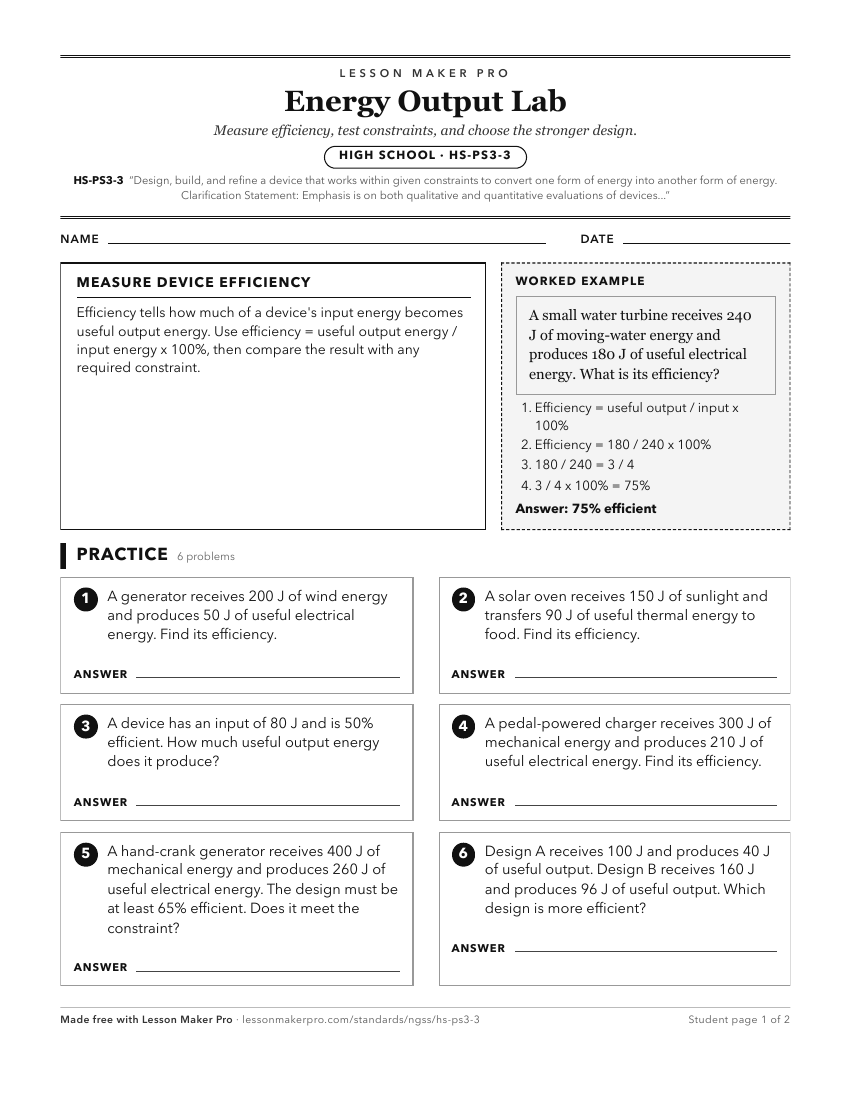
A ready-to-print activity worksheet aligned to HS-PS3-3, with an answer key for the teacher on its own page. No account needed.
PDF, US Letter, prints cleanly in black and white.
Download the worksheetLearning progression
Where This Standard Sits
See the whole path on the Physical Science progression map.
Before This Standard
If students are struggling here, check these first.
- MS-PS3-4
MS work connects energy transfer to matter, mass, and temperature, supporting HS choices when designing devices that convert energy forms.
- MS-PS3-3
Middle school thermal transfer device design supports high school energy conversion design through testing devices and optimizing energy performance under constraints.
- MS-PS3-2
Understanding stored potential energy helps students explain and optimize how devices convert energy from one form to another.
- MS-PS1-4
Understanding thermal energy, temperature, and particle motion supports reasoning about energy inputs, outputs, and losses in conversion devices.
- MS-PS3-1
Understanding kinetic energy depends on mass and speed helps students reason about energy forms and losses when refining conversion devices.
Keep exploring
Related Standards
- 1-PS4-4
Use tools and materials to design and build a device that uses light or sound to solve the problem of communicating over a distance.
- 4-PS3-4
Apply scientific ideas to design, test, and refine a device that converts energy from one form to another.
- MS-PS1-6
Undertake a design project to construct, test, and modify a device that either releases or absorbs thermal energy by chemical processes.
Turn this exact standard into a lesson
Grade, subject, topic, and the complete standard are prefilled. Create one free, no account needed.
Also for this standard:Make a WorksheetMake a QuizMake a Sub Lesson