NGSS MS-PS3-3
The Standard
Apply scientific principles to design, construct, and test a device that either minimizes or maximizes thermal energy transfer.
Next Generation Science Standards
Teacher's field guide
What This Standard Means
What Students Need to Do
- Students use ideas about conduction, convection, and radiation to plan and build a device that controls heating or cooling. They measure temperature changes, compare results, and improve the design.
What Mastery Looks Like
- Students build a device that meets a clear heating or cooling goal and test it against a comparison setup. They use temperature data to explain which design features worked and suggest a useful revision.
Common Misconceptions
- Students may think cold moves into an object, rather than thermal energy moving from warmer areas to cooler areas. They may also think insulation creates heat or completely stops energy transfer.
How to Assess It
- Give students this exit ticket: Sketch a container that keeps water warm, label two design features, and explain how each slows thermal energy transfer.
Lesson moves
Ways to Teach It
Build insulated cups from foil, cotton, paper, and bubble wrap, then compare water temperatures after ten minutes.
Ask students to explain whether a shiny metal lunch box or a foam lunch box would better keep food warm.
Run a material sorting game where teams classify classroom items as conductors, insulators, absorbers, or reflectors and defend each choice.
Inspect lunch bags or drink containers, then identify how their materials and shapes control thermal energy transfer.
Free download
Printable MS-PS3-3 Worksheet
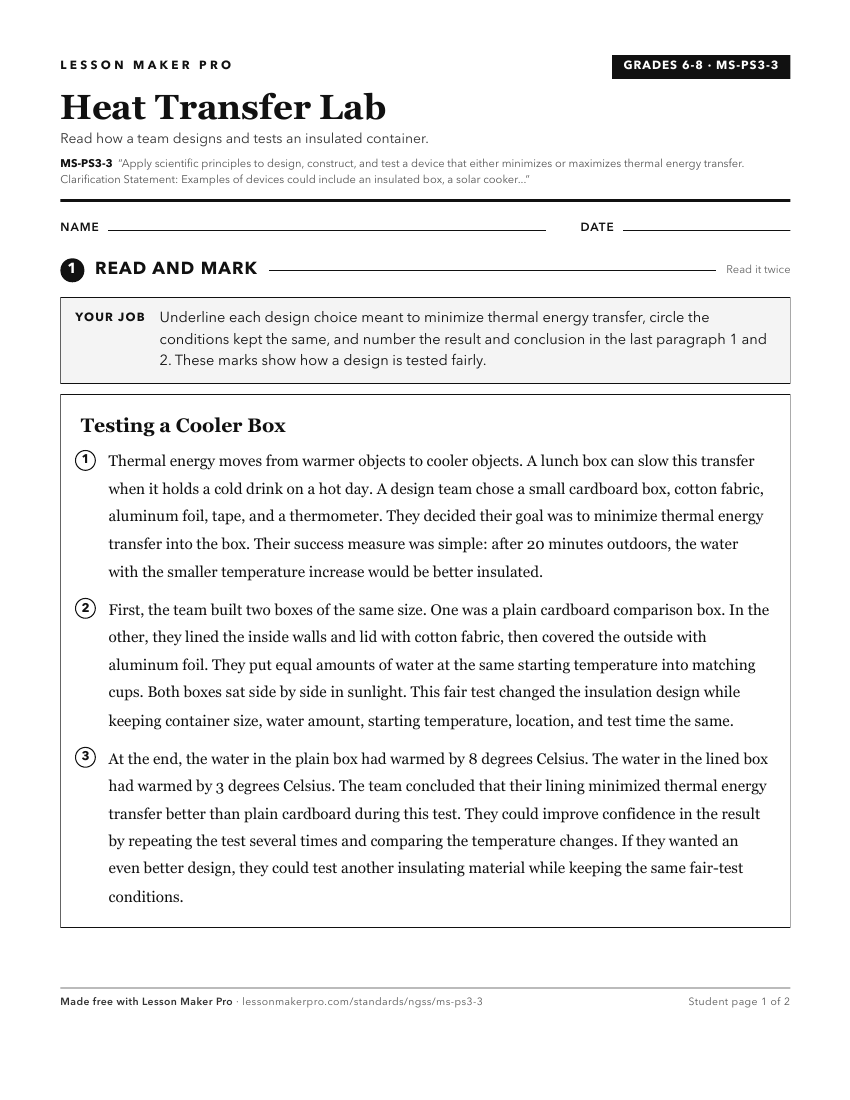
A ready-to-print activity worksheet aligned to MS-PS3-3, with an answer key for the teacher on its own page. No account needed.
PDF, US Letter, prints cleanly in black and white.
Download the worksheetLearning progression
Where This Standard Sits
See the whole path on the Physical Science progression map.
Before This Standard
If students are struggling here, check these first.
- 4-PS3-4
Designing and testing energy-conversion devices prepares students to optimize devices for controlling thermal energy transfer.
- 4-PS3-2
Students carry forward the idea that heat transfers energy, then apply it to control thermal transfer in a designed device.
- 4-PS3-3
Collision work introduces energy transfer and conversion, which supports later designing devices that control thermal energy transfer.
What This Unlocks
Mastery here sets students up for these next.
- HS-PS3-4
Designing devices to control heat transfer supports investigating how temperature differences drive energy toward a more uniform distribution.
- HS-PS3-3
Middle school thermal transfer device design supports high school energy conversion design through testing devices and optimizing energy performance under constraints.
- HS-PS3-2
Designing for thermal energy transfer gives concrete experience with energy movement that later supports particle-motion models of macroscopic energy.
- HS-PS3-1
Thermal transfer design experience supports tracking energy flows between system components before using calculations to model energy changes.
Keep exploring
Related Standards
- MS-PS1-6
Undertake a design project to construct, test, and modify a device that either releases or absorbs thermal energy by chemical processes.
- HS-PS2-3
Apply scientific and engineering ideas to design, evaluate, and refine a device that minimizes the force on a macroscopic object during a collision.
Turn this exact standard into a lesson
Grade, subject, topic, and the complete standard are prefilled. Create one free, no account needed.
Also for this standard:Make a WorksheetMake a QuizMake a Sub Lesson