NGSS HS-PS2-3
The Standard
Apply scientific and engineering ideas to design, evaluate, and refine a device that minimizes the force on a macroscopic object during a collision.
Next Generation Science Standards
Teacher's field guide
What This Standard Means
What Students Need to Do
- Students use ideas about momentum, stopping time, and force to design a device that protects an object in a collision. They test the device, judge its performance, and revise it using evidence.
What Mastery Looks Like
- Students build and test a device under controlled collision conditions. They use observations, measurements, and force-time reasoning to explain which design works better and how to improve it.
Common Misconceptions
- Students may think padding removes the force rather than increasing stopping time and reducing average force. They may also assume thicker padding always works better or confuse force with momentum.
How to Assess It
- Give this exit ticket: The same cart stops in 0.05 seconds with bumper A and 0.20 seconds with bumper B. Which bumper produces less average force, and by what factor?
Lesson moves
Ways to Teach It
Build a container from cups, straws, tape, and cotton that protects a raw egg during a one-meter drop.
Ask students to explain why bending their knees when landing reduces the average force on their bodies.
Run a card sort matching collision scenarios, stopping times, and relative average forces, then have teams justify each match.
Compare helmet test data and recommend one design for a cyclist, citing stopping time, force, and visible damage.
Free download
Printable HS-PS2-3 Worksheet
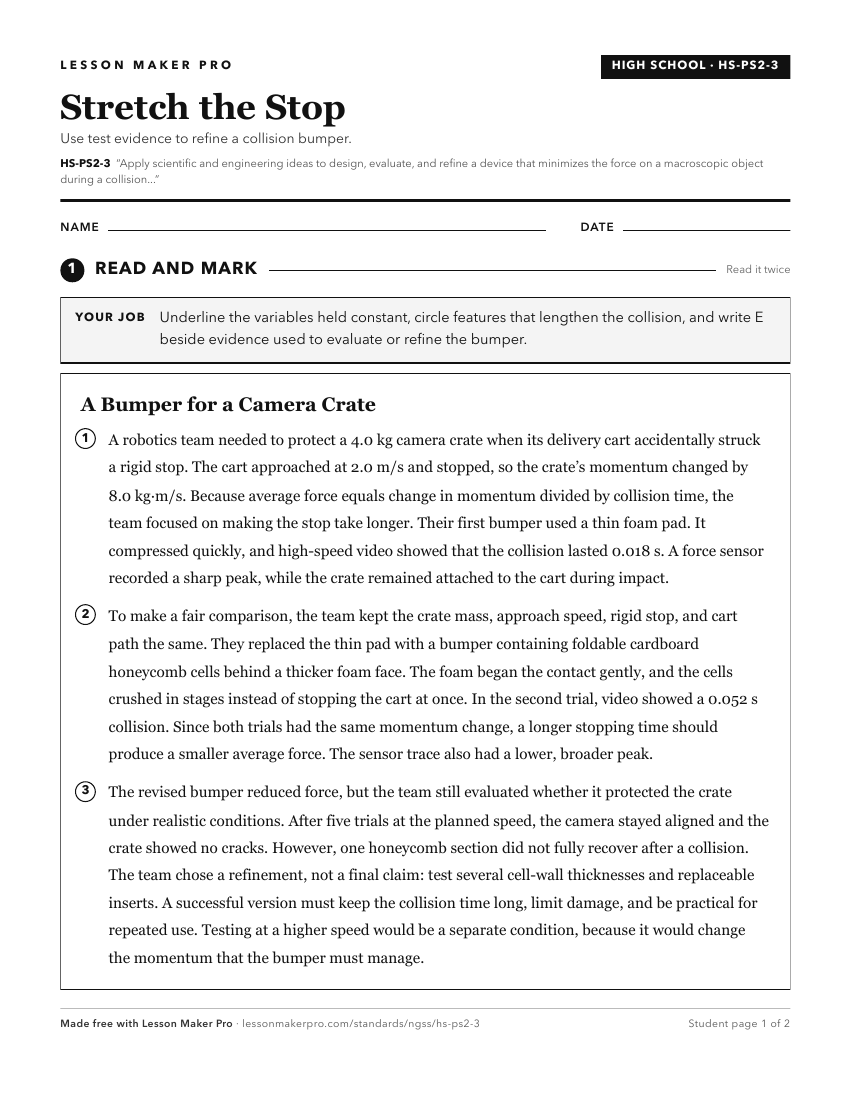
A ready-to-print activity worksheet aligned to HS-PS2-3, with an answer key for the teacher on its own page. No account needed.
PDF, US Letter, prints cleanly in black and white.
Download the worksheetLearning progression
Where This Standard Sits
See the whole path on the Physical Science progression map.
Before This Standard
If students are struggling here, check these first.
Keep exploring
Related Standards
- MS-ESS3-3
Apply scientific principles to design a method for monitoring and minimizing a human impact on the environment.
- MS-PS3-3
Apply scientific principles to design, construct, and test a device that either minimizes or maximizes thermal energy transfer.
- 4-PS3-4
Apply scientific ideas to design, test, and refine a device that converts energy from one form to another.
Turn this exact standard into a lesson
Grade, subject, topic, and the complete standard are prefilled. Create one free, no account needed.
Also for this standard:Make a WorksheetMake a QuizMake a Sub Lesson