NGSS MS-PS1-6
The Standard
Undertake a design project to construct, test, and modify a device that either releases or absorbs thermal energy by chemical processes.
Next Generation Science Standards
Teacher's field guide
What This Standard Means
What Students Need to Do
- Students design and build a simple hot or cold pack that uses dissolving substances to change temperature. They measure temperature over time, then modify the substance amount, concentration, or insulation to meet set criteria.
What Mastery Looks Like
- A student can build a pack that reaches a target temperature change for a set time. They collect accurate temperature and time data. They use those results to make and explain one useful design change.
Common Misconceptions
- Students may think insulation makes heat or cold rather than slowing energy transfer. They may treat temperature and thermal energy as the same, or assume more solute always gives a better result. Some change several variables at once, so they cannot connect results to one design choice.
How to Assess It
- Exit ticket: A cold pack cools water by 3°C for two minutes, but the goal is 6°C for five minutes. Name one design change and explain what measurements would show whether it worked.
Lesson moves
Ways to Teach It
Teams wear goggles and test double-sealed bags containing teacher-approved salts and water, then revise the best pack using temperature data.
Write a claim explaining whether changing solute amount or insulation would better meet a five-minute temperature target, using class data.
Play Design Swap: groups draw amount, concentration, and time cards, predict the result, then compare predictions with a data table.
Compare instant hand warmers and cold packs, then sketch a lunch-delivery pack that keeps food within a chosen temperature range.
Free download
Printable MS-PS1-6 Worksheet
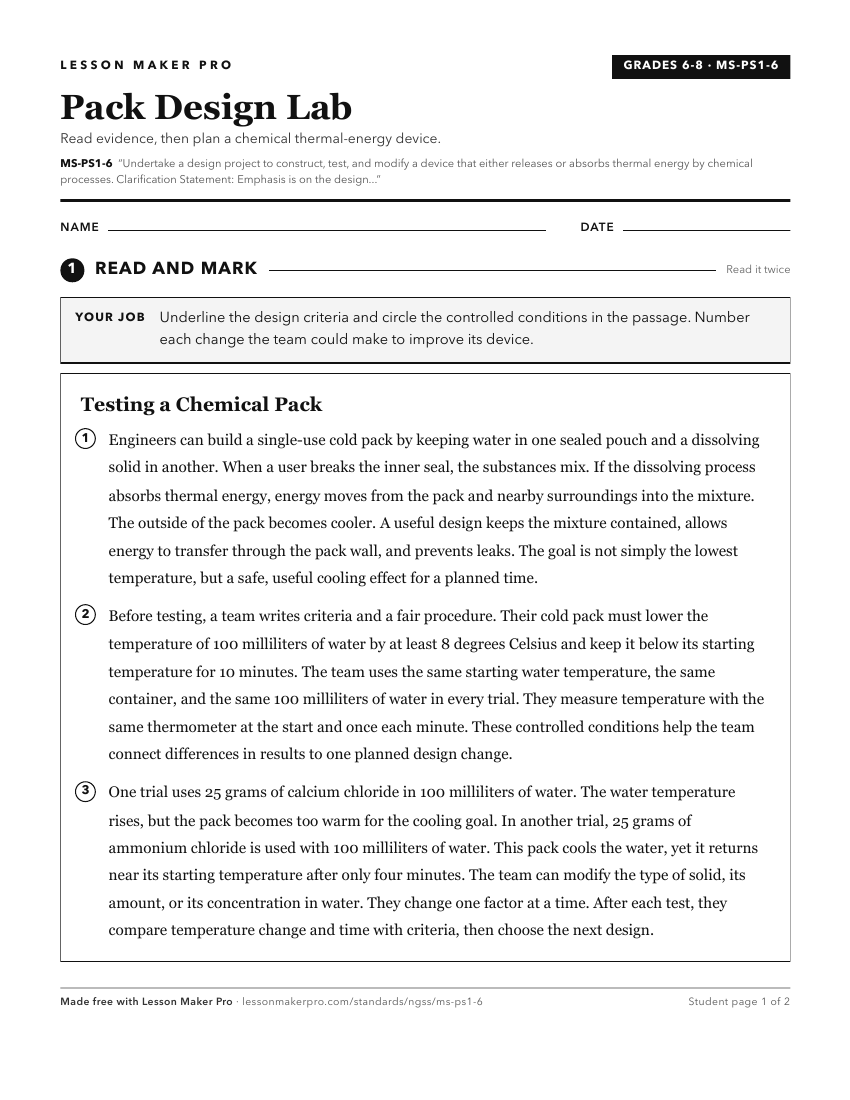
A ready-to-print activity worksheet aligned to MS-PS1-6, with an answer key for the teacher on its own page. No account needed.
PDF, US Letter, prints cleanly in black and white.
Download the worksheetLearning progression
Where This Standard Sits
See the whole path on the Physical Science progression map.
What This Unlocks
Mastery here sets students up for these next.
- HS-PS1-5
Experience with chemical processes that absorb or release heat supports explaining how temperature changes particle collisions and reaction rates.
- HS-PS1-7
Middle school work with chemical processes supports recognizing reactions as systems, but mass conservation math is a distinct high school step.
- HS-PS1-6
Designing and testing chemical systems carries over, while high school adds equilibrium conditions that shift product amounts.
- HS-PS1-4
Experience with reactions that release or absorb heat supports the HS shift to explaining energy changes through bond energies.
- HS-PS1-2
Middle school work with chemical processes and energy transfer supports later explanations of why reactions occur and produce specific outcomes.
Keep exploring
Related Standards
- MS-PS3-3
Apply scientific principles to design, construct, and test a device that either minimizes or maximizes thermal energy transfer.
- 4-PS3-4
Apply scientific ideas to design, test, and refine a device that converts energy from one form to another.
- HS-PS3-3
Design, build, and refine a device that works within given constraints to convert one form of energy into another form of energy.
Turn this exact standard into a lesson
Grade, subject, topic, and the complete standard are prefilled. Create one free, no account needed.
Also for this standard:Make a WorksheetMake a QuizMake a Sub Lesson