NGSS HS-PS3-4
The Standard
Plan and conduct an investigation to provide evidence that the transfer of thermal energy when two components of different temperature are combined within a closed system results in a more uniform energy distribution among the components in the system (second law of thermodynamics).
Next Generation Science Standards
Teacher's field guide
What This Standard Means
What Students Need to Do
- Plan and run a controlled test in an insulated container using two samples at different temperatures. Record mass and temperature over time. Use graphs and q = mcΔT calculations to show energy transfer and the approach to equilibrium.
What Mastery Looks Like
- A student writes a repeatable procedure with measured masses, starting temperatures, time intervals, and controls. They graph both temperatures as they approach one value. They calculate energy gained and lost, then explain small mismatches using measurement error or energy transfer outside the setup.
Common Misconceptions
- Students often say that cold moves into the warmer component. They may use a simple average even when masses or materials differ. They may think equilibrium means equal thermal energy rather than equal temperature and no net transfer.
How to Assess It
- Exit ticket: Mix 100 g of 80°C water with 200 g of 20°C water in an ideal insulated cup. Predict the final temperature, calculate each sample's energy change using q = mcΔT, and explain the result.
Lesson moves
Ways to Teach It
Mix warm and cool water in a lidded foam cup, recording both starting temperatures and the mixture temperature every 30 seconds.
Have students write: Why is the final temperature not always the average of the two starting temperatures?
Give teams data cards to match with graphs, energy calculations, and claims about which component gained or lost energy.
Compare coffee cooling in a ceramic mug and insulated mug, then explain which setup better limits energy transfer to the room.
Free download
Printable HS-PS3-4 Worksheet
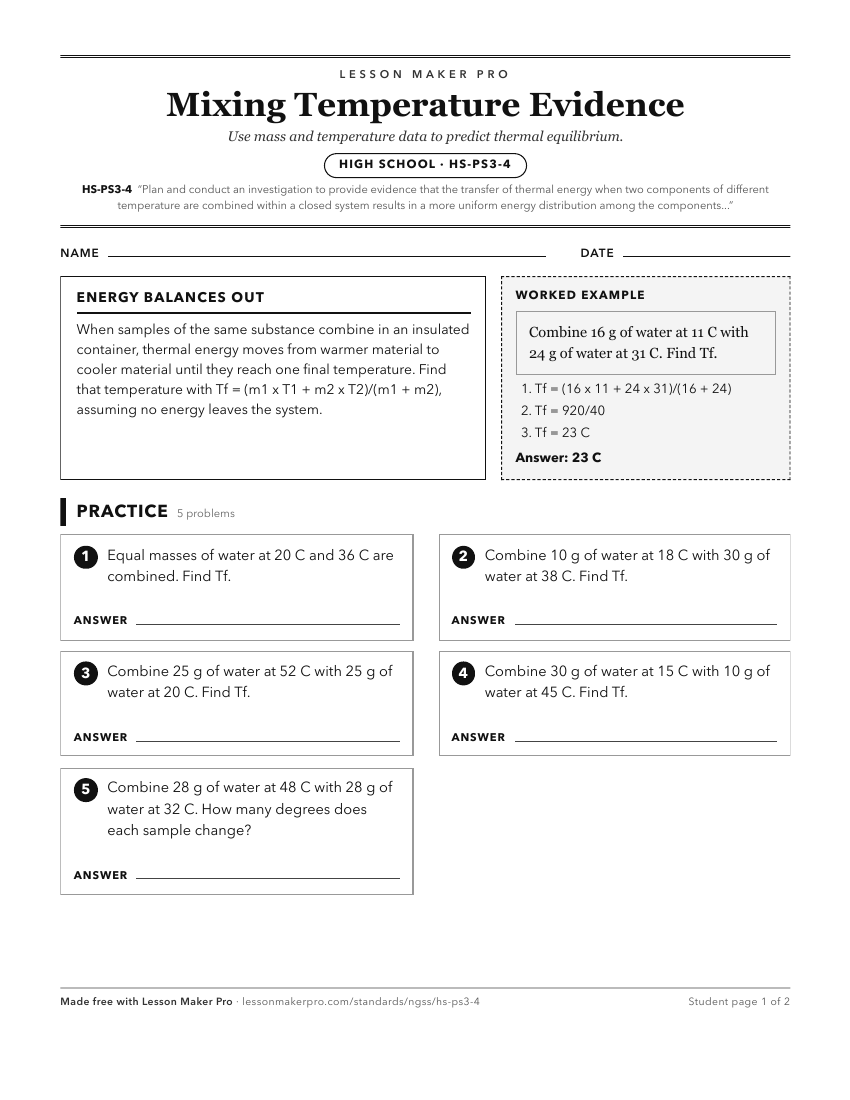
A ready-to-print activity worksheet aligned to HS-PS3-4, with an answer key for the teacher on its own page. No account needed.
PDF, US Letter, prints cleanly in black and white.
Download the worksheetLearning progression
Where This Standard Sits
See the whole path on the Physical Science progression map.
Before This Standard
If students are struggling here, check these first.
- MS-PS3-4
Understanding how mass, material, and temperature change affect thermal energy transfer supports investigating energy redistribution toward thermal equilibrium.
- MS-PS3-3
Designing devices to control heat transfer supports investigating how temperature differences drive energy toward a more uniform distribution.
- MS-PS3-5
Middle school energy transfer arguments support high school investigations of thermal energy moving toward uniform distribution in closed systems.
Keep exploring
Related Standards
- 5-PS1-2
Measure and graph quantities to provide evidence that regardless of the type of change that occurs when heating, cooling, or mixing substances, the total weight...
- 4-PS3-2
Make observations to provide evidence that energy can be transferred from place to place by sound, light, heat, and electric currents.
- HS-PS1-5
Apply scientific principles and evidence to provide an explanation about the effects of changing the temperature or concentration of the reacting particles on t...
Turn this exact standard into a lesson
Grade, subject, topic, and the complete standard are prefilled. Create one free, no account needed.
Also for this standard:Make a WorksheetMake a QuizMake a Sub Lesson