NGSS 5-PS1-2
The Standard
Measure and graph quantities to provide evidence that regardless of the type of change that occurs when heating, cooling, or mixing substances, the total weight of matter is conserved.
Next Generation Science Standards
Teacher's field guide
What This Standard Means
What Students Need to Do
- Students weigh a closed setup before and after melting, dissolving, or mixing. They graph the measurements and use the data to show that all matter stays accounted for.
What Mastery Looks Like
- A student uses a balance correctly, includes the container each time, and makes an accurate graph. They compare totals and explain small differences as measurement error or lost material.
Common Misconceptions
- Students may think dissolved solids disappear, melted ice weighs less, or bubbles have no weight. They may forget to include the container when weighing. Some treat small scale differences as proof that matter was created or destroyed.
How to Assess It
- Exit ticket: Three sealed bags weigh 120 g, 135 g, and 150 g before mixing, then the same amounts afterward. Draw a paired bar graph and write one sentence explaining what the data show.
Lesson moves
Ways to Teach It
Place salt in a paper cup inside a sealed bag of water, weigh it, tip to mix, reweigh, and graph both values.
Write a claim answering: Where did the ice go after melting, and what weight evidence supports your answer?
Match cards showing change scenarios, data tables, and graphs, then flag any pair suggesting a spill, leak, or weighing mistake.
Weigh a sealed frozen juice pouch, let it thaw, reweigh it, and connect the result to food shipping and storage.
Free download
Printable 5-PS1-2 Worksheet
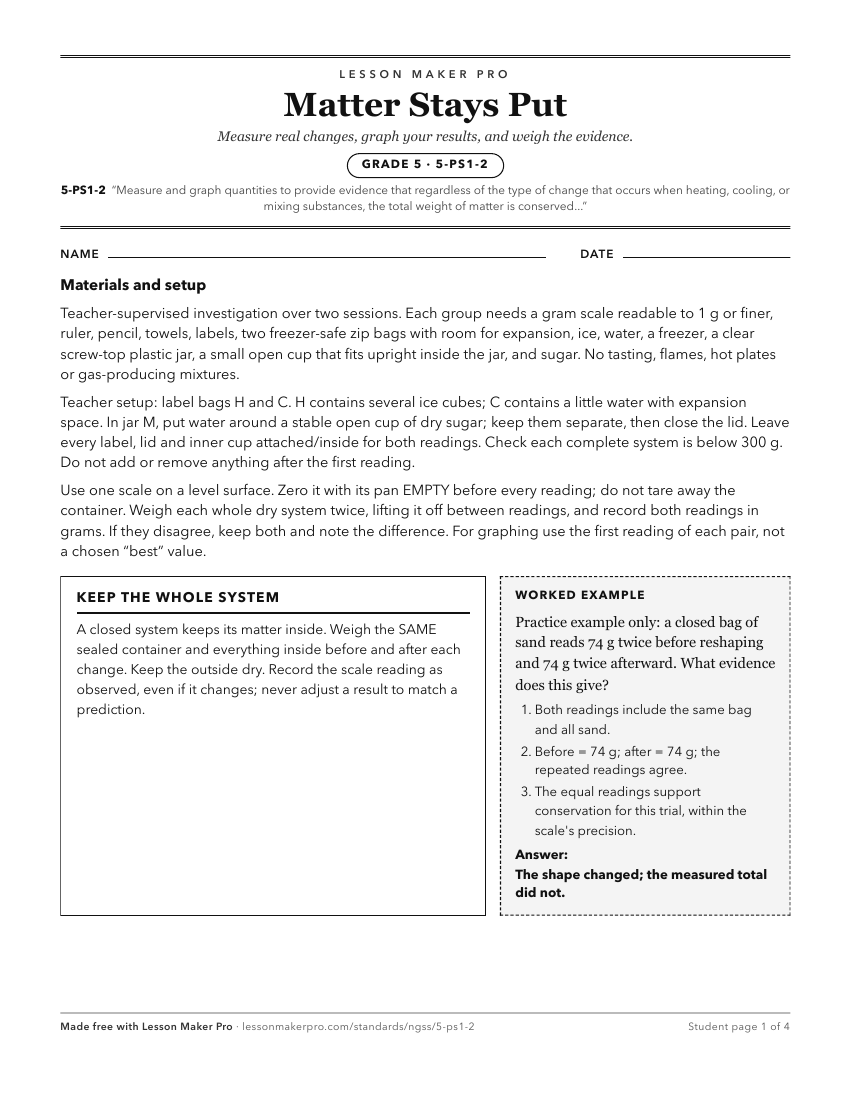
A ready-to-print activity worksheet aligned to 5-PS1-2, with an answer key for the teacher on its own page. No account needed.
PDF, US Letter, prints cleanly in black and white.
Download the worksheetLearning progression
Where This Standard Sits
See the whole path on the Physical Science progression map.
What This Unlocks
Mastery here sets students up for these next.
- MS-PS1-5
Students move from measured mass conservation during changes to modeling atom conservation as the explanation for mass conservation in reactions.
- MS-PS1-2
Measuring changes while conserving matter supports using before-and-after evidence to identify when substances become new substances.
- MS-PS1-1
Conservation of matter in observable changes prepares students to explain substances as particles that rearrange into molecules and structures.
Keep exploring
Related Standards
- HS-PS1-7
Use mathematical representations to support the claim that atoms, and therefore mass, are conserved during a chemical reaction.
- HS-PS2-2
Use mathematical representations to support the claim that the total momentum of a system of objects is conserved when there is no net force on the system.
- HS-PS3-4
Plan and conduct an investigation to provide evidence that the transfer of thermal energy when two components of different temperature are combined within a clo...
Turn this exact standard into a lesson
Grade, subject, topic, and the complete standard are prefilled. Create one free, no account needed.
Also for this standard:Make a WorksheetMake a QuizMake a Sub Lesson