NGSS HS-PS1-7
The Standard
Use mathematical representations to support the claim that atoms, and therefore mass, are conserved during a chemical reaction.
Next Generation Science Standards
Teacher's field guide
What This Standard Means
What Students Need to Do
- Students balance simple chemical equations and use coefficients, molar masses, and mole ratios to compare amounts before and after a reaction. They explain how matching atom counts leads to equal total mass.
What Mastery Looks Like
- Given a simple balanced equation and one reactant amount, students calculate a product amount with units and a clear mole-ratio setup. They verify equal atom counts and account for the total mass.
Common Misconceptions
- Students may change subscripts instead of coefficients when balancing equations. They may treat coefficients as gram ratios rather than mole ratios. They may think mass disappears when gas escapes an open container.
How to Assess It
- Exit ticket: For 2H₂ + O₂ → 2H₂O, list atom counts and calculate masses for 2.00 mol H₂, 1.00 mol O₂, and 2.00 mol H₂O. Show that the total masses agree.
Lesson moves
Ways to Teach It
Use colored beads to build 2H₂ + O₂, rearrange them into 2H₂O, and record atom counts before and after.
Ask students to write: How does a balanced equation connect particle counts, moles, and measured mass?
Run a card sort matching balanced equations, particle diagrams, mole ratios, and reactant-product mass tables.
Calculate the carbon dioxide produced by burning 16 g of methane, then trace each product atom to a reactant.
Free download
Printable HS-PS1-7 Worksheet
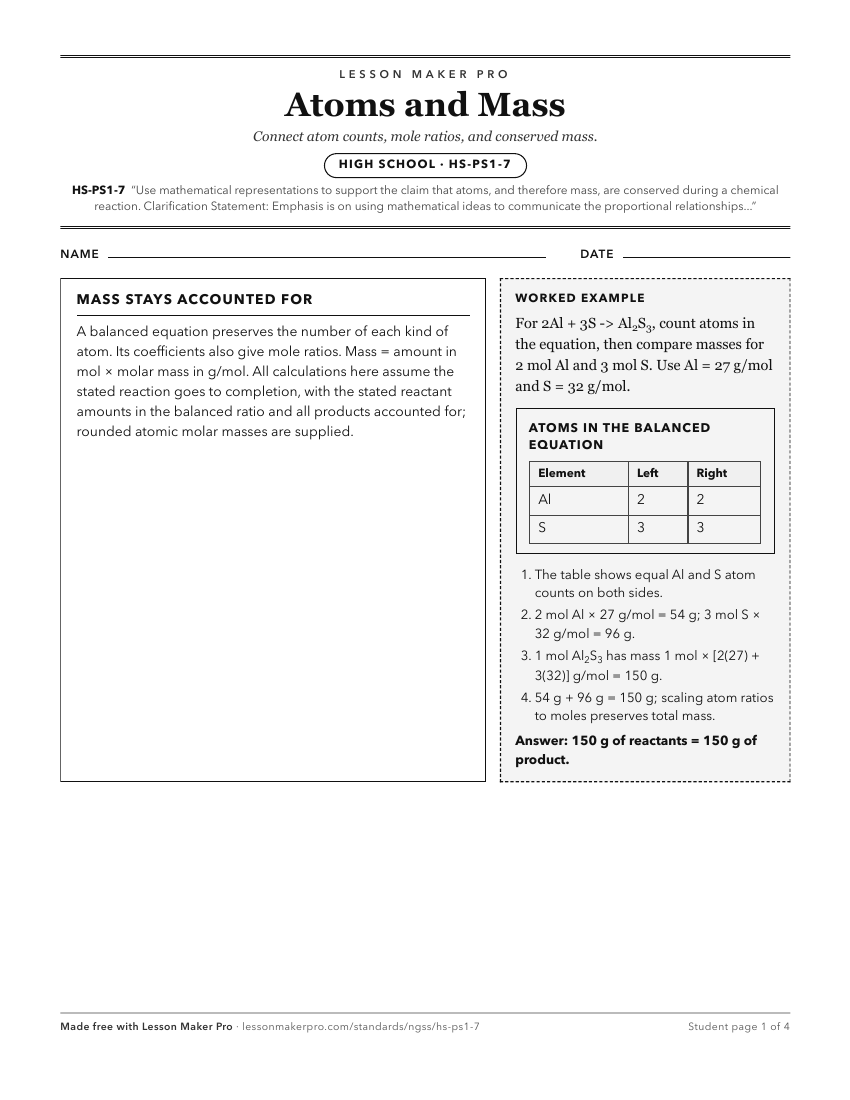
A ready-to-print activity worksheet aligned to HS-PS1-7, with an answer key for the teacher on its own page. No account needed.
PDF, US Letter, prints cleanly in black and white.
Download the worksheetLearning progression
Where This Standard Sits
See the whole path on the Physical Science progression map.
Before This Standard
If students are struggling here, check these first.
- MS-PS1-5
The high school math work depends on the middle school idea that reactions rearrange atoms without changing atom counts or mass.
- MS-PS1-3
Understanding that synthetic materials result from chemical transformations supports seeing reactions as rearrangements of matter before quantifying conserved mass.
- MS-PS1-6
Middle school work with chemical processes supports recognizing reactions as systems, but mass conservation math is a distinct high school step.
- MS-PS1-2
Identifying evidence of reactions prepares students to track reactants and products when using math to show mass conservation.
Keep exploring
Related Standards
- 5-PS1-2
Measure and graph quantities to provide evidence that regardless of the type of change that occurs when heating, cooling, or mixing substances, the total weight...
- HS-PS1-2
Construct and revise an explanation for the outcome of a simple chemical reaction based on the outermost electron states of atoms, trends in the periodic table,...
- HS-PS2-2
Use mathematical representations to support the claim that the total momentum of a system of objects is conserved when there is no net force on the system.
Turn this exact standard into a lesson
Grade, subject, topic, and the complete standard are prefilled. Create one free, no account needed.
Also for this standard:Make a WorksheetMake a QuizMake a Sub Lesson