NGSS HS-PS1-2
The Standard
Construct and revise an explanation for the outcome of a simple chemical reaction based on the outermost electron states of atoms, trends in the periodic table, and knowledge of the patterns of chemical properties.
Next Generation Science Standards
Teacher's field guide
What This Standard Means
What Students Need to Do
- Students use valence electron arrangements, periodic trends, and chemical property patterns to explain why simple reactions produce particular substances. They connect electron transfer or sharing to stable products. They revise explanations when evidence conflicts with their first model.
What Mastery Looks Like
- Given main-group reactants, students predict a reasonable product and support it with valence electrons and group trends. For hydrocarbon combustion, they predict carbon dioxide and water. They can correct an explanation that shows the wrong electron behavior.
Common Misconceptions
- Students often say atoms react because they want full shells, without describing electron transfer or sharing. They may use total electrons instead of valence electrons, ignore group trends, or treat combustion as melting or disappearance.
How to Assess It
- Exit ticket: Sodium reacts with chlorine to form sodium chloride. Use Lewis dot diagrams and periodic table groups to explain the product, then correct the claim, “Chlorine gives an electron to sodium.”
Lesson moves
Ways to Teach It
Give pairs paper models of sodium and chlorine atoms; students move electron tokens, build the product, and label the resulting charges.
Ask students to write and defend why magnesium oxide has a 1:1 ratio rather than a 1:2 ratio.
Run a card match with element cards, valence-electron diagrams, likely ions, and product formulas; teams justify each completed set.
Use a gas-stove flame photo and particle diagrams to explain why methane combustion forms carbon dioxide and water.
Free download
Printable HS-PS1-2 Worksheet
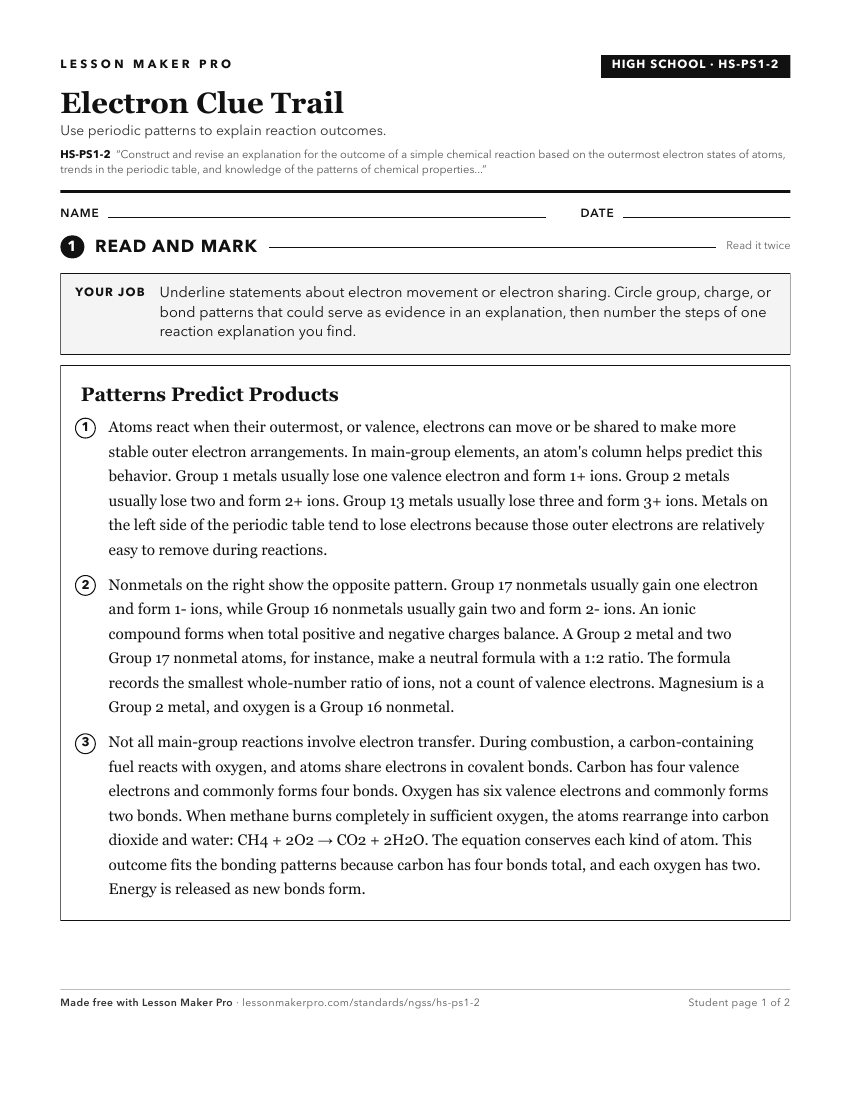
A ready-to-print activity worksheet aligned to HS-PS1-2, with an answer key for the teacher on its own page. No account needed.
PDF, US Letter, prints cleanly in black and white.
Download the worksheetLearning progression
Where This Standard Sits
See the whole path on the Physical Science progression map.
Before This Standard
If students are struggling here, check these first.
- MS-PS1-1
Understanding atoms as components of molecules and structures is needed to explain how electron states drive reaction products.
- MS-PS1-2
Students move from using property changes as evidence of reactions to explaining reaction outcomes with electron states and periodic trends.
- MS-PS1-4
Particle-level models of matter prepare students to explain reactions using smaller atomic features and property patterns.
- MS-PS1-6
Middle school work with chemical processes and energy transfer supports later explanations of why reactions occur and produce specific outcomes.
- MS-PS1-3
Knowing materials come from natural resources through chemical changes supports later explanations of how reactants form products with predictable properties.
- MS-PS1-5
Understanding reactions as rearrangements of conserved atoms supports HS explanations of products using valence electrons and periodic chemical patterns.
Keep exploring
Related Standards
- HS-PS1-1
Use the periodic table as a model to predict the relative properties of elements based on the patterns of electrons in the outermost energy level of atoms.
- HS-PS1-5
Apply scientific principles and evidence to provide an explanation about the effects of changing the temperature or concentration of the reacting particles on t...
Turn this exact standard into a lesson
Grade, subject, topic, and the complete standard are prefilled. Create one free, no account needed.
Also for this standard:Make a WorksheetMake a QuizMake a Sub Lesson