NGSS MS-PS1-2
The Standard
Analyze and interpret data on the properties of substances before and after the substances interact to determine if a chemical reaction has occurred.
Next Generation Science Standards
Teacher's field guide
What This Standard Means
What Students Need to Do
- Students compare measurements and recorded observations for materials before and after an interaction. They decide whether the final materials have different characteristic properties. They support the decision with specific data rather than appearance alone.
What Mastery Looks Like
- Students can read a table or graph and identify meaningful property differences between starting and final substances. They make a clear claim and support it with specific data, while separating chemical reactions from physical changes.
Common Misconceptions
- Students may treat melting, boiling, or dissolving as proof that a reaction occurred. They may rely on bubbles, temperature change, or appearance without comparing measurable properties. Some think every property must change when new substances form.
How to Assess It
- Give this exit ticket: “A white solid dissolves in water and melts at 80°C. After heating, the brown product is insoluble and does not melt at 80°C. Did a reaction occur? Cite two data points.”
Lesson moves
Ways to Teach It
Mix calcium chloride and sodium carbonate solutions, filter the solid, then compare its solubility with the starting solids.
Give students a before-and-after property table and ask, “Did new substances form? Support your claim with two measurements.”
Teams sort scenario cards into reaction or physical change, then earn points by citing property data that support each choice.
Analyze fire investigator data for a material and its burned remains, then explain how changed properties help identify a chemical reaction.
Free download
Printable MS-PS1-2 Worksheet
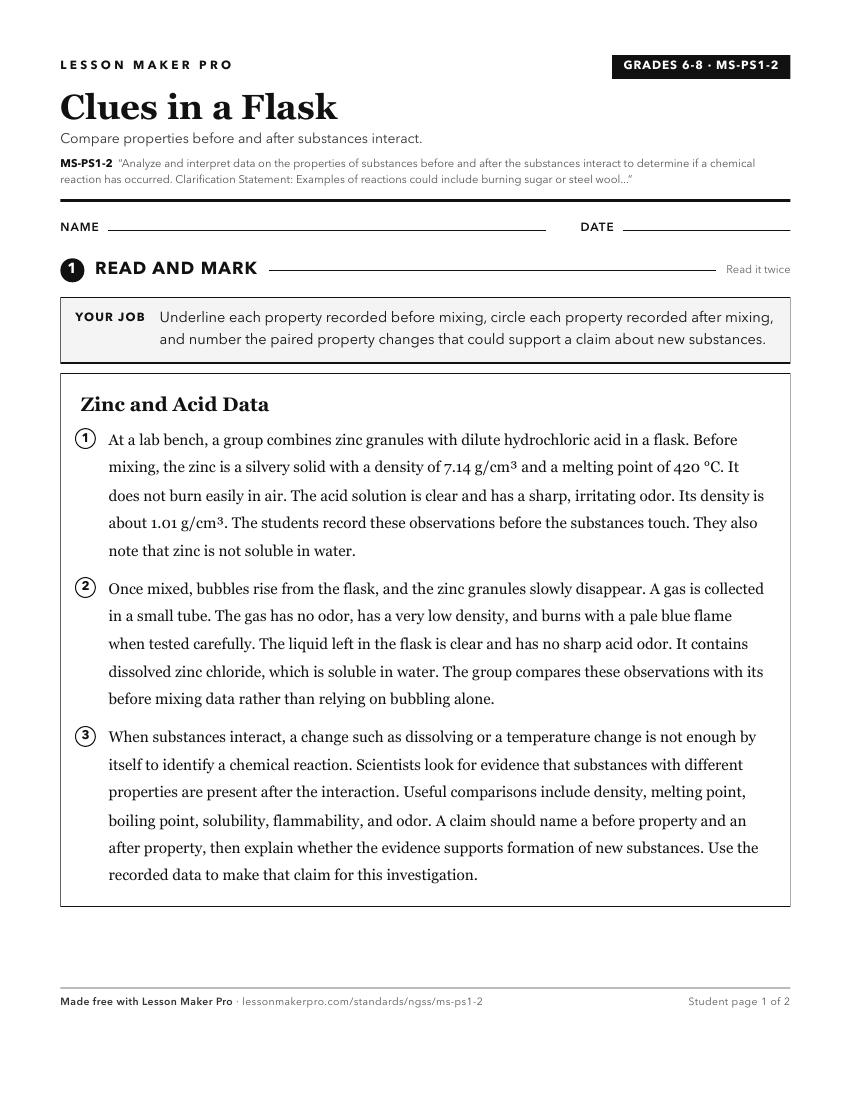
A ready-to-print activity worksheet aligned to MS-PS1-2, with an answer key for the teacher on its own page. No account needed.
PDF, US Letter, prints cleanly in black and white.
Download the worksheetLearning progression
Where This Standard Sits
See the whole path on the Physical Science progression map.
Before This Standard
If students are struggling here, check these first.
What This Unlocks
Mastery here sets students up for these next.
- HS-PS1-4
Identifying chemical reactions from before-and-after substance data supports later modeling of reactions as bond changes with energy release or absorption.
- HS-PS1-3
Students carry forward using substance properties as evidence, then connect those properties to particle structure and electrical forces.
- HS-PS1-2
Students move from using property changes as evidence of reactions to explaining reaction outcomes with electron states and periodic trends.
- HS-PS1-1
Interpreting substance properties and reaction evidence prepares students to connect observable properties to atomic structure and periodic patterns.
- HS-PS1-7
Identifying evidence of reactions prepares students to track reactants and products when using math to show mass conservation.
- HS-PS1-6
Recognizing reactants and products from substance data supports later reasoning about changing reaction conditions to favor products at equilibrium.
Keep exploring
Related Standards
Turn this exact standard into a lesson
Grade, subject, topic, and the complete standard are prefilled. Create one free, no account needed.
Also for this standard:Make a WorksheetMake a QuizMake a Sub Lesson