NGSS HS-PS1-5
The Standard
Apply scientific principles and evidence to provide an explanation about the effects of changing the temperature or concentration of the reacting particles on the rate at which a reaction occurs.
Next Generation Science Standards
Teacher's field guide
What This Standard Means
What Students Need to Do
- Students use temperature, concentration, and reaction-rate data to explain why one simple reaction proceeds faster than another. They connect rate changes to how often particles collide and whether collisions have enough energy.
What Mastery Looks Like
- Students compare trials where only temperature or concentration changes and identify which reaction is faster. They use data to explain that concentration increases collision frequency, while temperature increases collision frequency and the number of collisions with enough energy.
Common Misconceptions
- Students may think higher temperature creates more particles or that higher concentration makes each particle move faster. They may also assume every collision produces a reaction. Some describe faster reactions without connecting the data to collision frequency or energy.
How to Assess It
- Exit ticket: At 20°C, doubling reactant A raises the rate from 2 to 4 units per minute. Heating the concentrated trial to 40°C raises it to 9 units per minute. Explain both changes using particle collisions.
Lesson moves
Ways to Teach It
Time equal magnesium strips reacting with two hydrochloric acid concentrations, then graph the reaction times and compare collision frequency.
Ask students to explain why warming reactants can speed a reaction even when the number of particles stays the same.
Give groups temperature, concentration, and rate cards to match, then require a collision-based explanation for each set.
Compare refrigeration and room-temperature food storage, then connect slower spoilage reactions to lower particle energy and fewer successful collisions.
Free download
Printable HS-PS1-5 Worksheet
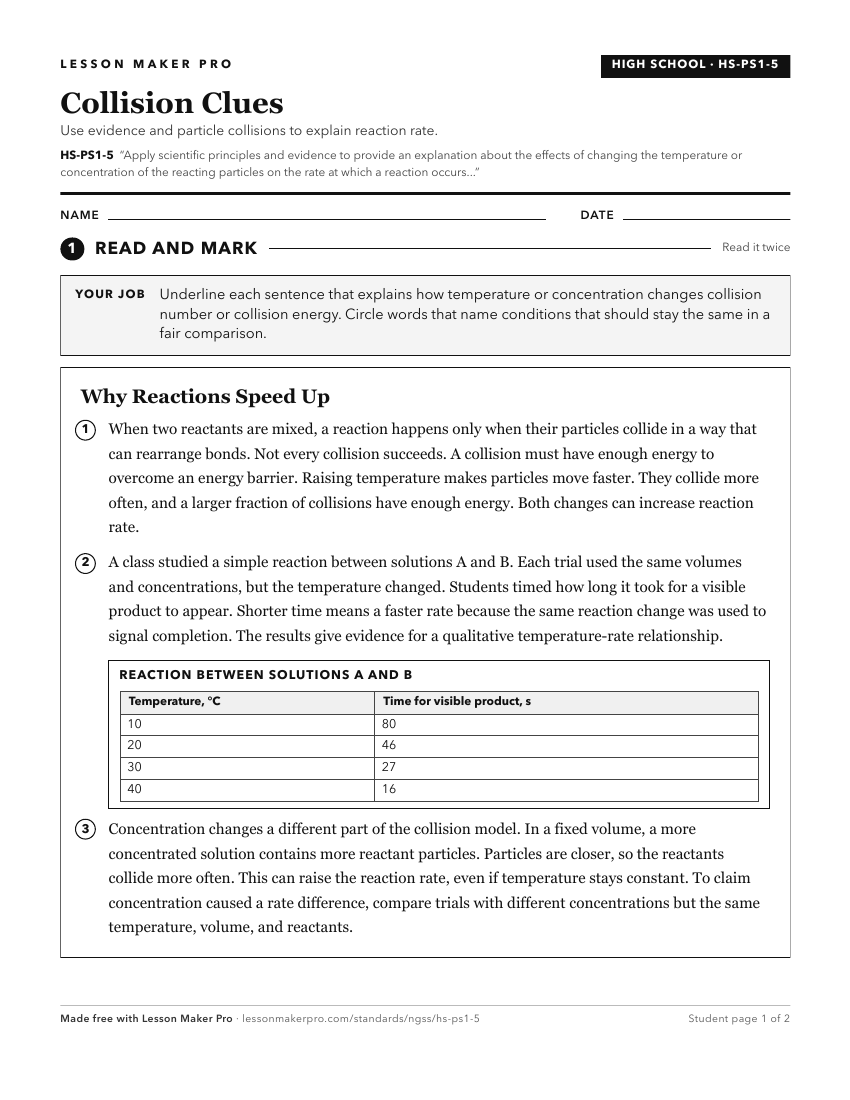
A ready-to-print activity worksheet aligned to HS-PS1-5, with an answer key for the teacher on its own page. No account needed.
PDF, US Letter, prints cleanly in black and white.
Download the worksheetLearning progression
Where This Standard Sits
See the whole path on the Physical Science progression map.
Before This Standard
If students are struggling here, check these first.
- MS-PS1-6
Experience with chemical processes that absorb or release heat supports explaining how temperature changes particle collisions and reaction rates.
- MS-PS1-3
Understanding synthetic materials as products of chemical reactions supports later explanations of how conditions change how fast reactions occur.
- MS-PS1-2
Recognizing evidence that substances reacted supports later explanations of how particle temperature and concentration change reaction speed.
- MS-PS1-5
Tracking atoms in reactions supports understanding reacting particles, which is needed before explaining how temperature and concentration change reaction rates.
Keep exploring
Related Standards
- HS-PS1-2
Construct and revise an explanation for the outcome of a simple chemical reaction based on the outermost electron states of atoms, trends in the periodic table,...
- MS-PS1-4
Develop a model that predicts and describes changes in particle motion, temperature, and state of a pure substance when thermal energy is added or removed.
- MS-PS3-4
Plan an investigation to determine the relationships among the energy transferred, the type of matter, the mass, and the change in the average kinetic energy of...
Turn this exact standard into a lesson
Grade, subject, topic, and the complete standard are prefilled. Create one free, no account needed.
Also for this standard:Make a WorksheetMake a QuizMake a Sub Lesson