NGSS 5-PS1-1
The Standard
Develop a model to describe that matter is made of particles too small to be seen. Clarification Statement: Examples of evidence could include adding air to expand a basketball, compressing air in a syringe, dissolving sugar in water, and evaporating salt water. Assessment Boundary: Assessment does not include the atomic-scale mechanism of evaporation and condensation or defining the unseen particles.
Next Generation Science Standards
Teacher's field guide
What This Standard Means
What Students Need to Do
- Students make drawings or physical models to explain observations involving air, dissolved substances, and evaporation. They show that unseen matter remains present even when it changes location or spacing.
What Mastery Looks Like
- Students create particle diagrams that explain compression, dissolving, or evaporation. Their models keep the matter present and use spacing or location to show observed changes.
Common Misconceptions
- Students may think dissolved sugar disappears or evaporated water stops existing. They may also draw particles shrinking during compression or believe air is empty space.
How to Assess It
- Give students a drawing of a sealed syringe before compression. Ask them to draw the compressed syringe and explain what changed and what stayed the same.
Adopted as
This framework is adopted as written in California, Connecticut, Delaware, District of Columbia, Hawaii, Illinois, Kansas, Maryland, Nevada, New Hampshire, New Mexico, Rhode Island, Vermont.
Lesson moves
Ways to Teach It
Seal air in a needleless syringe, press the plunger, and have students draw particle diagrams before and after compression.
Ask students to write: Where did the sugar go after it dissolved, and what evidence supports your answer?
Give groups compression, dissolving, and evaporation cards to match with particle diagrams, then require one spoken reason for each match.
Compare an inflated and deflated basketball, then have students explain how unseen air changes the ball's shape and firmness.
Free download
Printable 5-PS1-1 Worksheet
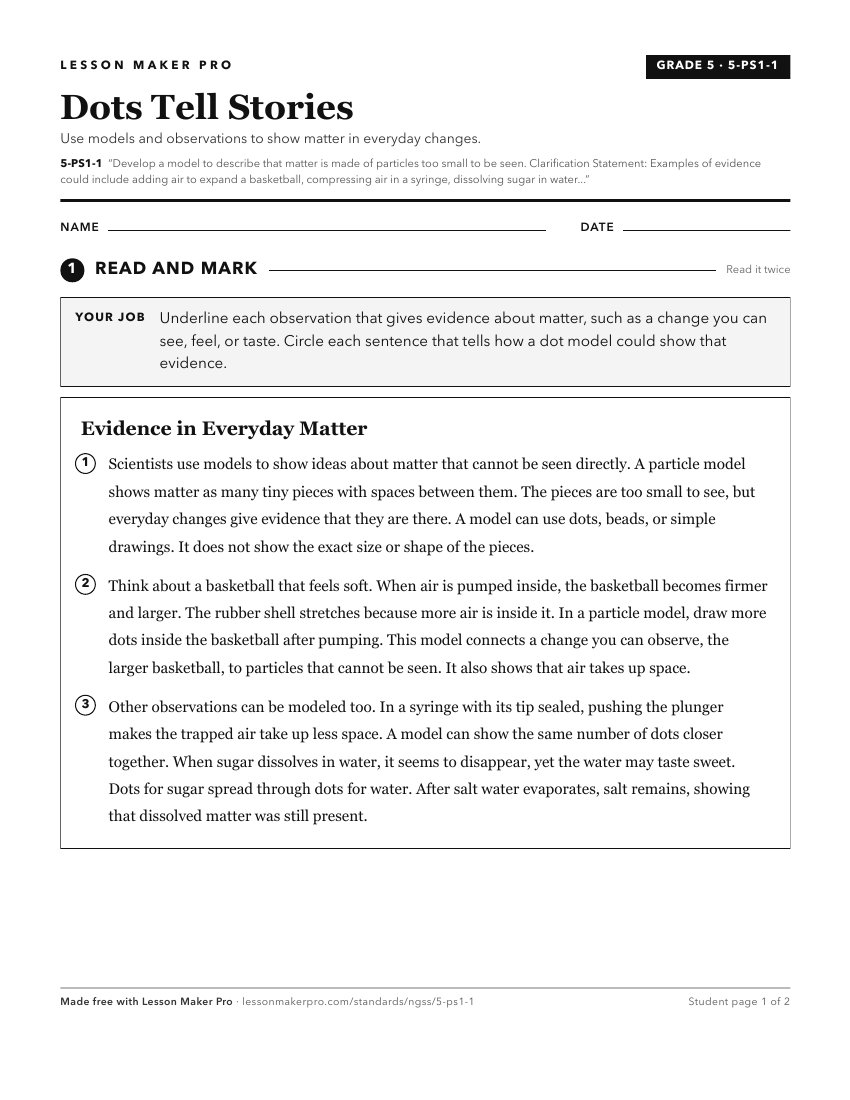
A ready-to-print activity worksheet aligned to 5-PS1-1, with an answer key for the teacher on its own page. No account needed.
PDF, US Letter, prints cleanly in black and white.
Download the worksheetLearning progression
Where This Standard Sits
See the whole path on the Physical Science progression map.
What This Unlocks
Mastery here sets students up for these next.
Keep exploring
Related Standards
- HS-PS3-2
Develop and use models to illustrate that energy at the macroscopic scale can be accounted for as a combination of energy associated with the motions of particl...
- MS-PS3-2
Develop a model to describe that when the arrangement of objects interacting at a distance changes, different amounts of potential energy are stored in the syst...
- MS-PS1-4
Develop a model that predicts and describes changes in particle motion, temperature, and state of a pure substance when thermal energy is added or removed.
- 5-LS2-1
Develop a model to describe the movement of matter among plants, animals, decomposers, and the environment.
Turn this exact standard into a lesson
Grade, subject, topic, and the complete standard are prefilled. Create one free, no account needed.
Also for this standard:Make a WorksheetMake a QuizMake a Sub Lesson