NGSS HS-PS1-6
The Standard
Refine the design of a chemical system by specifying a change in conditions that would produce increased amounts of products at equilibrium.
Next Generation Science Standards
Teacher's field guide
What This Standard Means
What Students Need to Do
- Students predict how changing concentration, pressure, or temperature affects a reversible reaction. They choose one change that increases product yield and explain the particle-level response.
What Mastery Looks Like
- Given a reversible reaction, students select one condition to change and correctly predict the shift. They explain how particles respond and why more product forms.
Common Misconceptions
- Students often think equilibrium means equal amounts of reactants and products. They may also think catalysts shift equilibrium, or that pressure changes affect reactions without gases.
How to Assess It
- Exit ticket: For N₂ + 3H₂ ⇌ 2NH₃ + heat, name one condition change that increases NH₃ and explain why at the particle level.
Lesson moves
Ways to Teach It
Use colored beads in cups to model equilibrium, then remove product beads and repeat exchange rounds to track product formation.
Ask students to explain in writing why removing ammonia causes a system to make more ammonia.
Give teams condition cards to sort under shifts left, shifts right, or no shift for several reversible equations.
Have students recommend one change to improve ammonia yield in the Haber process, then explain the production tradeoff.
Free download
Printable HS-PS1-6 Worksheet
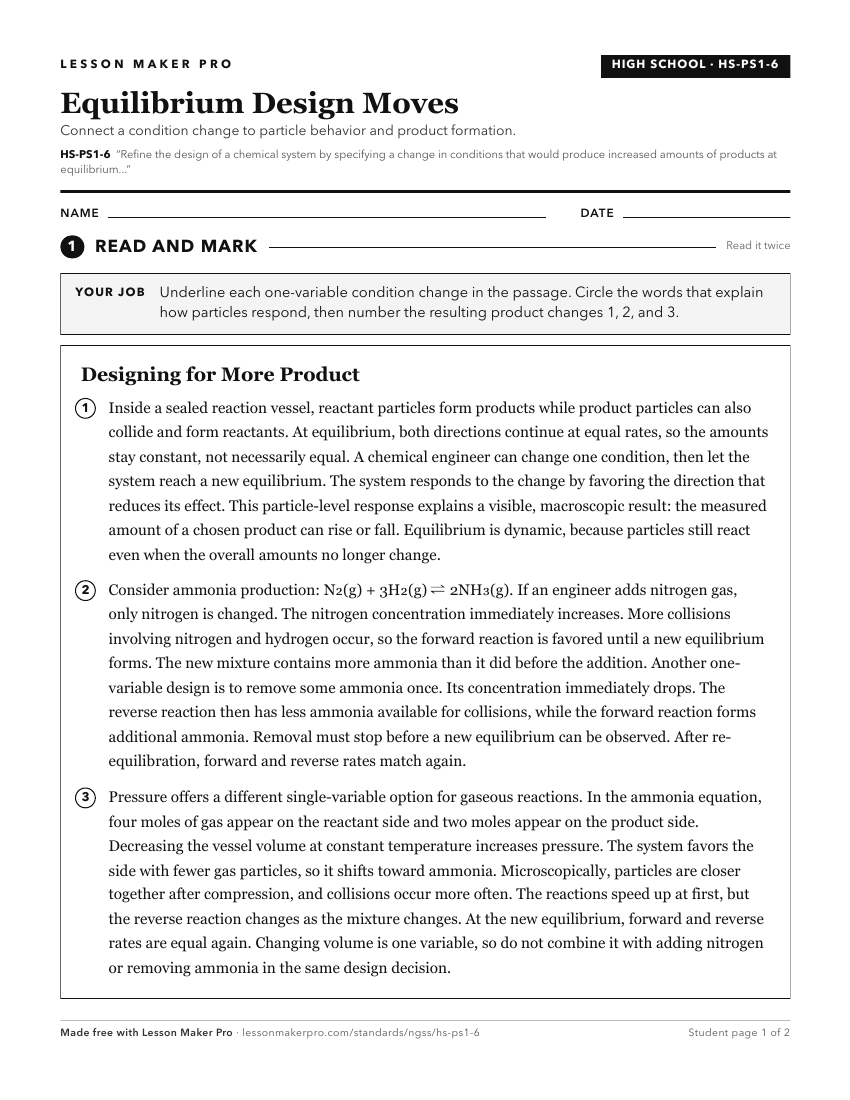
A ready-to-print activity worksheet aligned to HS-PS1-6, with an answer key for the teacher on its own page. No account needed.
PDF, US Letter, prints cleanly in black and white.
Download the worksheetLearning progression
Where This Standard Sits
See the whole path on the Physical Science progression map.
Before This Standard
If students are struggling here, check these first.
- MS-PS1-5
Conservation of atoms and mass supports reaction thinking, but equilibrium optimization adds reversible reactions and condition effects.
- MS-PS1-6
Designing and testing chemical systems carries over, while high school adds equilibrium conditions that shift product amounts.
- MS-PS1-2
Recognizing reactants and products from substance data supports later reasoning about changing reaction conditions to favor products at equilibrium.
- MS-PS1-3
Understanding that reactions transform natural resources into useful products supports later design choices to increase desired chemical products.
Keep exploring
Related Standards
- MS-LS1-7
Develop a model to describe how food is rearranged through chemical reactions forming new molecules that support growth and/or release energy as this matter mov...
- HS-PS1-2
Construct and revise an explanation for the outcome of a simple chemical reaction based on the outermost electron states of atoms, trends in the periodic table,...
- HS-PS1-5
Apply scientific principles and evidence to provide an explanation about the effects of changing the temperature or concentration of the reacting particles on t...
Turn this exact standard into a lesson
Grade, subject, topic, and the complete standard are prefilled. Create one free, no account needed.
Also for this standard:Make a WorksheetMake a QuizMake a Sub Lesson