Georgia S8P4
Georgia Standard (Element Cluster)
Obtain, evaluate, and communicate information to support the claim that electromagnetic (light) waves behave differently than mechanical (sound) waves.
Georgia Standards of Excellence for Science
Cluster contents
Elements in This Standard
S8P4 is a Georgia science standard. These are the elements under it.
- S8P4.a
Ask questions to develop explanations about the similarities and differences between electromagnetic and mechanical waves.
- S8P4.b
Construct an explanation using data to illustrate the relationship between the electromagnetic spectrum and energy.
- S8P4.c
Design a device to illustrate practical applications of the electromagnetic spectrum (e.g., communication, medical, military).
- S8P4.d
Develop and use a model to compare and contrast how light and sound waves are reflected, refracted, absorbed, diffracted or transmitted through various material...
- S8P4.e
Analyze and interpret data to predict patterns in the relationship between density of media and wave behavior (i.e., speed).
- S8P4.f
Develop and use a model (e.g., simulations, graphs, illustrations) to predict and describe the relationships between wave properties (e.g., frequency, amplitude...
- S8P4.g
Develop and use models to demonstrate the effects that lenses have on light (i.e., formation an image) and their possible technological applications.
Teacher's field guide
What This Cluster Means
What Students Need to Do
- Students compare how light and sound travel, including whether each needs matter and how each transfers energy. They select reliable evidence and use it to explain the differences.
What Mastery Looks Like
- Students explain that sound needs a medium, while light can travel through empty space. They support the explanation with accurate observations, models, or source evidence.
Common Misconceptions
- Students may think sound travels through space or that light needs air. They may also think louder sounds or brighter lights travel faster.
How to Assess It
- Give students this exit prompt: “Why can astronauts see a spacecraft but not hear its engine in space?” Require a claim and two supporting facts.
Lesson moves
Ways to Teach It
Use a rope and a coiled spring to model transverse light waves and longitudinal sound waves, then compare particle motion.
Ask students to write which wave could carry a message across empty space and support their answer with two facts.
Run a card sort with examples, properties, and diagrams labeled light, sound, both, or neither.
Analyze why spacecraft use radio signals instead of voices to communicate, then explain how radio waves cross space.
Free download
Printable S8P4 Worksheet
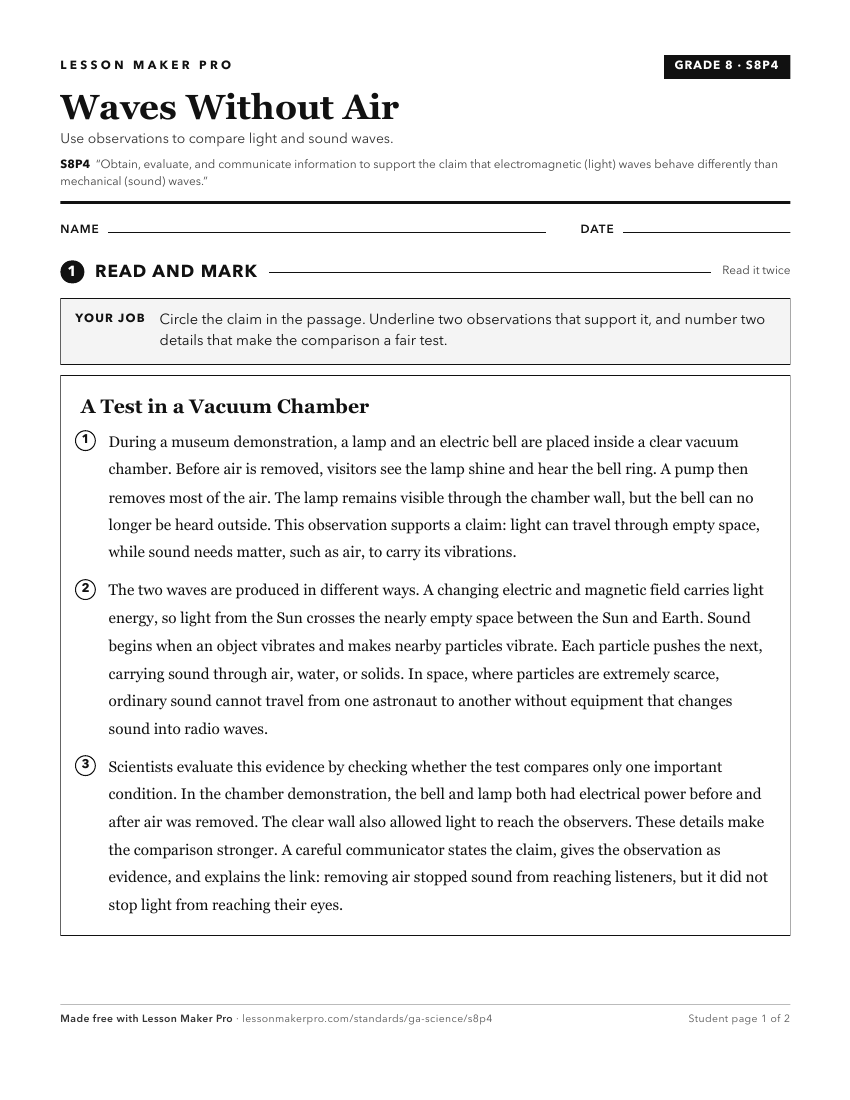
A ready-to-print activity worksheet aligned to S8P4, with an answer key for the teacher on its own page. No account needed.
PDF, US Letter, prints cleanly in black and white.
Download the worksheetKeep exploring
Related Standards
Turn this cluster into a lesson
Grade, subject, topic, and the complete cluster are prefilled. Create one free, no account needed.
Also for this cluster:Make a WorksheetMake a QuizMake a Sub Lesson