Georgia S8P4.d
The Standard
- S8P4
- Obtain, evaluate, and communicate information to support the claim that electromagnetic (light) waves behave differently than mechanical (sound) waves.
Develop and use a model to compare and contrast how light and sound waves are reflected, refracted, absorbed, diffracted or transmitted through various materials.
Georgia Standards of Excellence for Science · Obtain, evaluate, and communicate information to support the claim that electromagnetic (light) waves behave differently than mechanical (sound) waves.
Teacher's field guide
What This Standard Means
What Students Need to Do
- Students create diagrams or physical models showing what happens when light and sound meet different materials. They compare reflection, refraction, absorption, diffraction, and transmission for both wave types.
What Mastery Looks Like
- A student can predict how light or sound will behave when it meets a named material or opening. They can label a model and explain similarities and differences using evidence from observations.
Common Misconceptions
- Some students think both light and sound can travel through empty space. They may call any bending refraction, even when sound spreads around a doorway through diffraction. They may treat absorption as disappearance rather than energy transfer.
How to Assess It
- Exit ticket: Draw and label what happens when light meets a glass window and sound meets a partly open door. Identify two interactions for each and explain one difference.
Lesson moves
Ways to Teach It
Use a flashlight with water, foil, and clear plastic, then test a phone tone with foam and a doorway; sketch each result.
Write a response to: Why can you hear someone around a corner but not see that person?
Sort cards showing echoes, bent straws, curtains, sound around corners, and windows into reflection, refraction, absorption, diffraction, or transmission.
Inspect a classroom window and acoustic ceiling tile, then explain which light or sound behavior each design uses.
Free download
Printable S8P4.d Worksheet
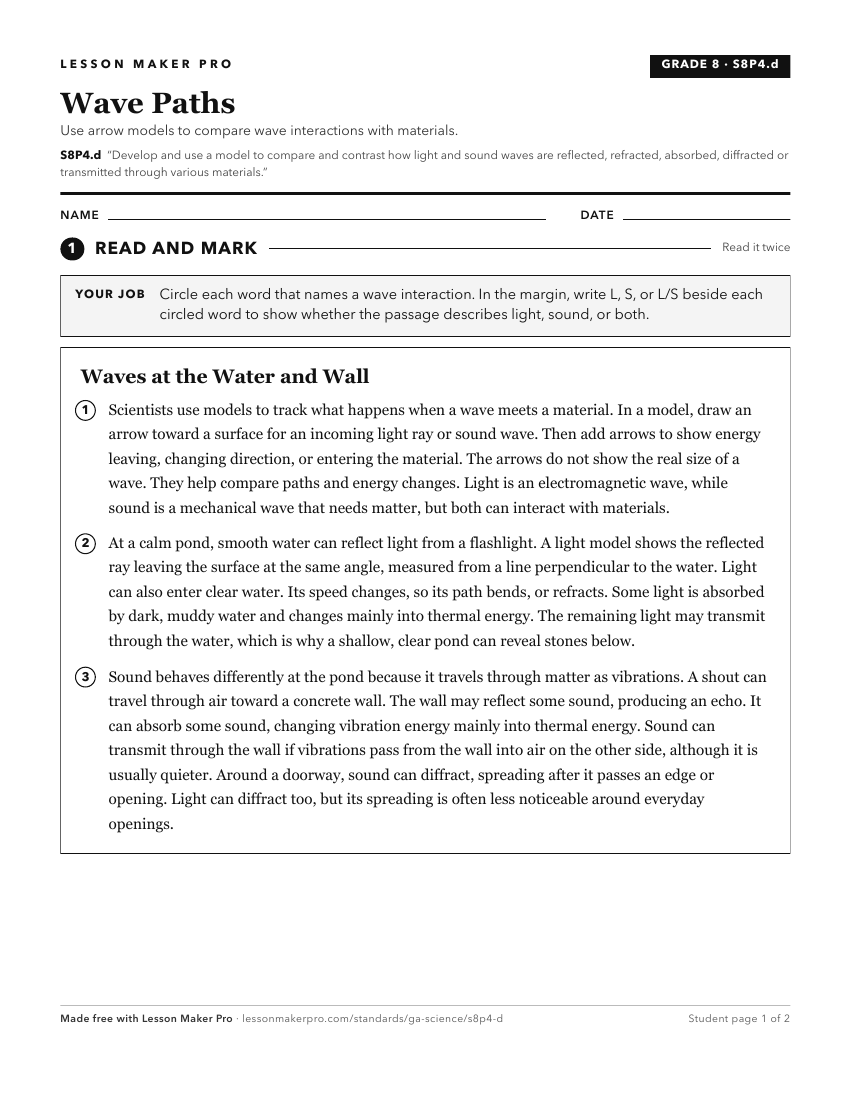
A ready-to-print activity worksheet aligned to S8P4.d, with an answer key for the teacher on its own page. No account needed.
PDF, US Letter, prints cleanly in black and white.
Download the worksheetKeep exploring
Related Standards
- S8P4
Obtain, evaluate, and communicate information to support the claim that electromagnetic (light) waves behave differently than mechanical (sound) waves.
- S8P4.f
Develop and use a model (e.g., simulations, graphs, illustrations) to predict and describe the relationships between wave properties (e.g., frequency, amplitude...
- S4P1.c
Plan and carry out an investigation utilizing everyday materials to explore examples of when light is refracted.
- S8P4.g
Develop and use models to demonstrate the effects that lenses have on light (i.e., formation an image) and their possible technological applications.
Turn this exact standard into a lesson
Grade, subject, topic, and the complete standard are prefilled. Create one free, no account needed.
Also for this standard:Make a WorksheetMake a QuizMake a Sub Lesson