Georgia S8P4.g
The Standard
- S8P4
- Obtain, evaluate, and communicate information to support the claim that electromagnetic (light) waves behave differently than mechanical (sound) waves.
Develop and use models to demonstrate the effects that lenses have on light (i.e., formation an image) and their possible technological applications.
Georgia Standards of Excellence for Science · Obtain, evaluate, and communicate information to support the claim that electromagnetic (light) waves behave differently than mechanical (sound) waves.
Teacher's field guide
What This Standard Means
What Students Need to Do
- Students create and read ray models for convex and concave lenses. They predict an image’s location, orientation, and relative size, then connect each lens to devices such as cameras or eyeglasses.
What Mastery Looks Like
- Students accurately trace principal rays and show where they meet or appear to meet. They explain why a convex lens can produce different images as object distance changes, while a concave lens produces a smaller virtual image.
Common Misconceptions
- Students often think every lens magnifies or that every image can be projected onto a screen. They may confuse convex and concave lenses or draw light rays bending before they reach the lens.
How to Assess It
- Give students a convex-lens diagram with an object beyond 2F. Ask them to draw two principal rays, locate the image, and label its orientation and relative size.
Lesson moves
Ways to Teach It
Use a convex lens, illuminated arrow, and index card screen; move the screen until a sharp image forms, then record its size and orientation.
Ask students to write: Why can a convex lens project an image onto a screen, while a concave lens usually cannot?
Run a card sort matching lens shapes, ray diagrams, image descriptions, and devices such as cameras, magnifiers, and eyeglasses.
Examine a phone camera lens and reading glasses, then sketch how each redirects light to serve its purpose.
Free download
Printable S8P4.g Worksheet
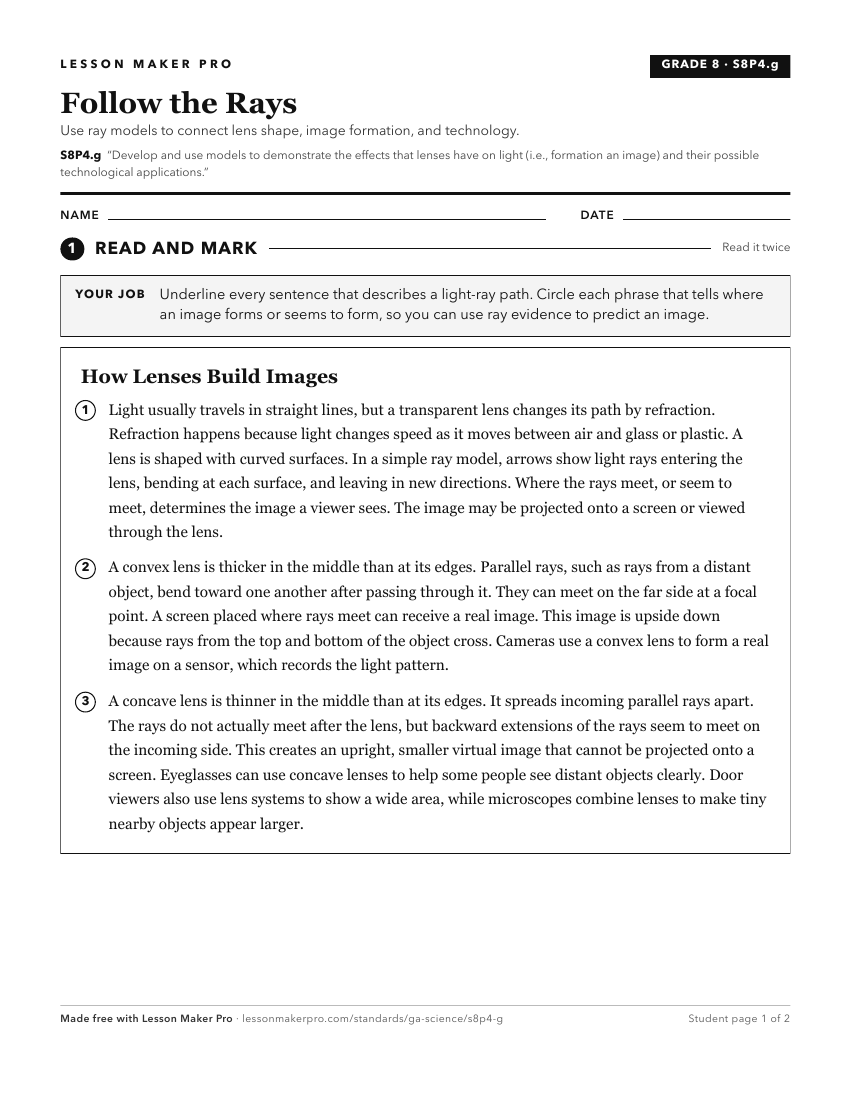
A ready-to-print activity worksheet aligned to S8P4.g, with an answer key for the teacher on its own page. No account needed.
PDF, US Letter, prints cleanly in black and white.
Download the worksheetKeep exploring
Related Standards
- S8P4.d
Develop and use a model to compare and contrast how light and sound waves are reflected, refracted, absorbed, diffracted or transmitted through various material...
- S4P1
Obtain, evaluate, and communicate information about the nature of light and how light interacts with objects.
- S8P4.f
Develop and use a model (e.g., simulations, graphs, illustrations) to predict and describe the relationships between wave properties (e.g., frequency, amplitude...
- S4P1.c
Plan and carry out an investigation utilizing everyday materials to explore examples of when light is refracted.
Turn this exact standard into a lesson
Grade, subject, topic, and the complete standard are prefilled. Create one free, no account needed.
Also for this standard:Make a WorksheetMake a QuizMake a Sub Lesson