Georgia S8P4.f
The Standard
- S8P4
- Obtain, evaluate, and communicate information to support the claim that electromagnetic (light) waves behave differently than mechanical (sound) waves.
Develop and use a model (e.g., simulations, graphs, illustrations) to predict and describe the relationships between wave properties (e.g., frequency, amplitude, and wavelength) and energy.
Georgia Standards of Excellence for Science · Obtain, evaluate, and communicate information to support the claim that electromagnetic (light) waves behave differently than mechanical (sound) waves.
Teacher's field guide
What This Standard Means
What Students Need to Do
- Students read and build diagrams, graphs, or simulations showing changes in wave properties. They predict that frequency and wavelength vary inversely at constant speed, while greater amplitude and higher light frequency indicate more energy.
What Mastery Looks Like
- A student changes one variable in a model and correctly predicts the others while stating that wave speed is fixed. The student uses labels, values, or model evidence without confusing amplitude with frequency.
Common Misconceptions
- Students often think taller waves travel faster or treat amplitude and frequency as the same measurement. They may think high frequency always means high amplitude and forget that wavelength decreases with frequency only when speed is unchanged.
How to Assess It
- Exit ticket: A light wave's speed stays constant while its frequency doubles. Students sketch the new wavelength, compare photon energy, and explain how doubling amplitude would affect energy.
Lesson moves
Ways to Teach It
Use a rope to create waves with two amplitudes and two frequencies, then record crest height, crest spacing, and effort in a table.
Ask students why wavelength must shrink as frequency rises at constant speed, and require a labeled sketch plus the wave speed equation.
Run a card sort matching wave diagrams, frequency values, wavelength values, and energy claims, with wave speed held constant.
Use a phone tone generator and color-changing bulb to connect volume and brightness with amplitude, and pitch and color with frequency.
Free download
Printable S8P4.f Worksheet
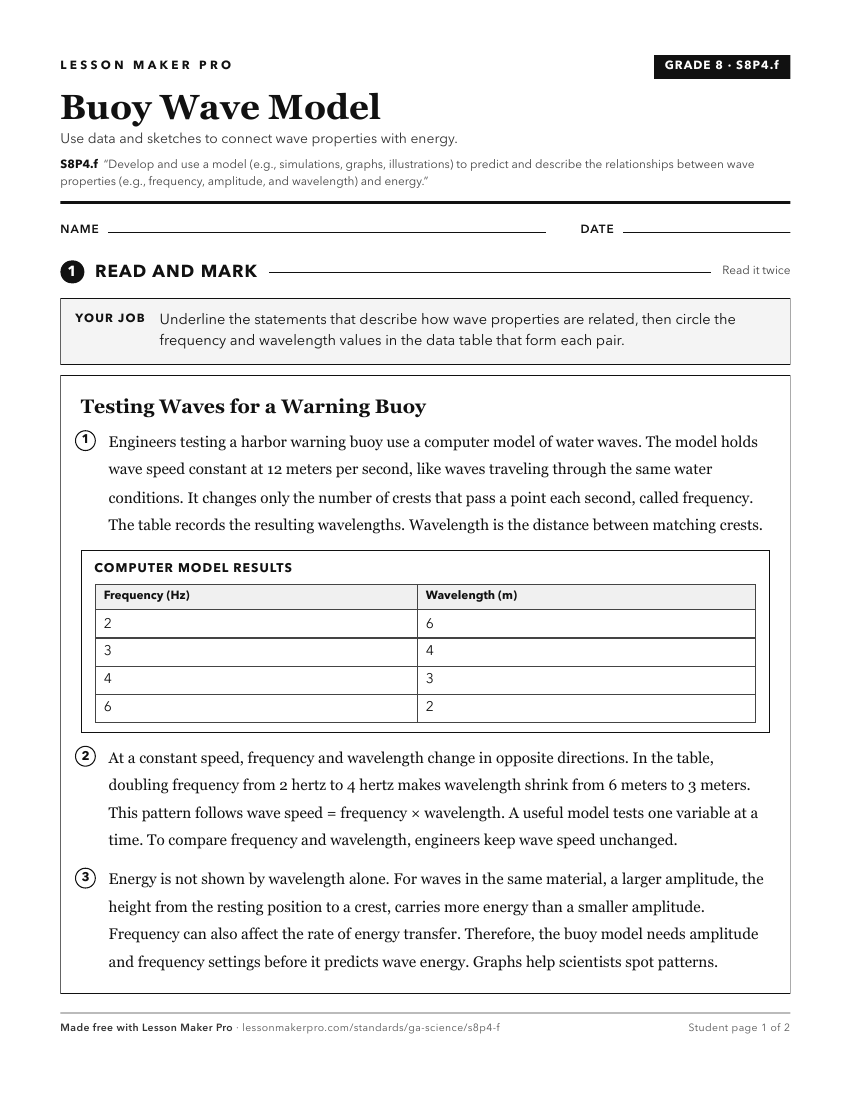
A ready-to-print activity worksheet aligned to S8P4.f, with an answer key for the teacher on its own page. No account needed.
PDF, US Letter, prints cleanly in black and white.
Download the worksheetKeep exploring
Related Standards
- S8P4.a
Ask questions to develop explanations about the similarities and differences between electromagnetic and mechanical waves.
- S8P4.b
Construct an explanation using data to illustrate the relationship between the electromagnetic spectrum and energy.
- S8P4.d
Develop and use a model to compare and contrast how light and sound waves are reflected, refracted, absorbed, diffracted or transmitted through various material...
- S8P4.e
Analyze and interpret data to predict patterns in the relationship between density of media and wave behavior (i.e., speed).
Turn this exact standard into a lesson
Grade, subject, topic, and the complete standard are prefilled. Create one free, no account needed.
Also for this standard:Make a WorksheetMake a QuizMake a Sub Lesson