Georgia S8P4.b
The Standard
- S8P4
- Obtain, evaluate, and communicate information to support the claim that electromagnetic (light) waves behave differently than mechanical (sound) waves.
Construct an explanation using data to illustrate the relationship between the electromagnetic spectrum and energy.
Georgia Standards of Excellence for Science · Obtain, evaluate, and communicate information to support the claim that electromagnetic (light) waves behave differently than mechanical (sound) waves.
Teacher's field guide
What This Standard Means
What Students Need to Do
- Students read spectrum tables, graphs, or diagrams to identify patterns in frequency, wavelength, and energy. They use specific data to explain that higher frequency waves have more energy and shorter wavelengths.
What Mastery Looks Like
- Students correctly rank electromagnetic waves by energy using frequency or wavelength data. They support their ranking with numerical evidence and explain the pattern clearly.
Common Misconceptions
- Students may think longer wavelengths carry more energy or that frequency and wavelength increase together. They may also confuse wave brightness with a wave's position and energy on the spectrum.
How to Assess It
- Give students three waves with frequencies of 10^8, 10^14, and 10^18 hertz. Ask them to rank the waves by energy and explain their ranking using the data.
Lesson moves
Ways to Teach It
Give pairs spectrum cards showing wave type, frequency, wavelength, and energy, then have them arrange the cards and annotate the trends.
Ask students to write a claim explaining why ultraviolet waves have more energy than infrared waves, using two values from a spectrum chart.
Play Spectrum Line-Up by calling out wavelengths or frequencies and having teams place labeled wave cards in the correct energy order.
Examine a sunscreen label and UV index chart, then explain why protection targets ultraviolet waves rather than visible light.
Free download
Printable S8P4.b Worksheet
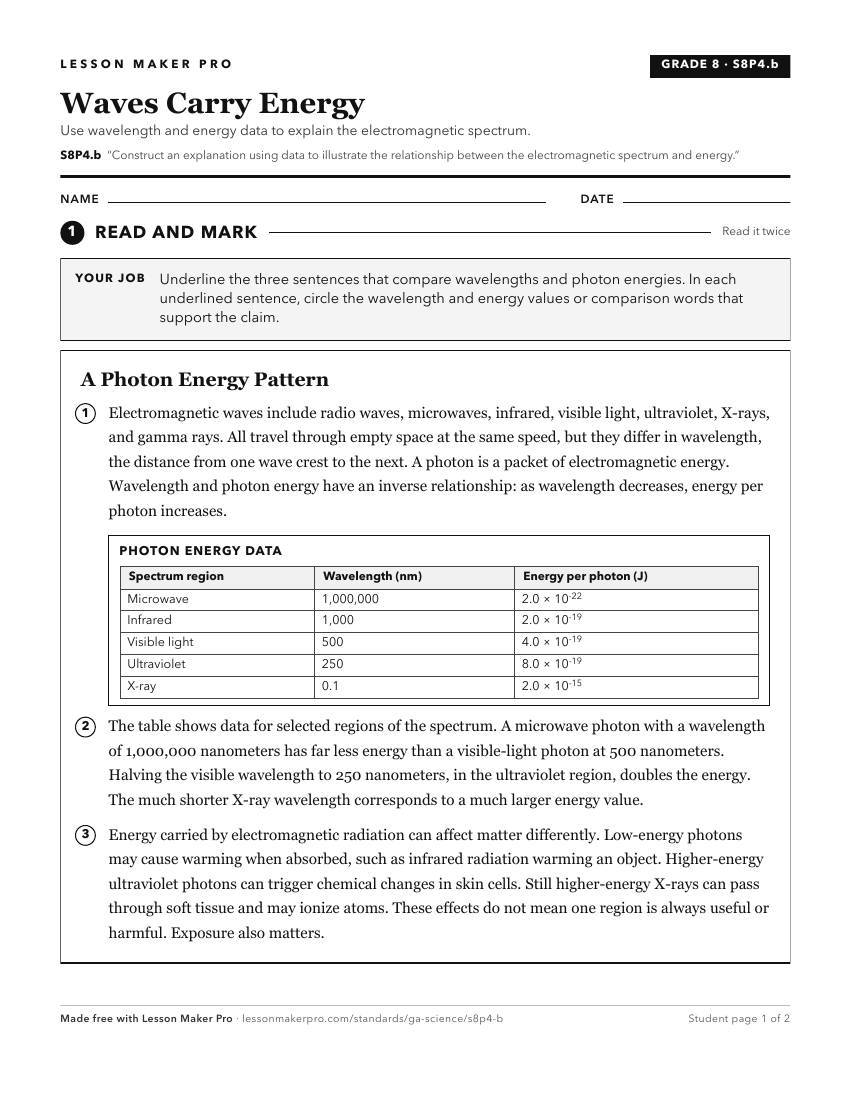
A ready-to-print activity worksheet aligned to S8P4.b, with an answer key for the teacher on its own page. No account needed.
PDF, US Letter, prints cleanly in black and white.
Download the worksheetKeep exploring
Related Standards
- S8P2.c
Construct an argument to support a claim about the type of energy transformations within a system [e.g., lighting a match (light to heat), turning on a light (e...
- S8P4.c
Design a device to illustrate practical applications of the electromagnetic spectrum (e.g., communication, medical, military).
- S8P4.f
Develop and use a model (e.g., simulations, graphs, illustrations) to predict and describe the relationships between wave properties (e.g., frequency, amplitude...
- S1P1.a
Use observations to construct an explanation of how light is required to make objects visible.
Turn this exact standard into a lesson
Grade, subject, topic, and the complete standard are prefilled. Create one free, no account needed.
Also for this standard:Make a WorksheetMake a QuizMake a Sub Lesson