Georgia S8P4.c
The Standard
- S8P4
- Obtain, evaluate, and communicate information to support the claim that electromagnetic (light) waves behave differently than mechanical (sound) waves.
Design a device to illustrate practical applications of the electromagnetic spectrum (e.g., communication, medical, military).
Georgia Standards of Excellence for Science · Obtain, evaluate, and communicate information to support the claim that electromagnetic (light) waves behave differently than mechanical (sound) waves.
Teacher's field guide
What This Standard Means
What Students Need to Do
- Students choose a practical problem and select a suitable region of the electromagnetic spectrum. They design, build, test, and revise a device or model that shows how the waves solve that problem.
What Mastery Looks Like
- Students can label the wave source, path, receiver, and output in their design. They explain why the selected wave fits the task and distinguish the electromagnetic signal from any sound produced.
Common Misconceptions
- Students may think radio waves are sound waves or that microwaves only heat food. They may assume all electromagnetic radiation is equally dangerous. Some draw a device without showing how waves carry energy or information.
How to Assess It
- Ask students to sketch a device that uses one spectrum region for communication, medicine, or security. Require labels for the source, wave, receiver, and output.
Lesson moves
Ways to Teach It
Build a coded light communicator with two flashlights, cardboard tubes, and a Morse code key, then test it across the room.
Write a patent pitch naming the wave region, problem solved, device parts, and how the signal reaches its receiver.
Draw application cards and spectrum cards, match each pair, then sketch a device that uses the selected wave.
Map how a phone call travels through radio antennas, and label the transmitter, wave path, receiver, and converted sound.
Free download
Printable S8P4.c Worksheet
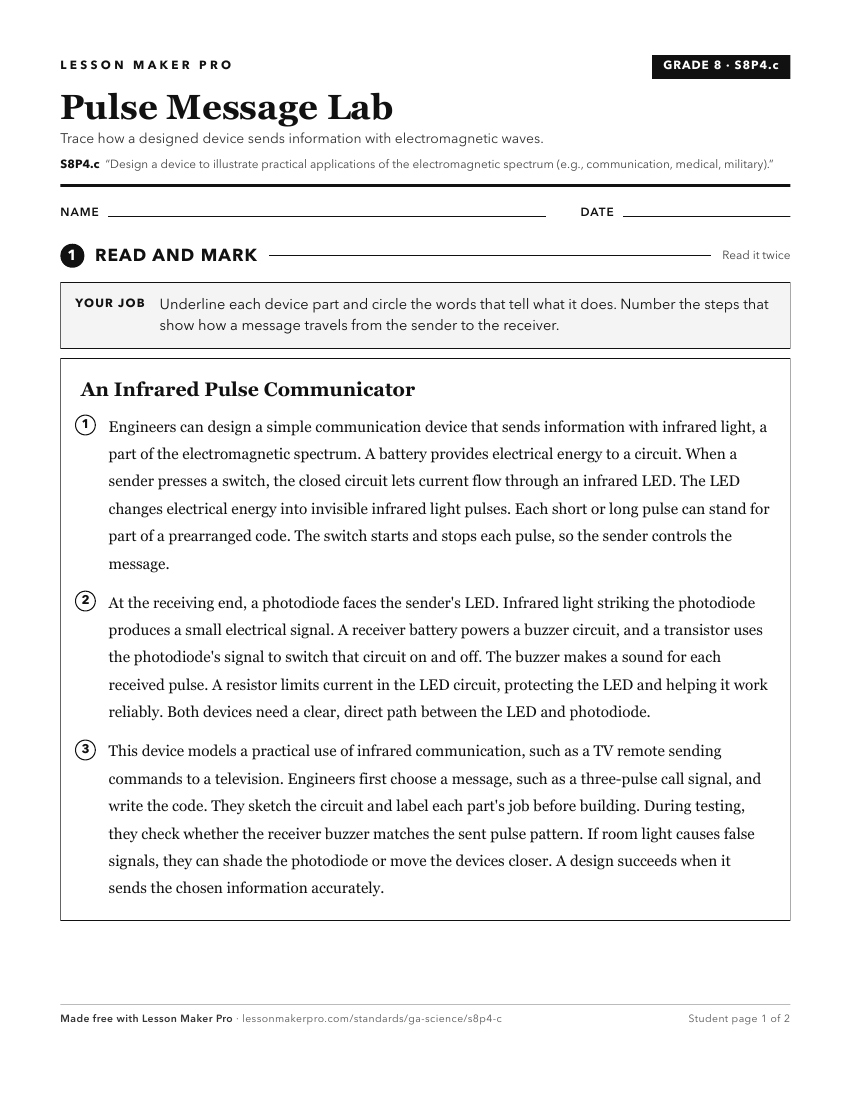
A ready-to-print activity worksheet aligned to S8P4.c, with an answer key for the teacher on its own page. No account needed.
PDF, US Letter, prints cleanly in black and white.
Download the worksheetKeep exploring
Related Standards
- S4P2.b
Design and construct a device to communicate across a distance using light and/or sound.
- S8P4.b
Construct an explanation using data to illustrate the relationship between the electromagnetic spectrum and energy.
- S1P1.e
Design a signal that can serve as an emergency alert using light and/or sound to communicate over a distance.
- S8P4.g
Develop and use models to demonstrate the effects that lenses have on light (i.e., formation an image) and their possible technological applications.
Turn this exact standard into a lesson
Grade, subject, topic, and the complete standard are prefilled. Create one free, no account needed.
Also for this standard:Make a WorksheetMake a QuizMake a Sub Lesson