Georgia S8P4.a
The Standard
- S8P4
- Obtain, evaluate, and communicate information to support the claim that electromagnetic (light) waves behave differently than mechanical (sound) waves.
Ask questions to develop explanations about the similarities and differences between electromagnetic and mechanical waves.
Georgia Standards of Excellence for Science · Obtain, evaluate, and communicate information to support the claim that electromagnetic (light) waves behave differently than mechanical (sound) waves.
Teacher's field guide
What This Standard Means
What Students Need to Do
- Students ask focused questions about how light and sound waves travel and behave. They use observations or reliable sources to explain shared features and differences, including whether a medium is required.
What Mastery Looks Like
- Students can explain that both wave types transfer energy and have properties such as wavelength, frequency, and amplitude. They can support the claim that sound needs matter to travel, while light can cross empty space.
Common Misconceptions
- Students may think light needs air because they usually observe it on Earth, or that sound can travel through space. They may also think waves carry matter forward or confuse pitch with loudness.
How to Assess It
- Give this exit ticket: “An astronaut sees two tools strike together outside a spacecraft but hears nothing. Write one question and explain why this happens.”
Lesson moves
Ways to Teach It
Send pulses through a slinky, then shine a flashlight across the room, and have students list what each wave needs to travel.
Discuss: “Why can sunlight reach Earth through space, but sound from the Sun cannot?” Require one piece of evidence.
Sort wave cards by mechanical or electromagnetic, then match each card with its medium, energy source, frequency, and amplitude clues.
Diagram a phone call, labeling the electromagnetic signal between phones and the mechanical sound wave traveling from speaker to ear.
Free download
Printable S8P4.a Worksheet
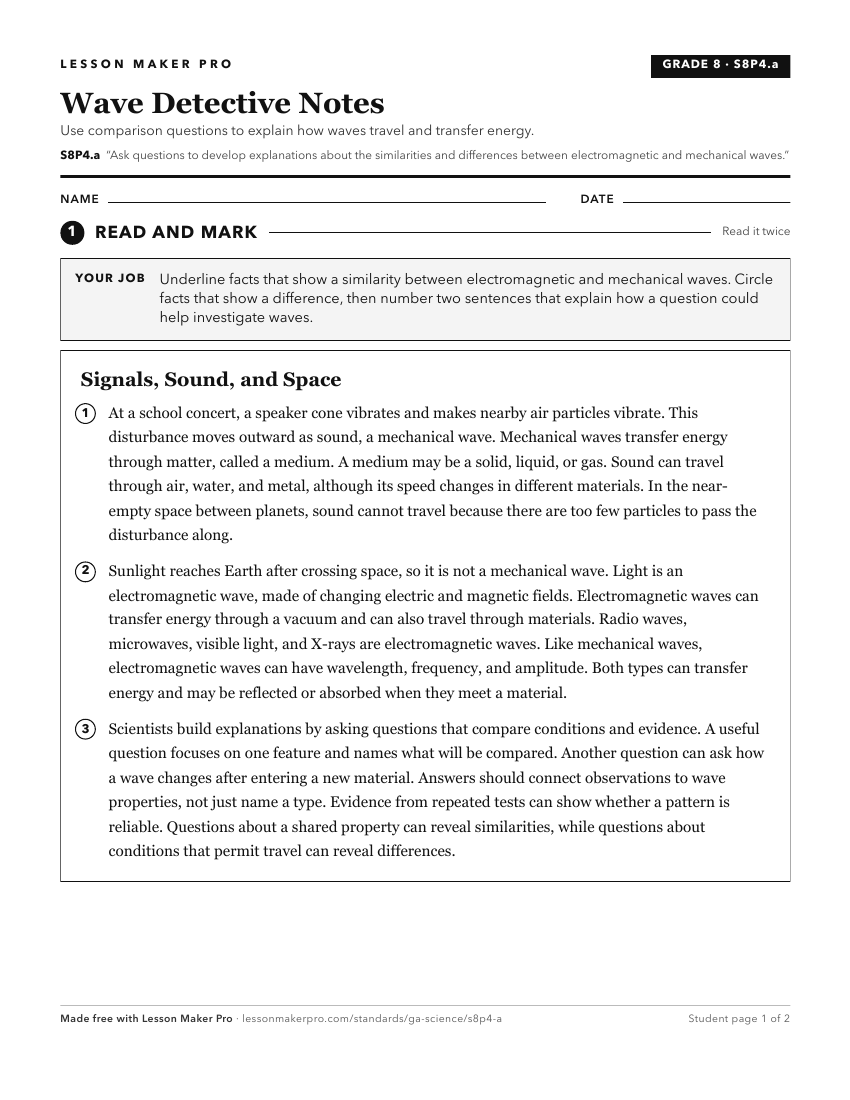
A ready-to-print activity worksheet aligned to S8P4.a, with an answer key for the teacher on its own page. No account needed.
PDF, US Letter, prints cleanly in black and white.
Download the worksheetKeep exploring
Related Standards
- S8P4.d
Develop and use a model to compare and contrast how light and sound waves are reflected, refracted, absorbed, diffracted or transmitted through various material...
- S5P3.a
Construct an argument based on experimental evidence to communicate the differences in function and purpose of an electromagnet and a magnet.
- S8P4
Obtain, evaluate, and communicate information to support the claim that electromagnetic (light) waves behave differently than mechanical (sound) waves.
- S8P4.f
Develop and use a model (e.g., simulations, graphs, illustrations) to predict and describe the relationships between wave properties (e.g., frequency, amplitude...
Turn this exact standard into a lesson
Grade, subject, topic, and the complete standard are prefilled. Create one free, no account needed.
Also for this standard:Make a WorksheetMake a QuizMake a Sub Lesson