Georgia 5.NR.3
Georgia Standard (Expectation Cluster)
Describe fractions and perform operations with fractions to solve relevant, mathematical problems using part-whole strategies and visual models.
Georgia's K-12 Mathematics Standards
Cluster contents
Expectations in This Standard
5.NR.3 is a Georgia mathematics standard. These are the expectations under it.
- 5.NR.3.1
Explain the meaning of a fraction as division of the numerator by the denominator (a/b = a ÷ b). Solve problems involving division of whole numbers leading to a...
- 5.NR.3.2
Compare and order up to three fractions with different numerators and/or different denominators by flexibly using a variety of tools and strategies.
- 5.NR.3.3
Model and solve problems involving addition and subtraction of fractions and mixed numbers with unlike denominators.
- 5.NR.3.4
Model and solve problems involving multiplication of a fraction and a whole number.
- 5.NR.3.5
Explain why multiplying a whole number by a fraction greater than one results in a product greater than the whole number, and why multiplying a whole number by ...
- 5.NR.3.6
Model and solve problems involving division of a unit fraction by a whole number and a whole number by a unit fraction.
Teacher's field guide
What This Cluster Means
What Students Need to Do
- Students identify the whole, represent fractions and mixed numbers, and explain how the parts relate. They use equivalent fractions and models to add, subtract, and multiply fractions. They also model division involving whole numbers and unit fractions, connect models to equations, and solve context problems.
What Mastery Looks Like
- Students choose the correct operation, draw an accurate area, length, or set model, and calculate correctly. They label units, simplify when appropriate, and explain how the model matches the equation.
Common Misconceptions
- Students may add denominators, compare fractions by denominator size alone, or draw models with unequal wholes. They may assume multiplication always makes a number larger or division always makes it smaller. Mixed numbers and remainders are also often converted incorrectly.
How to Assess It
- Give this exit ticket: “A recipe uses 3/4 cup of oats per batch. How much is needed for 2 1/2 batches?” Require a model, equation, and labeled answer.
Lesson moves
Ways to Teach It
Use fraction strips to model 2 1/3 minus 3/4, then record equivalent fractions and an equation.
Ask, “Why does 3/5 times 1/2 give less than 3/5?” Students sketch a model and defend their response.
Play Division Match by pairing cards such as 4 divided by 1/3 with the correct model and quotient cards.
Scale a snack recipe to 1 1/2 batches, using measuring cups or diagrams to find each new ingredient amount.
Free download
Printable 5.NR.3 Worksheet
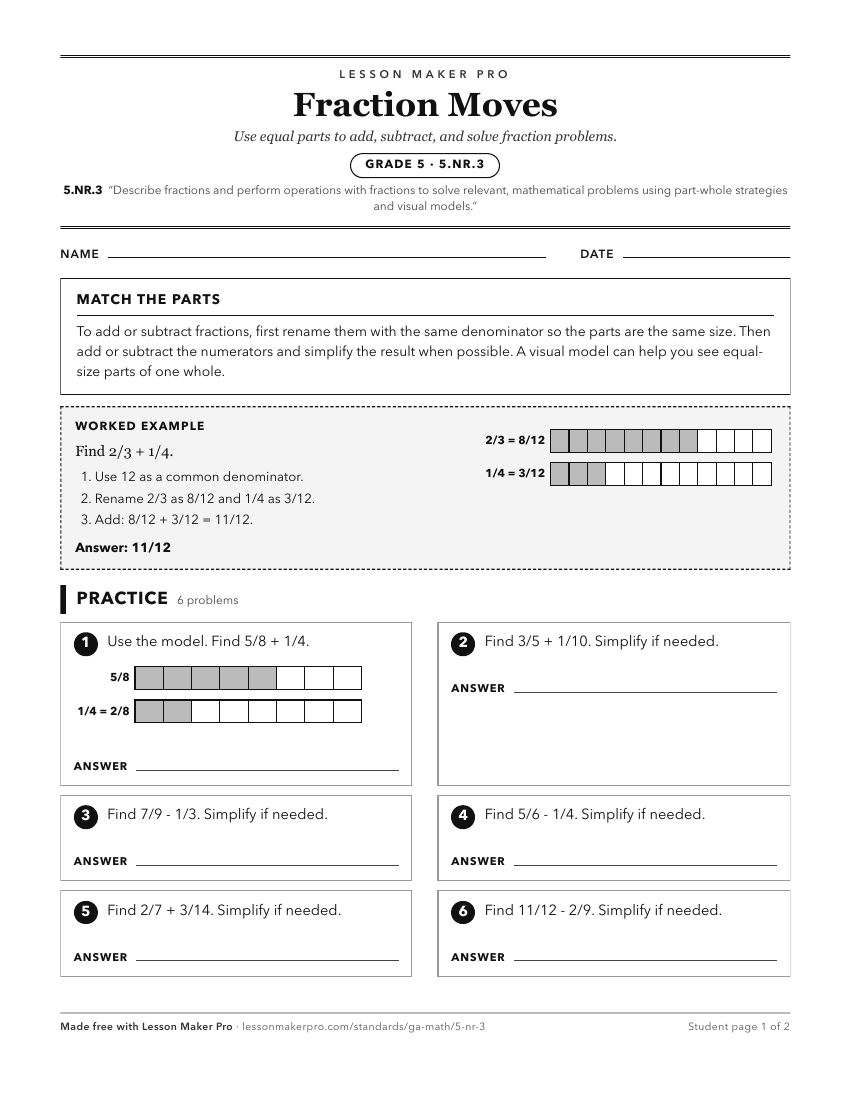
A ready-to-print activity worksheet aligned to 5.NR.3, with an answer key for the teacher on its own page. No account needed.
PDF, US Letter, prints cleanly in black and white.
Download the worksheetKeep exploring
Related Standards
- 4.NR.5
Solve real-life problems involving addition, equivalence, comparison of fractions with denominators of 10 and 100, and comparison of decimal numbers as tenths a...
- 3.PAR.3.6
Solve practical, relevant problems involving multiplication and division within 100 using part-whole strategies, visual representations, and/or concrete models.
- 4.NR.4
Solve real-life problems involving addition, subtraction, equivalence, and comparison of fractions with denominators of 2, 3, 4, 5, 6, 8, 10, 12, and 100 using ...
Turn this cluster into a lesson
Grade, subject, topic, and the complete cluster are prefilled. Create one free, no account needed.
Also for this cluster:Make a WorksheetMake a QuizMake a Sub Lesson