Georgia 4.NR.4
Georgia Standard (Expectation Cluster)
Solve real-life problems involving addition, subtraction, equivalence, and comparison of fractions with denominators of 2, 3, 4, 5, 6, 8, 10, 12, and 100 using part-whole strategies and visual models.
Georgia's K-12 Mathematics Standards
Cluster contents
Expectations in This Standard
4.NR.4 is a Georgia mathematics standard. These are the expectations under it.
- 4.NR.4.1
Using concrete materials, drawings, and number lines, demonstrate and explain the relationship between equivalent fractions, including fractions greater than on...
- 4.NR.4.2
Compare two fractions with the same numerator or the same denominator by reasoning about their size and recognize that comparisons are valid only when the two f...
- 4.NR.4.3
Compare two fractions with different numerators and/or different denominators by flexibly using a variety of tools and strategies and recognize that comparisons...
- 4.NR.4.4
Represent whole numbers and fractions as the sum of unit fractions.
- 4.NR.4.5
Represent a fraction as a sum of fractions with the same denominator in more than one way, recording with an equation.
- 4.NR.4.6
Add and subtract fractions and mixed numbers with like denominators using a variety of tools.
Teacher's field guide
What This Cluster Means
What Students Need to Do
- Students solve story problems by adding, subtracting, comparing, or finding equivalent fractions. They use fraction strips, number lines, or area models to show how the quantities relate.
What Mastery Looks Like
- Students choose a useful model, such as fraction strips or an area model. They find equivalent fractions, solve accurately, and explain comparisons or answers using the problem context.
Common Misconceptions
- Students may add or subtract both numerators and denominators. They may compare fractions by looking only at the denominator or assume unlike denominators cannot represent equal amounts.
How to Assess It
- Give this exit ticket: “Maya ate 3/8 of a pizza and Luis ate 1/4. Who ate more, and how much more?” Require a labeled model and equation.
Lesson moves
Ways to Teach It
Give pairs fraction strips to model 1/3 + 1/4, then record an equation and explain how the model shows the sum.
Ask students to write and defend an answer: Which is greater, 5/6 or 7/8, and how does a model prove it?
Play Fraction Match with cards showing fractions, equivalent forms, and visual models; students collect sets of three matching representations.
Use grocery sale signs marked 1/2 off, 1/4 off, and 3/10 off; students compare discounts and explain which saves more.
Free download
Printable 4.NR.4 Worksheet
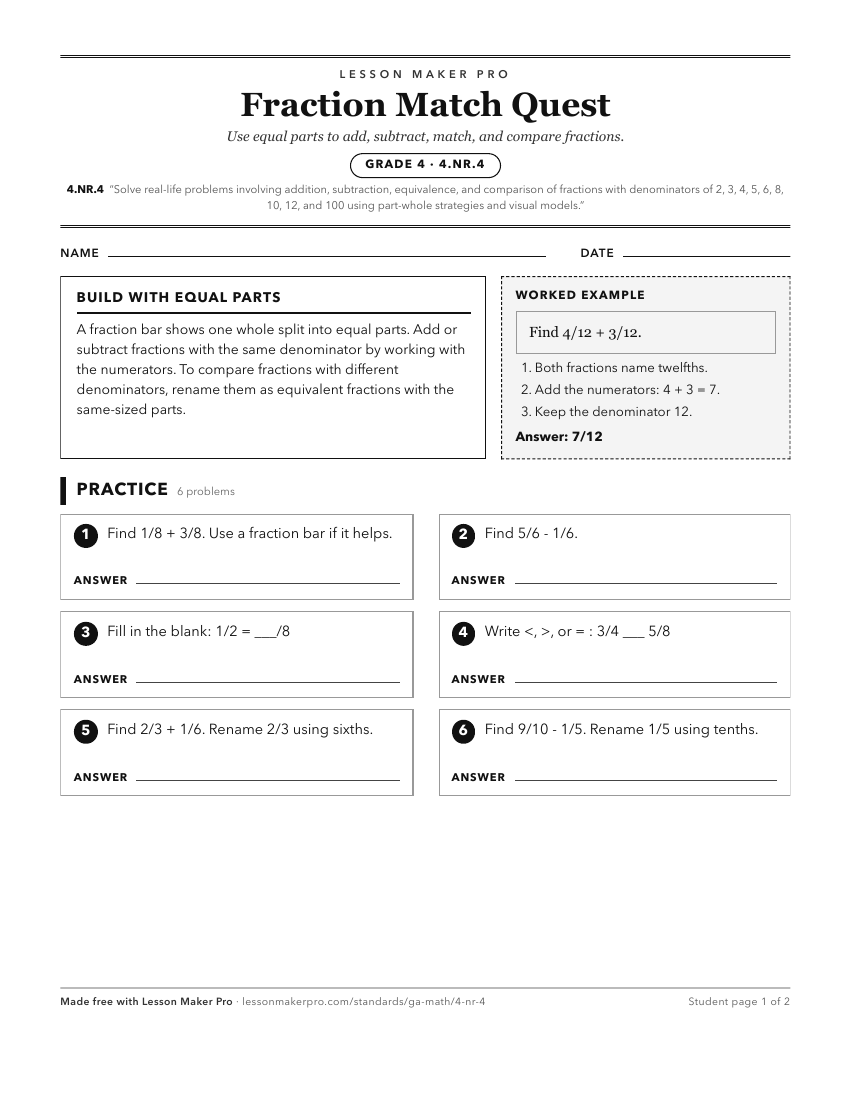
A ready-to-print activity worksheet aligned to 4.NR.4, with an answer key for the teacher on its own page. No account needed.
PDF, US Letter, prints cleanly in black and white.
Download the worksheetKeep exploring
Related Standards
- 3.PAR.3
Use part-whole strategies to solve real-life, mathematical problems involving multiplication and division with whole numbers within 100.
- 5.NR.3
Describe fractions and perform operations with fractions to solve relevant, mathematical problems using part-whole strategies and visual models.
- 4.NR.5
Solve real-life problems involving addition, equivalence, comparison of fractions with denominators of 10 and 100, and comparison of decimal numbers as tenths a...
- 3.PAR.3.6
Solve practical, relevant problems involving multiplication and division within 100 using part-whole strategies, visual representations, and/or concrete models.
Turn this cluster into a lesson
Grade, subject, topic, and the complete cluster are prefilled. Create one free, no account needed.
Also for this cluster:Make a WorksheetMake a QuizMake a Sub Lesson